Web designer resume examples & writing guide for 2026

Three web designer resumes following one designer from small-business sites at an agency to leading a software company's marketing site, rendered in a real template and annotated line by line. Each counts what a web lead checks: sites shipped, conversion, speed and accessibility.

By the Resumi editorial teamUpdated 9 min read

Showing the mid-level example

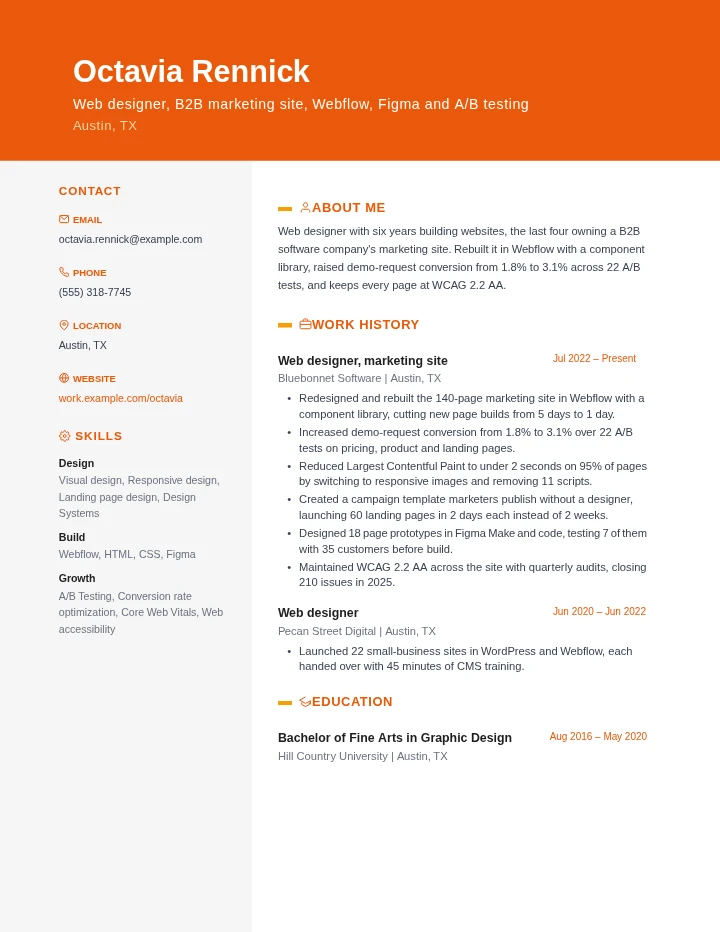
Web designer resume example, mid level, rendered in the Orange Creative template
Strength: Excellent

Written by the Resumi editorial team for a fictional candidate. Role facts come from O*NET and the U.S. Bureau of Labor Statistics.

Strength band is Resumi’s optimization score, not a ranking any employer sees.

What makes this resume work

Each marker on the page has a note here. Press a marker to jump to its note.

  1. 1

    Site, platform and method

    Web designer, B2B marketing site, Webflow, Figma and A/B testing. In-house postings treat the website as a product, and the headline says this designer owns one and tests it.

  2. 2

    Rebuild measured in build days

    A 140-page site rebuilt in Webflow with a component library, cutting new page builds from five days to one. A rebuild's value is what it does to every page after it, and this counts that.

  3. 3

    Conversion moved by tests

    Demo-request conversion from 1.8% to 3.1% over 22 A/B tests. Postings ask web designers for hypotheses and experiments, and the test count shows the gain was earned, not a one-off redesign.

  4. 4

    Speed measured with a metric

    Largest Contentful Paint under two seconds on 95% of pages. A named metric and a share of pages turn a vague claim about a fast site into something an engineer can verify.

  5. 5

    A template marketers use alone

    A campaign template that let marketers launch 60 landing pages in two days each. Design that removes the designer from routine work frees time for the tests that move conversion.

  6. 6

    Prototypes tested with customers

    Eighteen prototypes built in Figma Make and code, seven tested with 35 customers before build. Prototyping in code with AI tools is what growth web postings asked for this year.

Build your web designer resume

Free to start · no card

01The example, in full

The resume shown above, as text you can search and copy.

Octavia Rennick

Web designer, B2B marketing site, Webflow, Figma and A/B testing

Austin, TXoctavia.rennick@example.com(555) 318-7745work.example.com/octavia

Summary

Web designer with six years building websites, the last four owning a B2B software company's marketing site. Rebuilt it in Webflow with a component library, raised demo-request conversion from 1.8% to 3.1% across 22 A/B tests, and keeps every page at WCAG 2.2 AA.

Experience

Web designer, marketing site

Jul 2022 – Present

Bluebonnet Software · Austin, TX

  • Redesigned and rebuilt the 140-page marketing site in Webflow with a component library, cutting new page builds from 5 days to 1 day.
  • Increased demo-request conversion from 1.8% to 3.1% over 22 A/B tests on pricing, product and landing pages.
  • Reduced Largest Contentful Paint to under 2 seconds on 95% of pages by switching to responsive images and removing 11 scripts.
  • Created a campaign template marketers publish without a designer, launching 60 landing pages in 2 days each instead of 2 weeks.
  • Designed 18 page prototypes in Figma Make and code, testing 7 of them with 35 customers before build.
  • Maintained WCAG 2.2 AA across the site with quarterly audits, closing 210 issues in 2025.

Web designer

Jun 2020 – Jun 2022

Pecan Street Digital · Austin, TX

  • Launched 22 small-business sites in WordPress and Webflow, each handed over with 45 minutes of CMS training.

Education

Bachelor of Fine Arts in Graphic Design

Aug 2016 – May 2020

Hill Country University · Austin, TX

Skills

Design
Visual design, Responsive design, Landing page design, Design Systems
Build
Webflow, HTML, CSS, Figma
Growth
A/B Testing, Conversion rate optimization, Core Web Vitals, Web accessibility

02Market snapshot

Median pay
$104,000 median annual pay for web and digital interface designers
Typical education
Bachelor's degree, the typical entry education for web and digital interface designers
Job outlook
+6% for web and digital interface designers, 2025–35, about 8,000 more jobs
Common credentials
15 certifications listed, including Pearson's HTML and CSS and Tosa WordPress, and no license

Sources: BLS OES (May 2025) · BLS OOH (2025) · CareerOneStop (2026)

03The same resume at three levels

The tinted row is the level shown above.

  • Entry-level

    0–2 years

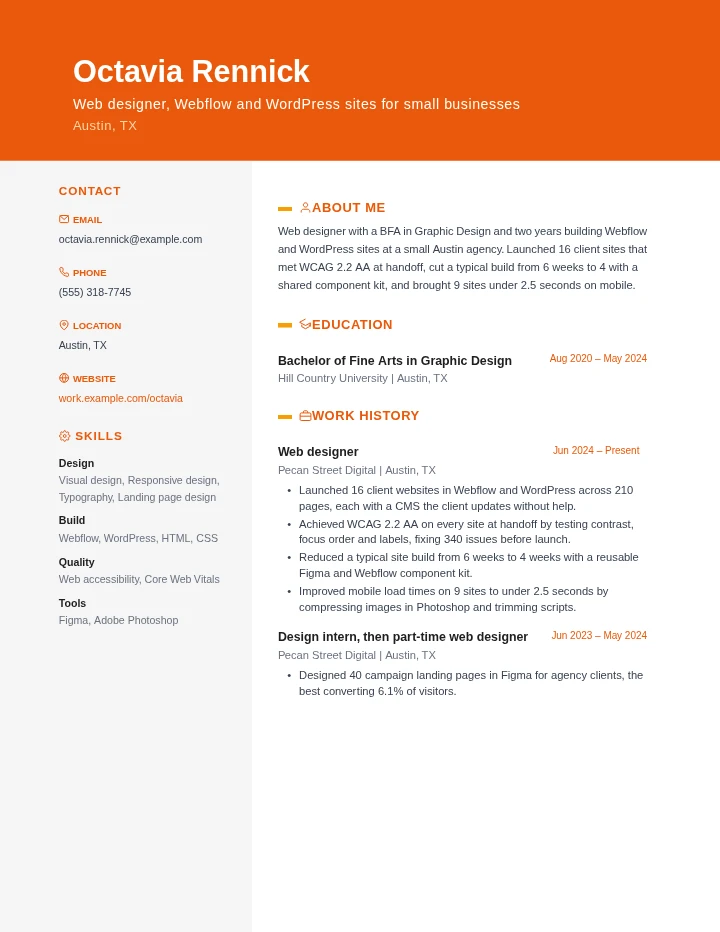
    The degree leads, then two agency years in four counted bullets: sites launched with their page count, accessibility met at handoff, build time cut with a component kit, and mobile speed brought under a threshold. The internship keeps one line with its best conversion rate.

    Typical titles: Web designer, Junior web designer, Webflow designer

  • Mid-level

    3–6 years

    The default view. Six years in the units a web lead weighs: a site rebuilt with faster page builds, conversion moved by tests, load speed measured, a template marketers use alone, prototypes tested with customers, and accessibility kept. The agency role keeps one line.

    Typical titles: Web designer, Marketing web designer, Growth web designer

  • Senior

    7+ years

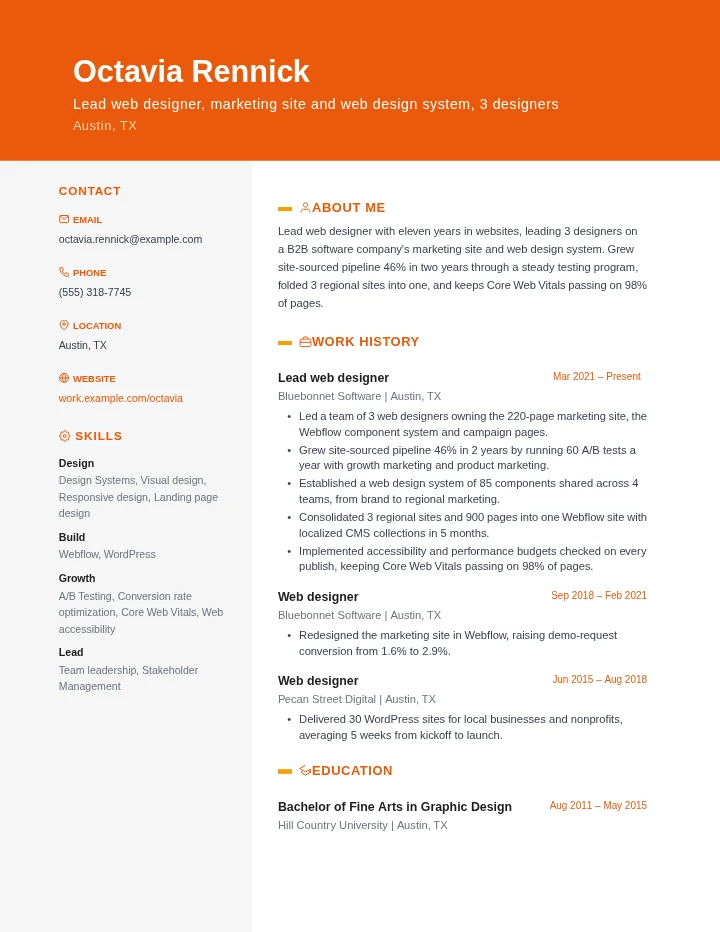
    Leading the site replaces building every page: three designers on a large site, pipeline grown through steady testing, a component system other teams share, regional sites consolidated, and performance and accessibility enforced on every publish. The two earlier roles keep one line each.

    Typical titles: Lead web designer, Senior web designer, Web design manager

04Summary

Weak

Creative web designer with a keen eye for aesthetics and a passion for building beautiful, user-friendly websites that clients love.

Strong

Web designer with six years building websites, the last four owning a B2B software company's marketing site. Rebuilt it in Webflow and raised demo-request conversion from 1.8% to 3.1% across 22 A/B tests.

A web lead reads for the kind of sites you build, the platform and what changed after launch. The strong version names a marketing site, Webflow and a conversion rate with its starting point. The weak version describes taste, which every portfolio claims and no resume can show.

05Bullets

Weak

  • Designed and updated website pages and worked with developers to make sure the site looked good on all devices.

Strong

  • Reduced Largest Contentful Paint to under 2 seconds on 95% of pages by switching to responsive images and removing 11 scripts.

Testing layouts for compatibility across browsers and devices is part of how O*NET defines the job, and speed is where a website design succeeds or fails on a phone. The strong bullet names the metric, the threshold, the share of pages and the fix. The weak bullet says the site looked good, which no reviewer can check.

06Skills and keywords

Design

  • Visual design (in the example)
  • Responsive design (in the example)
  • Typography
  • Landing page design (in the example)
  • Design Systems (in the example)
  • Prototyping

Build and platforms

  • Webflow (in the example)
  • WordPress (in the example)
  • HTML (in the example)
  • CSS (in the example)
  • JavaScript
  • Figma (in the example)

Growth and quality

  • A/B Testing (in the example)
  • Conversion rate optimization (in the example)
  • Core Web Vitals (in the example)
  • Web accessibility (in the example)
  • SEO
  • Google Analytics

Filled chips appear in the example above.

Paste a job description and Resumi shows which of these your resume already covers.

Build your web designer resume

07Mistakes to avoid

  1. Traffic credited to a redesign

    Fix: Competitor samples say a redesign lifted traffic or conversion by a round percentage with no period or starting point. Give the rate before and after, the number of tests or weeks behind it, and the page it applied to, so a reviewer can believe the change.

  2. Mockups where live sites belong

    Fix: Postings for web designers this year ask for portfolios of shipped production sites, not just mockups. Link live sites from your resume and count what launched: sites, pages, templates. A Figma file shows a design, and a live site shows it survived real content.

  3. Accessibility left unstated

    Fix: The W3C says WCAG 2.2 is current and recommends using the latest version. If your sites meet a level such as AA, say so, and say what you tested and fixed. Postings ask for accessibility knowledge, and few resumes prove it.

  4. Desktop comps, no speed or devices

    Fix: Trade writers now argue pixel-perfect desktop comps fail on fluid, multi-device sites. Show that your designs hold up where they are used: name mobile load times, Core Web Vitals or the breakpoints you designed for, with the result after launch.

  5. No sign you test and learn

    Fix: In-house web postings treat the site as a product, asking designers to form hypotheses and run A/B tests, often with AI tools in the workflow. Count the tests you ran, say what you changed because of them, and name the tools you prototype with.

08Format and template

One page with the portfolio link in the header. Lead each role with sites or pages shipped, then give conversion, speed and accessibility results as text rather than inside images, since screening software reads only text. Keep tools to the skills list and the bullets where you used them. This example uses Orange Creative. The same content works in Standard, Pink Accent and Red & Gray Modern.

Shown above: Orange Creative

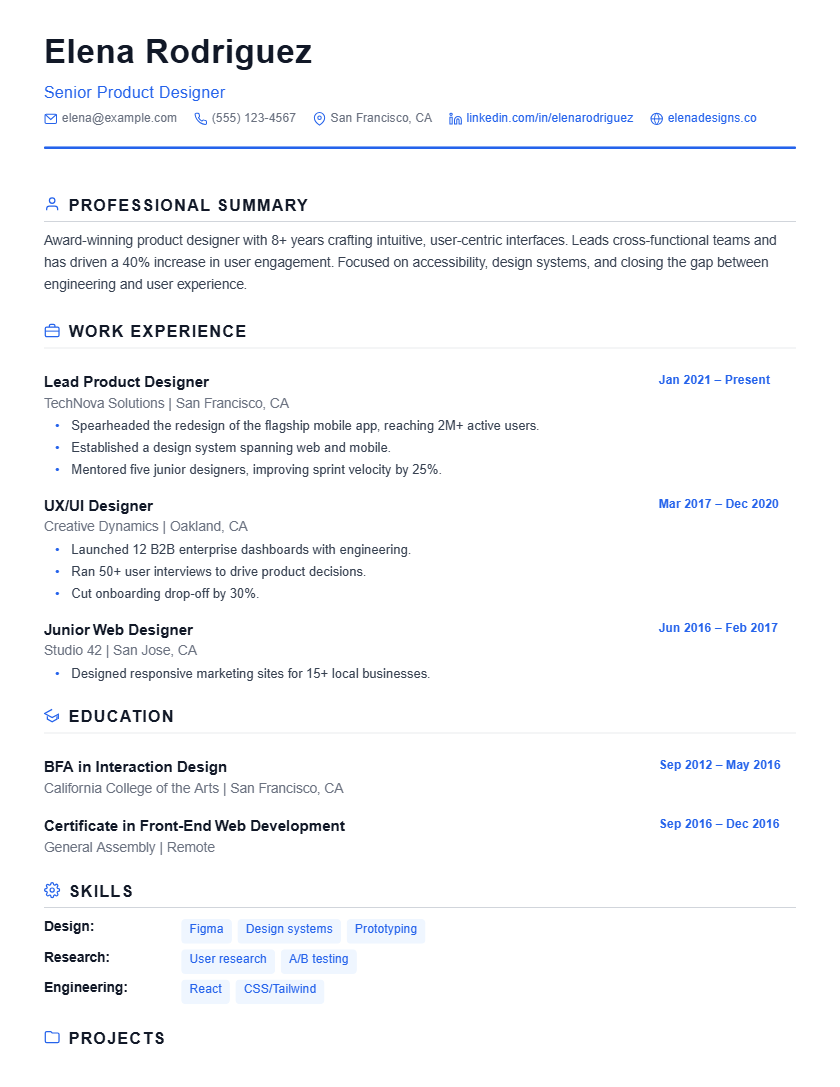
  • Standard template
    StandardFree
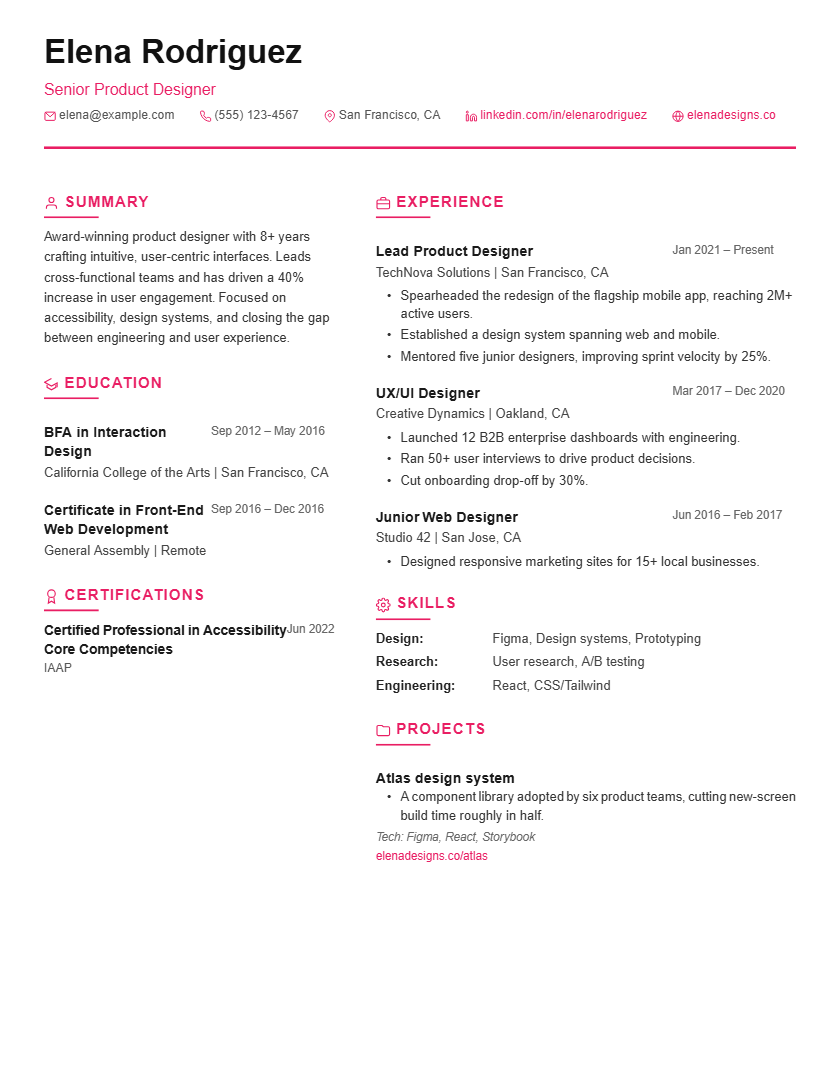
  • Pink Accent template
    Pink Accent
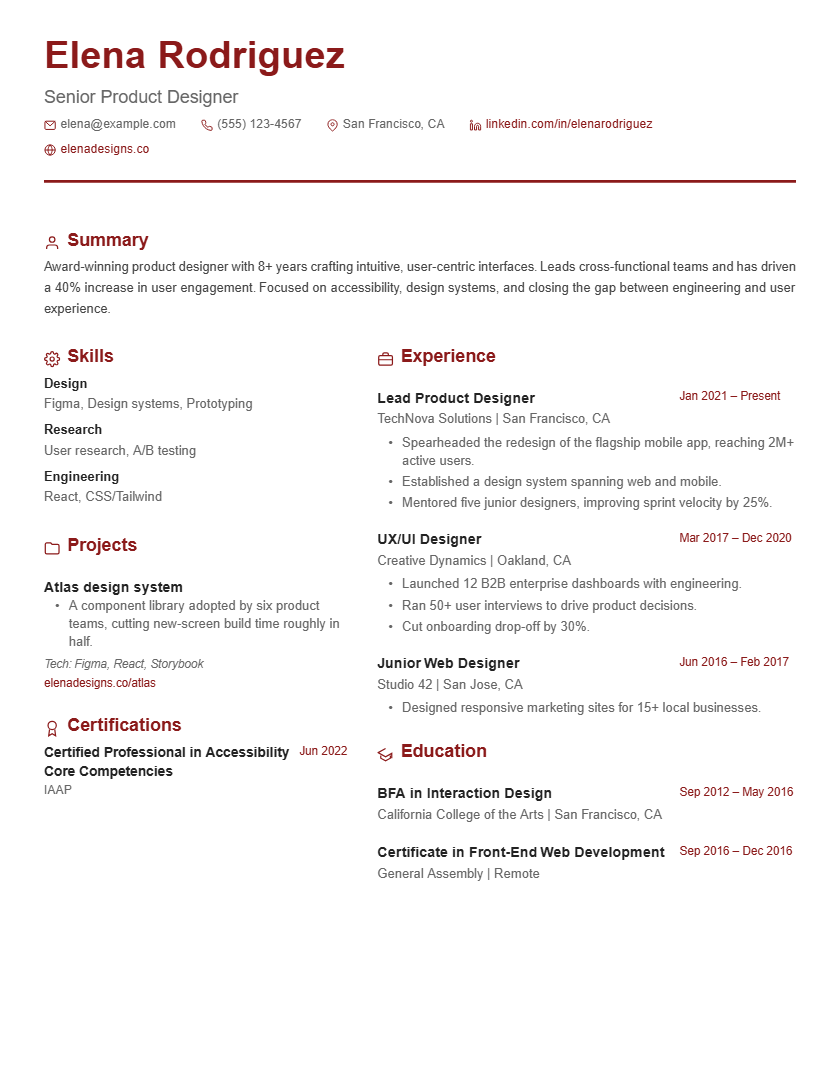
  • Red & Gray Modern template
    Red & Gray Modern

09Questions web designers ask

What is the difference between a web designer and a web developer?

BLS covers both on one handbook page but counts them separately. Digital designers create the look and feel of a site, its photos, color, type, graphics and layout, and make sure it is usable and compatible, while web developers build and maintain the technical side. Designers earned a median $104,000 in May 2025 and developers $92,650. Many web designer roles still ask for working HTML and CSS.

How much do web designers make?

The May 2025 median for web and digital interface designers was $104,000, with the lowest tenth under $53,750 and the highest tenth over $201,550. Industry matters: finance and insurance paid a median $133,260, information $130,140, computer systems design $109,990 and wholesale trade $87,640. About 13 percent of these designers are self-employed, where pay depends on clients rather than a salary band.

Do web designers need to know how to code?

Some code helps. Writing supporting code for websites is one of the occupation's highest-rated tasks in O*NET, and its count of 2025 postings names CSS in 20 percent, JavaScript in 19 and HTML in 17, behind Figma at 37. Postings read for this page asked for working HTML and CSS alongside Webflow. Show the code you write in a bullet, such as a component or a fix.

Should a web designer learn Webflow or WordPress?

Learn the one your target clients use. Neither appears in O*NET's count of 2025 postings for the occupation, which is dominated by Figma and front-end code, but CareerOneStop lists a Tosa WordPress certification, and the postings read for this page asked for Webflow by name. If you ship in both, list both, each in the bullets where you used it, with what you built.

What should a web designer's portfolio include?

Live sites come first. Postings read for this page asked for shipped production sites rather than mockups, and design hiring managers surveyed by Nielsen Norman Group want to see your role, the constraints, the process and the outcome. Keep it to a handful of projects, each with a link, the platform, and a result such as conversion, speed or accessibility.

Free to start

Build your web designer resume

No card, no trial that turns into a charge.

Sign up free