Actuary resume examples & writing guide for 2026

Three actuary resumes following one pricing actuary from passing exams to leading personal lines pricing as a fellow, rendered in a real template and annotated line by line. Each shows what a chief actuary checks: exams and credentials, premium priced, loss ratios and filings approved.

By the Resumi editorial teamUpdated 9 min read

Showing the mid-level example

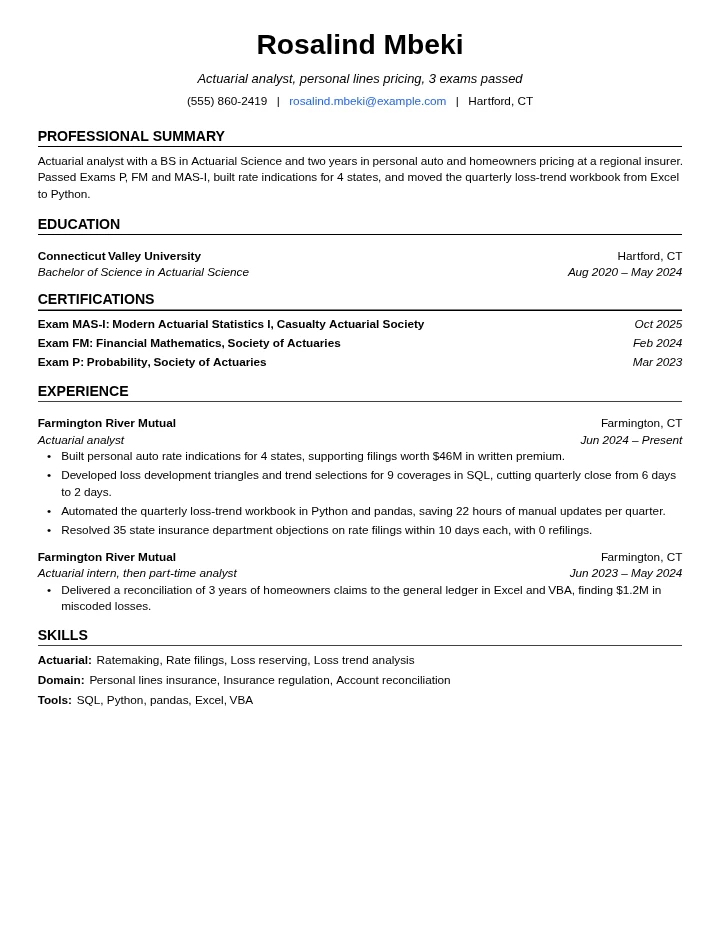
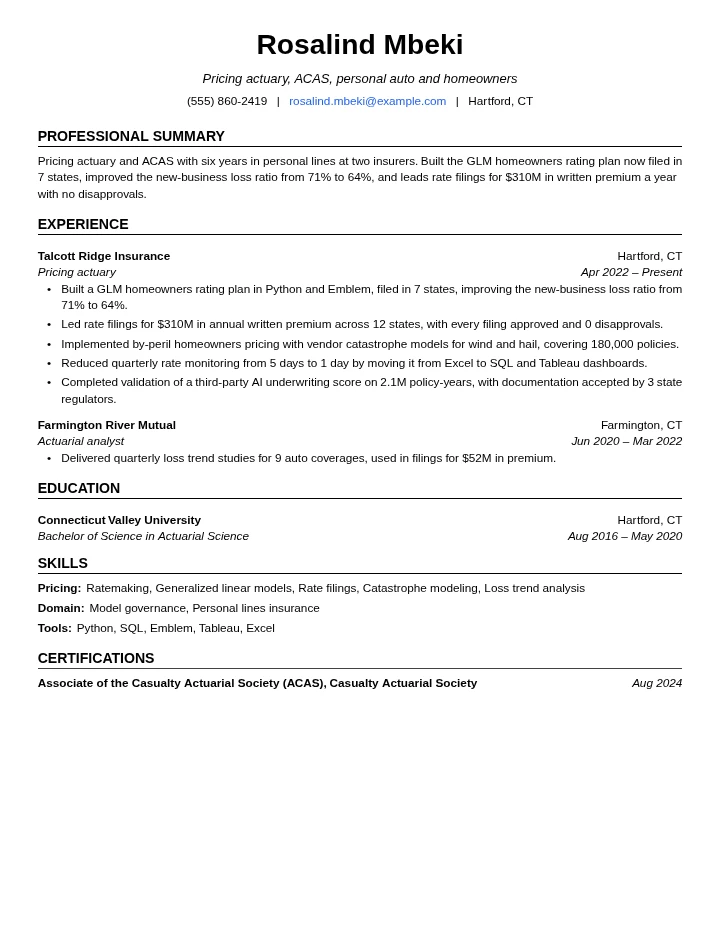
Actuary resume example, mid level, rendered in The Jake's template
Strength: Excellent

Written by the Resumi editorial team for a fictional candidate. Role facts come from O*NET and the U.S. Bureau of Labor Statistics.

Strength band is Resumi’s optimization score, not a ranking any employer sees.

What makes this resume work

Each marker on the page has a note here. Press a marker to jump to its note.

  1. 1

    Credential beside the title

    Pricing actuary, ACAS, personal auto and homeowners. Advancement depends on exams passed, so the associate credential sits in the headline next to the lines of business priced.

  2. 2

    Rating plan judged by loss ratio

    A GLM homeowners rating plan filed in seven states, with the new-business loss ratio from 71% to 64%. The loss ratio is the result a chief actuary reads first, given here before and after.

  3. 3

    Filings with premium and outcome

    Rate filings for $310M in premium across 12 states, every one approved. Postings this year ask pricing actuaries to support regulator inquiries, and the approval record is the evidence.

  4. 4

    Monitoring cut to a day

    Quarterly rate monitoring from five days to one by moving it from Excel to SQL and Tableau. SQL is the technology most named in actuary postings, and the bullet shows what it saved.

  5. 5

    An AI score validated for regulators

    A third-party AI underwriting score validated on 2.1M policy-years, with documentation regulators accepted. Insurers now ask actuaries to apply model governance to AI tools, and this shows it done.

  6. 6

    Earlier trend work in one line

    Loss trend studies for nine auto coverages, used in filings for $52M in premium. The analyst role keeps a single line, and it still names the premium the work supported.

Build your actuary resume

Free to start · no card

01The example, in full

The resume shown above, as text you can search and copy.

Rosalind Mbeki

Pricing actuary, ACAS, personal auto and homeowners

Hartford, CTrosalind.mbeki@example.com(555) 860-2419

Summary

Pricing actuary and ACAS with six years in personal lines at two insurers. Built the GLM homeowners rating plan now filed in 7 states, improved the new-business loss ratio from 71% to 64%, and leads rate filings for $310M in written premium a year with no disapprovals.

Experience

Pricing actuary

Apr 2022 – Present

Talcott Ridge Insurance · Hartford, CT

  • Built a GLM homeowners rating plan in Python and Emblem, filed in 7 states, improving the new-business loss ratio from 71% to 64%.
  • Led rate filings for $310M in annual written premium across 12 states, with every filing approved and 0 disapprovals.
  • Implemented by-peril homeowners pricing with vendor catastrophe models for wind and hail, covering 180,000 policies.
  • Reduced quarterly rate monitoring from 5 days to 1 day by moving it from Excel to SQL and Tableau dashboards.
  • Completed validation of a third-party AI underwriting score on 2.1M policy-years, with documentation accepted by 3 state regulators.

Actuarial analyst

Jun 2020 – Mar 2022

Farmington River Mutual · Farmington, CT

  • Delivered quarterly loss trend studies for 9 auto coverages, used in filings for $52M in premium.

Education

Bachelor of Science in Actuarial Science

Aug 2016 – May 2020

Connecticut Valley University · Hartford, CT

Skills

Pricing
Ratemaking, Generalized linear models, Rate filings, Catastrophe modeling, Loss trend analysis
Domain
Model governance, Personal lines insurance
Tools
Python, SQL, Emblem, Tableau, Excel

Certifications

Associate of the Casualty Actuarial Society (ACAS)

Aug 2024

Casualty Actuarial Society

02Market snapshot

Median pay
$130,000 median annual pay for actuaries
Typical education
Bachelor's degree, plus a series of certification exams taken during and after college
Job outlook
+9% for actuaries, 2025–35, about 2,900 more jobs
Common credentials
11 certifications listed, including ACAS, FCAS, ASA and FSA, and one license for pension work

Sources: BLS OES (May 2025) · BLS OOH (2025) · CareerOneStop (2026)

03The same resume at three levels

The tinted row is the level shown above.

  • Entry-level

    0–2 years

    The degree and three exams lead, each with its date, then two years of pricing work in four counted bullets: rate indications with the premium they support, development triangles that shortened the close, a workbook moved to Python, and regulator objections answered fast. The internship keeps one line.

    Typical titles: Actuarial analyst, Actuarial assistant, Pricing analyst

  • Mid-level

    3–6 years

    The default view. ACAS in the headline, then six years in the units a chief actuary weighs: a GLM rating plan with its loss ratio, filings with premium and approvals, catastrophe pricing by peril, monitoring automated, and an AI score validated for regulators. The analyst role keeps one line.

    Typical titles: Pricing actuary, Actuary, Associate actuary

  • Senior

    7+ years

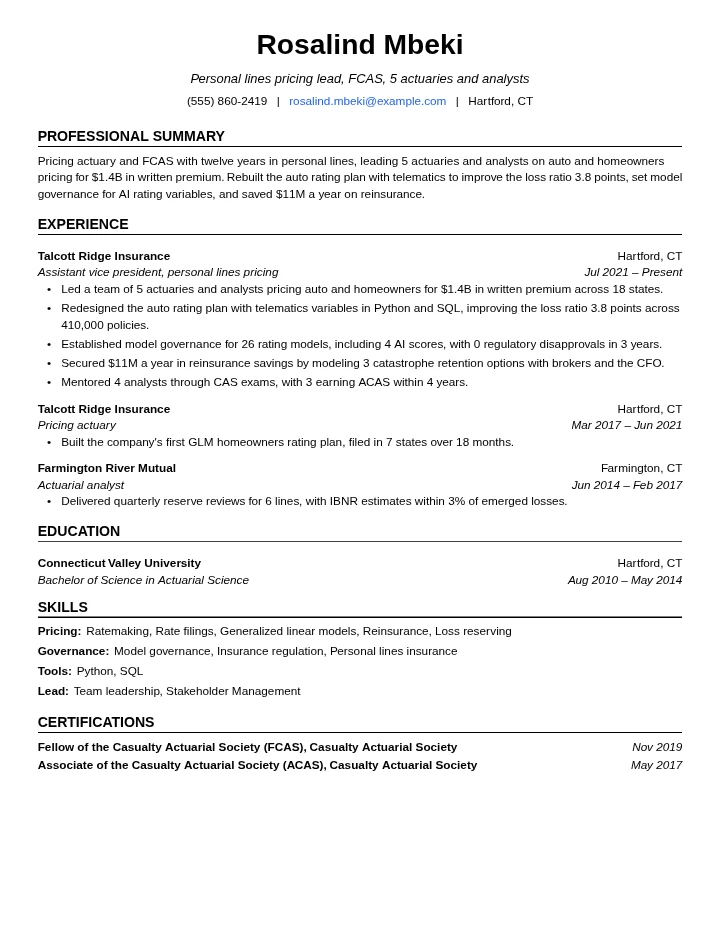
    Leading pricing replaces running indications: five people on $1.4B in premium, a rating plan rebuilt with telematics, governance over every rating model, reinsurance savings modeled with the CFO, and analysts credentialed. The two earlier roles keep one line each, and FCAS sits above ACAS.

    Typical titles: Pricing lead actuary, Assistant vice president, pricing, Chief pricing actuary

04Summary

Weak

Analytical and detail-oriented actuarial professional with strong quantitative skills, seeking to leverage expertise in risk analysis and modeling.

Strong

Pricing actuary and ACAS with six years in personal lines at two insurers. Built the GLM homeowners rating plan now filed in 7 states and improved the new-business loss ratio from 71% to 64%.

A chief actuary reads for the credential, the practice area and the book you priced before anything else. The strong version gives all three, then a loss ratio. The weak version is the objective statement actuarial recruiters tell candidates to drop, with no exam or line of business.

05Bullets

Weak

  • Assisted with pricing analysis and rate reviews for various lines of business, working closely with underwriting.

Strong

  • Led rate filings for $310M in annual written premium across 12 states, with every filing approved and 0 disapprovals.

Analyzing data to determine premium rates and reserves is the occupation's highest-rated task, and a filing is where that work meets a regulator. The strong bullet gives the premium, the number of states and the outcome. The weak bullet says the work was assisted, which tells a chief actuary nothing about whether the filings held up.

06Skills and keywords

Pricing and reserving

  • Ratemaking (in the example)
  • Rate filings (in the example)
  • Generalized linear models (in the example)
  • Loss reserving
  • Loss trend analysis (in the example)
  • Catastrophe modeling (in the example)
  • Reinsurance

Domain and governance

  • Personal lines insurance (in the example)
  • Model governance (in the example)
  • Insurance regulation

Tools

  • SQL (in the example)
  • Python (in the example)
  • Excel (in the example)
  • R
  • SAS
  • VBA
  • Emblem (in the example)
  • Tableau (in the example)

Credentials

  • Associate of the Casualty Actuarial Society (ACAS) (in the example)
  • Fellow of the Casualty Actuarial Society (FCAS)
  • Associate of the Society of Actuaries (ASA)
  • Fellow of the Society of Actuaries (FSA)
  • Enrolled Actuary

Filled chips appear in the example above.

Paste a job description and Resumi shows which of these your resume already covers.

Build your actuary resume

07Mistakes to avoid

  1. Exams buried at the bottom

    Fix: Actuarial recruiters say education and exam status come first on an early-career resume. List every exam passed with its month and year near the top, and the next sitting you are registered for. A hiring manager screens on that line before reading anything else.

  2. A credential from the wrong society

    Fix: A competitor's sample pairs a life society fellowship with property and casualty reserving. The Casualty Actuarial Society credentials property and casualty work, and the Society of Actuaries covers life, health, retirement and finance. Name the society and exams that match your practice area.

  3. SQL and Python listed, never shown

    Fix: Pricing postings this year ask for SQL and Python, and recruiters say interviews test the languages on your resume. Put each one in a bullet with what it built or automated, such as a trend workbook or a monitoring report, and the time it saved.

  4. Pricing work with no premium

    Fix: Rate indications, filings and rating plans all come with a premium volume, a number of states and an outcome. Give the written premium, the loss ratio before and after, and how the filings fared with regulators. Those are the numbers a chief actuary reads.

  5. An exam count that does not match

    Fix: Recruiters warn that offers have been rescinded when a resume was not completely factual, and call typos the biggest red flag. List exams exactly as passed, with real dates, and proofread every figure before you send it.

08Format and template

One column and one page. At entry level, put the degree and every exam passed with its date above your experience. Later, put the credential in the headline. Name the line of business and the premium in each pricing bullet, give loss ratios and filing outcomes as numbers, and keep SQL, Python and other tools in the bullets where you used them.

Shown above: The Jake's

  • Standard template
    StandardFree
  • Executive Classic template
    Executive Classic
  • Warm Classic template
    Warm Classic

09Questions actuaries ask

How many actuarial exams do you need to get hired?

BLS says many employers expect prospective hires to have passed at least one or two certification exams before graduation, alongside coursework in economics, finance and mathematical statistics. Associate status can take up to 7 years, with fellowship further on. Recruiters read for exams passed, an internship and one programming language, so list each exam with its date near the top of the page.

How much do actuaries make?

The May 2025 median for actuaries was $130,000, with the lowest tenth under $78,570 and the highest tenth over $215,100. By industry, finance and insurance paid a median $131,450, management of companies $129,810, government $129,650 and professional, scientific and technical services $124,130. BLS says advancement usually depends on job performance and the number of exams passed, which is why credentials sit so high on the page.

What is the difference between ACAS and ASA?

They come from different societies. CareerOneStop lists associate and fellow designations from both the Casualty Actuarial Society and the Society of Actuaries. Casualty actuaries price and reserve property and casualty insurance, while the fellowship tracks BLS lists, in life and annuities, group and health benefits, retirement benefits, quantitative finance, and enterprise risk management, follow the other path. Put the society's full name beside each credential.

Do actuaries need a license?

Most do not. O*NET lists one national license for the occupation, the Enrolled Actuary credential from the Joint Board for the Enrollment of Actuaries, and BLS says pension actuaries need it. Other actuaries rely on society credentials, which require exams, coursework and professionalism seminars. If you are enrolled, list it with the credential year, and otherwise show your exams and designation instead.

Will AI replace actuaries?

BLS projects employment of actuaries to grow 9 percent from 2025 to 2035, about 2,900 jobs, with about 1,500 openings a year, as insurers price new products, manage enterprise risk and assess changing health regulations. Pricing postings read for this page ask actuaries to validate models and set governance for automated tools, so show that work on your resume, with what you tested and who accepted it.

Free to start

Build your actuary resume

No card, no trial that turns into a charge.

Sign up free