UI designer resume examples & writing guide for 2026

Three UI resumes at junior, design systems and lead level, each rendered in the template the page names and pulled apart note by note. Every one counts what shipped, what it was built from, and what stopped breaking afterwards.

By the Resumi editorial teamUpdated 9 min read

Showing the mid-level example

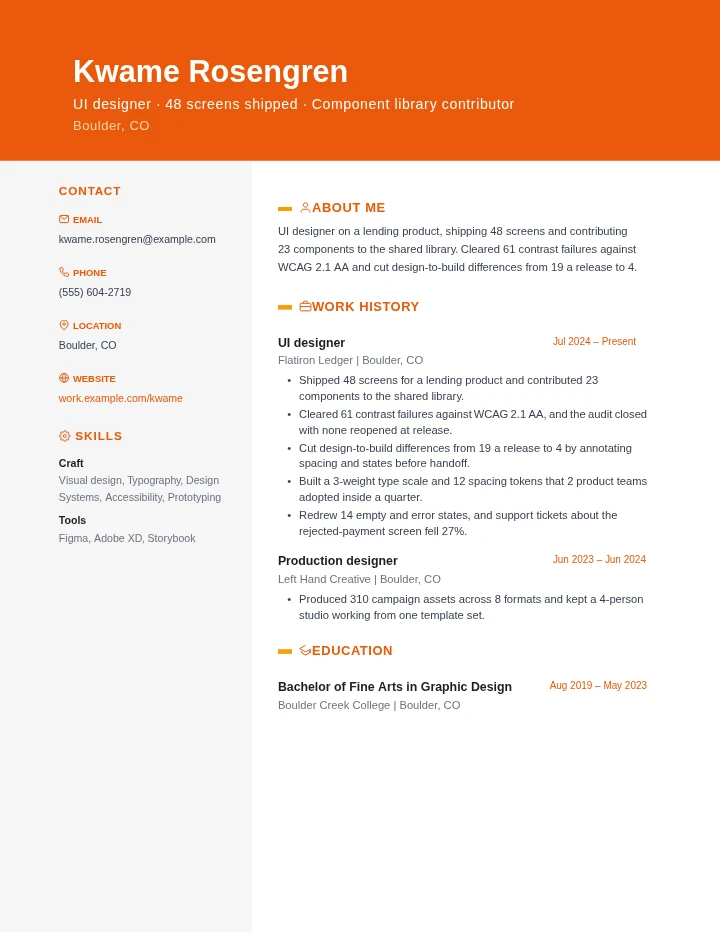
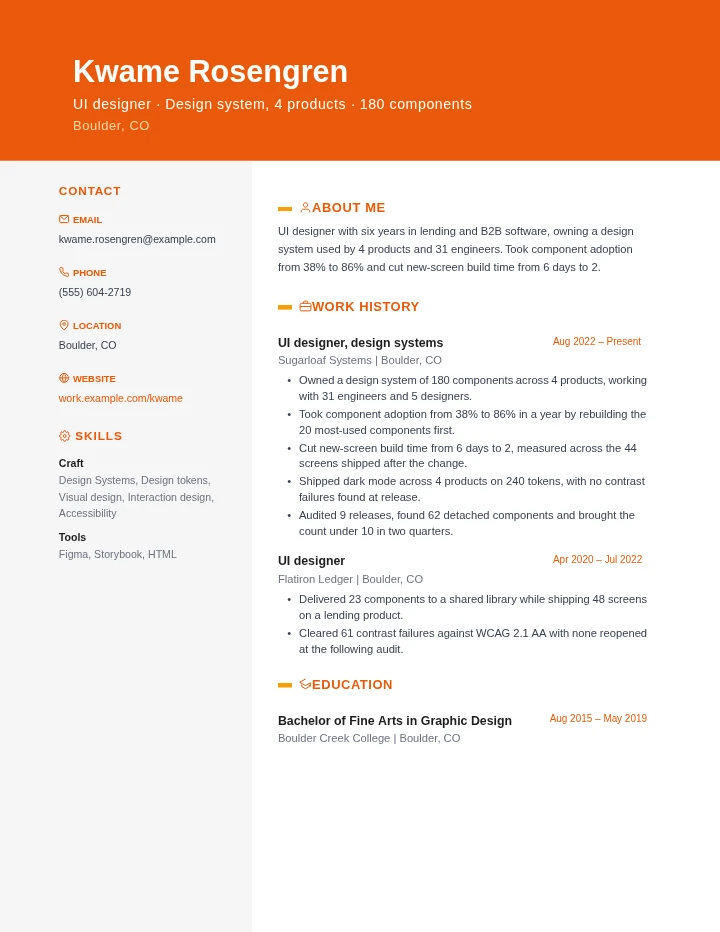
UI designer resume example, mid level, rendered in the Orange Creative template
Strength: Strong

Written by the Resumi editorial team for a fictional candidate. Role facts come from O*NET and the U.S. Bureau of Labor Statistics.

Strength band is Resumi’s optimization score, not a ranking any employer sees.

What makes this resume work

Each marker on the page has a note here. Press a marker to jump to its note.

  1. 1

    System size and reach

    A hundred and eighty components across four products. A design system on a resume means nothing without its size and how many teams consume it, and both are in the first line.

  2. 2

    Adoption with a starting point

    Thirty-eight percent to eighty-six. Adoption is the measure the field argues about, and quoting it without a baseline is the commonest way a systems designer overstates what they inherited.

  3. 3

    The order the work took

    The twenty most-used components rebuilt first. Sequencing is the whole skill in systems work, and naming it tells a hiring manager this person has run the trade-off rather than read about it.

  4. 4

    Build time, measured after

    Six days to two, across forty-four screens shipped afterwards. Time saved is the claim every system makes. Attaching the number of screens it was measured over is what makes it checkable.

  5. 5

    Detached components tracked down

    Sixty-two found across nine releases, under ten within two quarters. Detachment is the field's own health signal, and using it says this designer reads the system as a product with defects.

  6. 6

    Lending years, two lines

    The first job keeps the screen count and the contrast result. The system is what this reader is deciding on, so the system is where the page spends its space.

Build your UI designer resume

Free to start · no card

01The example, in full

The resume shown above, as text you can search and copy.

Kwame Rosengren

UI designer · Design system, 4 products · 180 components

Boulder, COkwame.rosengren@example.com(555) 604-2719work.example.com/kwame

Summary

UI designer with six years in lending and B2B software, owning a design system used by 4 products and 31 engineers. Took component adoption from 38% to 86% and cut new-screen build time from 6 days to 2.

Experience

UI designer, design systems

Aug 2022 – Present

Sugarloaf Systems · Boulder, CO

  • Owned a design system of 180 components across 4 products, working with 31 engineers and 5 designers.
  • Took component adoption from 38% to 86% in a year by rebuilding the 20 most-used components first.
  • Cut new-screen build time from 6 days to 2, measured across the 44 screens shipped after the change.
  • Shipped dark mode across 4 products on 240 tokens, with no contrast failures found at release.
  • Audited 9 releases, found 62 detached components and brought the count under 10 in two quarters.

UI designer

Apr 2020 – Jul 2022

Flatiron Ledger · Boulder, CO

  • Delivered 23 components to a shared library while shipping 48 screens on a lending product.
  • Cleared 61 contrast failures against WCAG 2.1 AA with none reopened at the following audit.

Education

Bachelor of Fine Arts in Graphic Design

Aug 2015 – May 2019

Boulder Creek College · Boulder, CO

Skills

Craft
Design Systems, Design tokens, Visual design, Interaction design, Accessibility
Tools
Figma, Storybook, HTML

02Market snapshot

Median pay
$104,000 median annual pay for web and digital interface designers, the occupation this title sits in
Typical education
Bachelor's degree typical. 52% of O*NET respondents said a bachelor's is required
Job outlook
+6% growth for digital interface designers, 2025–35, with about 13,600 openings a year
Common credentials
No license. 15 certifications listed, none of them a design credential

Sources: BLS OES (May 2025) · BLS OOH (2025) · CareerOneStop (2026)

03The same resume at three levels

The tinted row is the level shown above.

  • Entry-level

    0–2 years

    The headline counts screens and components rather than describing support. The summary carries an accessibility result and a handoff measure. The bullets pair each piece of craft with something that changed, and the studio year stays because production work is where consistency is learned.

    Typical titles: UI designer, Junior product designer, Visual designer

  • Mid-level

    3–6 years

    The headline gives the system its size and reach. The summary reports adoption from a stated baseline and build time after the change. The bullets carry the sequencing decision, a dark mode shipped on tokens, and a detached-component count driven down. The lending years keep two lines.

    Typical titles: UI designer, Design systems designer, Senior UI designer

  • Senior

    7+ years

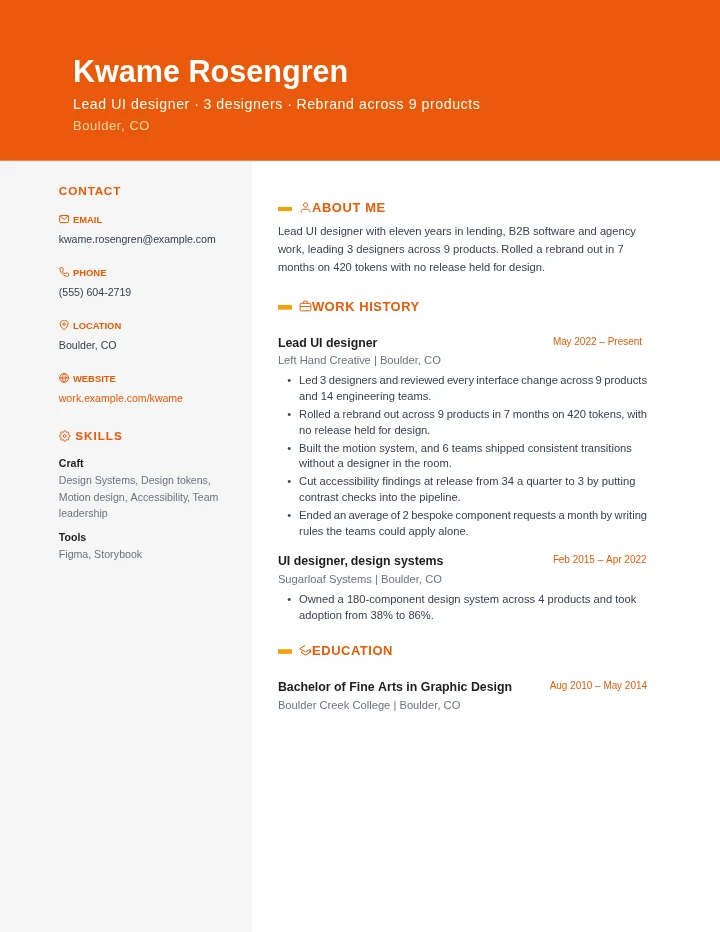
    Scope moves from a system to governance: designers led, products and engineering teams covered, a rebrand delivered without holding a release, a motion system other teams use unaided, accessibility checks moved into the pipeline, and bespoke requests ended by writing rules. The system years keep one line.

    Typical titles: Lead UI designer, Design systems lead, Staff designer

04Summary

Weak

Detail-oriented UI designer with an eye for clean, modern interfaces and a passion for pixel-perfect execution across web and mobile platforms.

Strong

UI designer with six years in lending and B2B software, owning a design system used by 4 products and 31 engineers. Took component adoption from 38% to 86% and cut new-screen build time from 6 days to 2.

Two industries, the thing owned, how many products and engineers depend on it, and two numbers with baselines. A hiring manager can tell within one read whether this person has run a system or contributed to one. The weak version has an eye and a passion, and every other applicant claims both.

05Bullets

Weak

  • Created clean, modern, pixel-perfect interfaces and maintained the design system to ensure a consistent user experience across products.

Strong

  • Took component adoption from 38% to 86% in a year by rebuilding the 20 most-used components first.

A baseline, an endpoint, a period and the sequencing decision behind it. An interviewer can ask which twenty and why those, and the answer exists. The weak bullet maintains a system that may have had four users, promises consistency nobody measured, and would survive being pasted onto any interface resume in the pile without a single word being changed.

06Skills and keywords

Craft

  • Visual design (in the example)
  • Design Systems (in the example)
  • Design tokens (in the example)
  • Interaction design (in the example)
  • Typography
  • Motion design

Quality

  • Accessibility (in the example)
  • Prototyping
  • Usability testing

Tools

  • Figma (in the example)
  • Storybook (in the example)
  • HTML (in the example)
  • Adobe XD
  • Sketch

Filled chips appear in the example above.

Paste a job description and Resumi shows which of these your resume already covers.

Build your UI designer resume

07Mistakes to avoid

  1. Pixel-perfect and clean standing in for evidence

    Fix: Those words appear on almost every interface resume and sort nobody. Replace them with counts: screens shipped, components built, contrast findings cleared, differences between design and build at release. Craft is easiest to prove with the defects that stopped appearing.

  2. A design system claimed with no size or reach

    Fix: Contributing three components to a library of two hundred and owning that library are different jobs. Give the component count, how many products consume it, how many engineers build against it, and the adoption rate with a baseline. Without those, the claim is unreadable.

  3. Adoption quoted without a starting point

    Fix: Eighty-six percent adoption means one thing if you inherited eighty and another if you inherited thirty-eight. Give both ends and the period. Add coverage or detached-component counts if you have them, because usage alone hides teams building everything custom around one button.

  4. No accessibility standard named anywhere

    Fix: Contrast, focus order and state visibility are interface work, and public sector and regulated buyers now require a stated standard with evidence. Name the standard, the screen count and what the audit found. It is the most verifiable thing on a UI page.

  5. Portfolio link buried at the bottom in small grey text

    Fix: The resume exists to get the portfolio opened, so put the link in the header where the eye starts. Make sure the work behind it shows the thinking, not just final frames. Reviewers give it minutes, and a gallery with no reasoning reads as decoration.

08Format and template

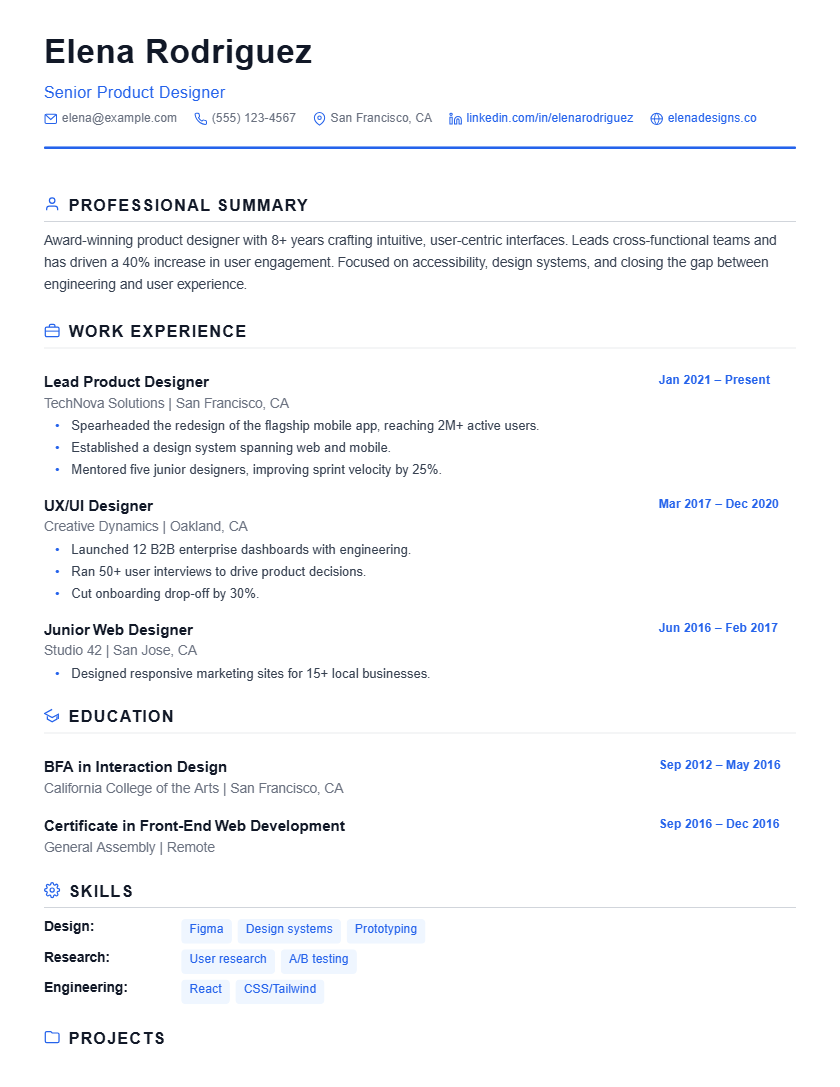
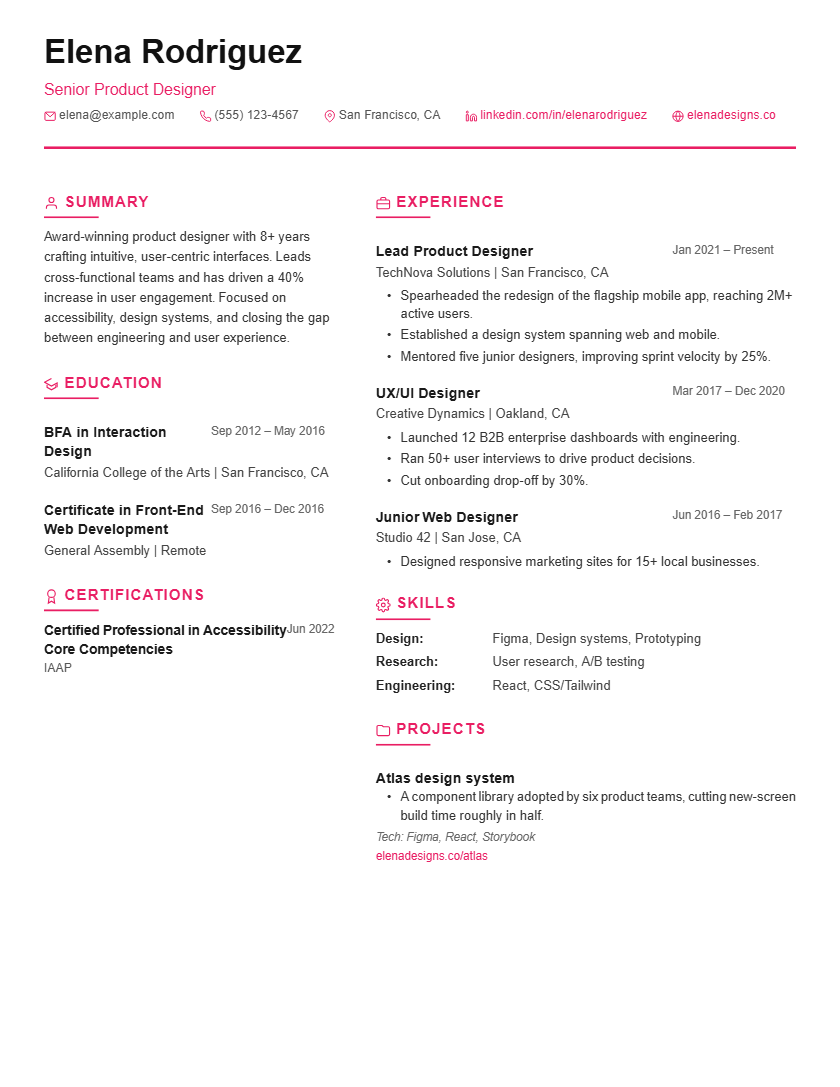
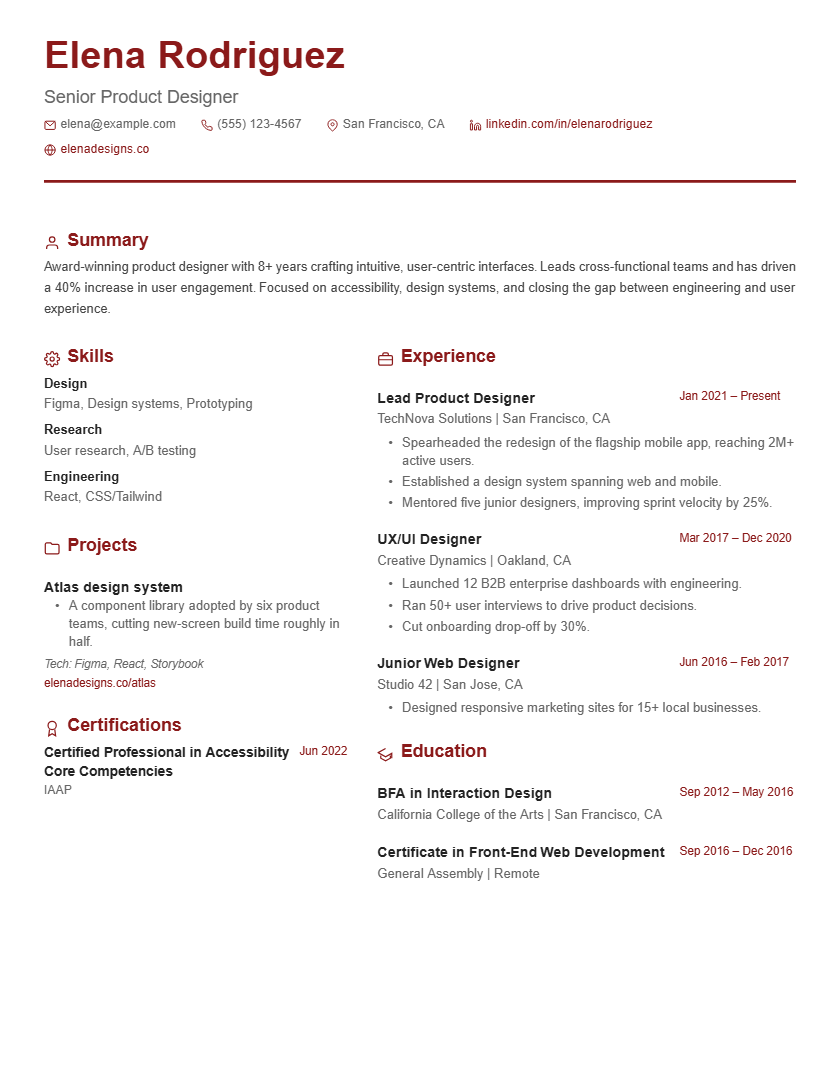
One page, the portfolio link in the header, and counts rather than adjectives in the first line of every role. Keep the numbers in the text where a parser can read them rather than inside an exported image, and hold the tool list to a single line. The frames belong in the portfolio. This example uses Orange Creative. The same content works in Standard, Pink Accent and Red & Gray Modern.

Shown above: Orange Creative

  • Standard template
    StandardFree
  • Pink Accent template
    Pink Accent
  • Red & Gray Modern template
    Red & Gray Modern

09Questions UI designers ask

What numbers belong on a UI designer resume?

Screens and components shipped, the size of any system you worked on and how many products and engineers depend on it, adoption with a baseline, detached components found and closed, contrast findings cleared against a named standard, differences between design and build at release, and build time before and after. Where an interface change moved a support or conversion number, carry that through too.

How is a UI designer resume different from a UX one?

Both sit in the same federal occupation and both need evidence, but the evidence differs. A UX page is judged on research, flows and the metric a decision moved. A UI page is judged on what shipped and what stopped breaking: components, tokens, contrast, consistency, handoff quality. If you do both, say which half you are stronger in rather than splitting the page evenly, because reviewers are hiring for one of them.

How do I show design system work if I did not own the system?

Say what you contributed and what happened to it. Components you authored and how many products picked them up, patterns you documented, the audit you ran, the detachments you tracked down, the accessibility annotations you added to handoff. Contribution with a measured consequence reads better than an ownership claim a reviewer can unpick in the first five minutes of an interview.

Do UI designers still need to know how to code?

Not to write production code, but enough to be useful at the boundary. Reading the component in the repository, understanding how tokens compile, knowing why a spacing value did not apply, working in Storybook: those save an engineer's afternoon and show up in the design-to-build difference count. Put the markup and styling you genuinely use on the page and leave off anything you would not want to be asked about.

Do design certifications help a UI designer?

Very little. The federal listing for this occupation shows no license and fifteen certifications from seven organizations, and not one of them is a design credential — they are software and platform certifications. Employers ask for a degree, a portfolio and evidence instead. A course certificate is worth one line at the bottom for a career changer and nothing at all further up.

How long should a UI designer resume be?

One page, through lead level. Eleven years fits once earlier roles collapse to a line holding what you owned and one number. Cut the adjectives first, then the tool list, then any bullet describing a deliverable with no consequence attached. What survives is what shipped, how many people depend on it and what stopped going wrong, which is what the portfolio review will test anyway.

Free to start

Build your UI designer resume

No card, no trial that turns into a charge.

Sign up free