Cybersecurity analyst resume examples & writing guide for 2026

Three cybersecurity analyst resumes at SOC tier 1, mid and senior level, rendered in a real template and annotated. Each sizes the environment in endpoints and alerts, and shows detection, response and vulnerability work with its result.

By the Resumi editorial teamUpdated 9 min read

Showing the mid-level example

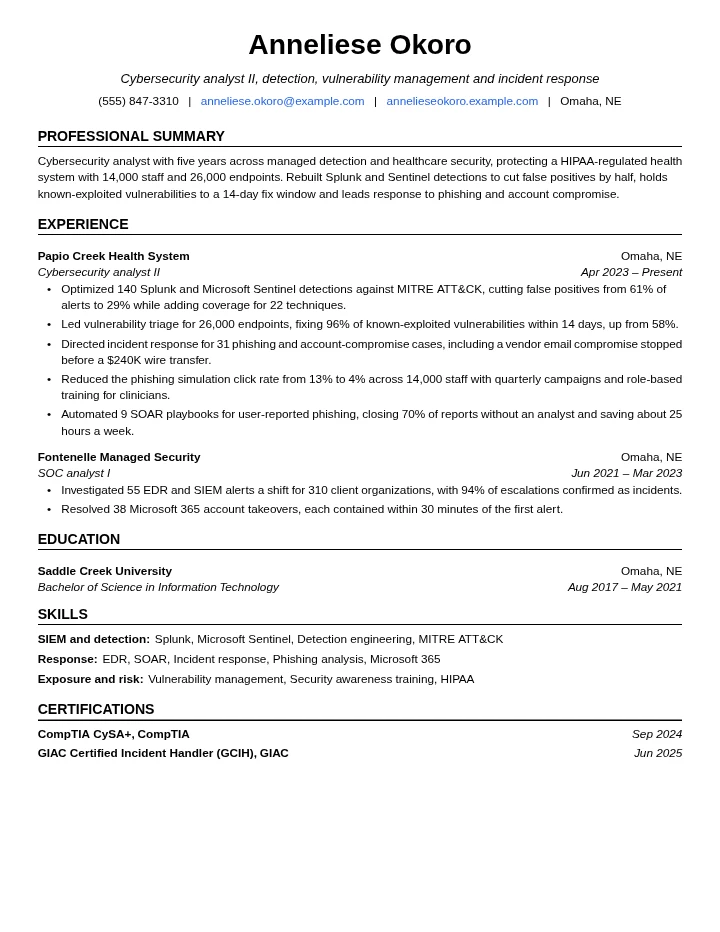
Cybersecurity analyst resume example, mid level, rendered in The Jake's template
Strength: Excellent

Written by the Resumi editorial team for a fictional candidate. Role facts come from O*NET and the U.S. Bureau of Labor Statistics.

Strength band is Resumi’s optimization score, not a ranking any employer sees.

What makes this resume work

Each marker on the page has a note here. Press a marker to jump to its note.

  1. 1

    Three kinds of work named

    Detection, vulnerability management and incident response in one headline. Mid-level postings expect an analyst to cover all three, and the headline tells a screener this candidate already does.

  2. 2

    False positives, before and after

    One hundred forty detections tuned against ATT&CK, cutting false positives from sixty-one percent of alerts to twenty-nine while adding coverage. Alert quality is what a security leader watches, and a baseline makes the claim testable.

  3. 3

    An incident with money saved

    Thirty-one phishing and account-compromise cases led, including a vendor email compromise stopped before a two hundred forty thousand dollar wire. Tying a response to the loss it prevented is how security work earns executive attention.

  4. 4

    Click rate against a baseline

    Phishing simulation clicks cut from thirteen percent to four across fourteen thousand staff, with training built for clinicians. It shows awareness work measured over time rather than a module assigned once a year.

  5. 5

    Phishing reports closed automatically

    Nine SOAR playbooks close seventy percent of user-reported phishing without an analyst, saving about twenty-five hours a week. Automation that frees analysts for real cases is now a core ask in SOC postings.

  6. 6

    CySA+ and GCIH, both dated

    The CompTIA analyst credential and the SANS incident handling credential, each with its date. Both appear on mid-level postings, and the incident handler credential matches the response work in the bullets above.

Build your cybersecurity analyst resume

Free to start · no card

01The example, in full

The resume shown above, as text you can search and copy.

Anneliese Okoro

Cybersecurity analyst II, detection, vulnerability management and incident response

Omaha, NEanneliese.okoro@example.com(555) 847-3310annelieseokoro.example.com

Summary

Cybersecurity analyst with five years across managed detection and healthcare security, protecting a HIPAA-regulated health system with 14,000 staff and 26,000 endpoints. Rebuilt Splunk and Sentinel detections to cut false positives by half, holds known-exploited vulnerabilities to a 14-day fix window and leads response to phishing and account compromise.

Experience

Cybersecurity analyst II

Apr 2023 – Present

Papio Creek Health System · Omaha, NE

  • Optimized 140 Splunk and Microsoft Sentinel detections against MITRE ATT&CK, cutting false positives from 61% of alerts to 29% while adding coverage for 22 techniques.
  • Led vulnerability triage for 26,000 endpoints, fixing 96% of known-exploited vulnerabilities within 14 days, up from 58%.
  • Directed incident response for 31 phishing and account-compromise cases, including a vendor email compromise stopped before a $240K wire transfer.
  • Reduced the phishing simulation click rate from 13% to 4% across 14,000 staff with quarterly campaigns and role-based training for clinicians.
  • Automated 9 SOAR playbooks for user-reported phishing, closing 70% of reports without an analyst and saving about 25 hours a week.

SOC analyst I

Jun 2021 – Mar 2023

Fontenelle Managed Security · Omaha, NE

  • Investigated 55 EDR and SIEM alerts a shift for 310 client organizations, with 94% of escalations confirmed as incidents.
  • Resolved 38 Microsoft 365 account takeovers, each contained within 30 minutes of the first alert.

Education

Bachelor of Science in Information Technology

Aug 2017 – May 2021

Saddle Creek University · Omaha, NE

Skills

SIEM and detection
Splunk, Microsoft Sentinel, Detection engineering, MITRE ATT&CK
Response
EDR, SOAR, Incident response, Phishing analysis, Microsoft 365
Exposure and risk
Vulnerability management, Security awareness training, HIPAA

Certifications

CompTIA CySA+

Sep 2024

CompTIA

GIAC Certified Incident Handler (GCIH)

Jun 2025

GIAC

02Market snapshot

Median pay
$129,180 median pay for information security analysts, the occupation that counts cybersecurity analysts
Typical education
53% of O*NET respondents said a bachelor's degree is required
Job outlook
Information security analyst jobs projected to grow 21% from 2025 to 2035, adding 40,600
Common credentials
No state license. 159 certifications from 37 organizations, Security+ and CISSP among them

Sources: BLS OES (May 2025) · O*NET (31.0) · BLS OOH (2025) · CareerOneStop (2026)

03The same resume at three levels

The tinted row is the level shown above.

  • Entry-level

    0–2 years

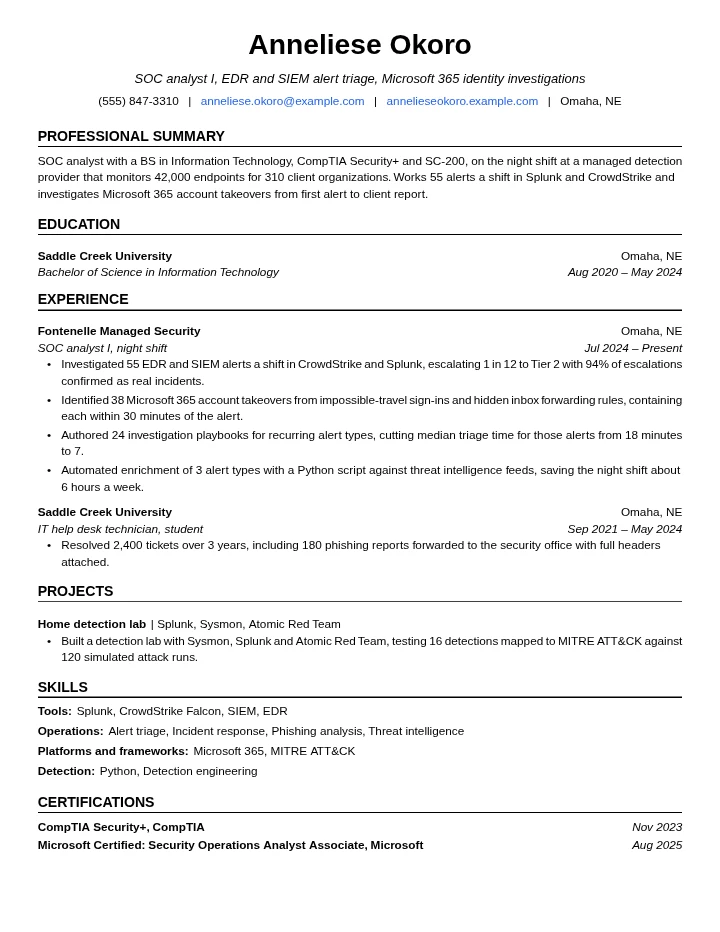
    The degree, Security+ and SC-200 come first, then two years on a managed detection night shift sized in endpoints, clients and alerts. Each bullet shows analyst work with a measure: escalation accuracy, account takeovers contained, playbooks that cut triage time and enrichment that saved hours. The lab adds detections of the candidate's own.

    Typical titles: SOC analyst I, Security operations analyst, Junior security analyst

  • Mid-level

    3–6 years

    Detection and exposure work replace the alert queue. The bullets carry detections tuned against ATT&CK with false positives halved, known-exploited vulnerabilities fixed on time, incidents led up to a stopped wire fraud, a lower phishing click rate and automation that closes routine reports. The detection-provider years keep two lines.

    Typical titles: Cybersecurity analyst II, Information security analyst, SOC analyst II

  • Senior

    7+ years

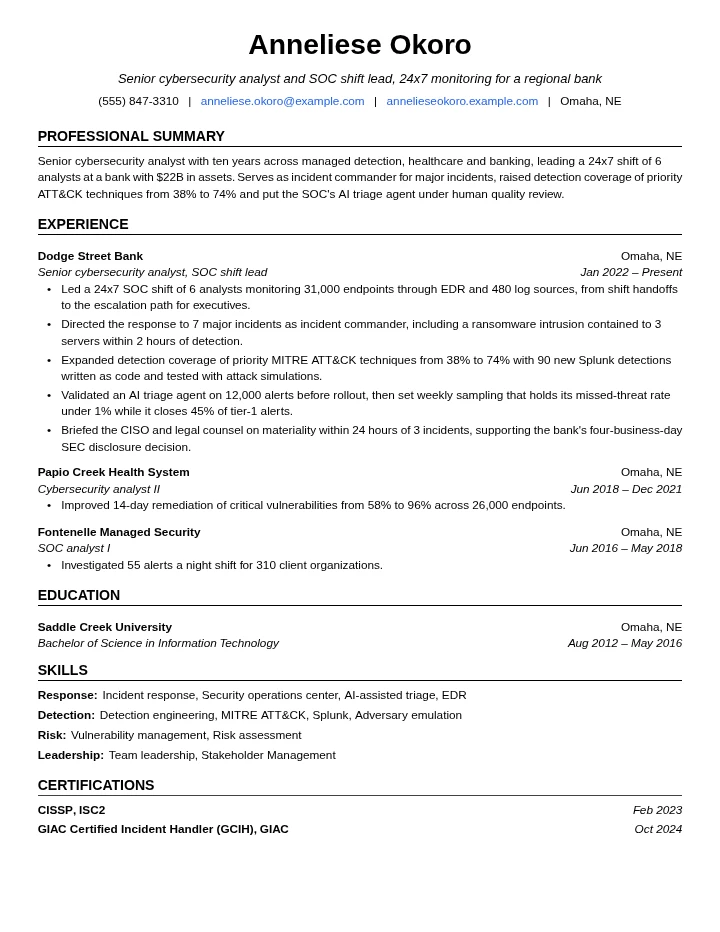
    Scope moves from cases to the SOC itself: a 24x7 shift of six, major incidents commanded, detection coverage measured against ATT&CK, an AI triage agent put under sampling review and executives briefed on materiality. Earlier roles keep one line each.

    Typical titles: Senior cybersecurity analyst, SOC shift lead, Cybersecurity analyst III

04Summary

Weak

Detail-oriented cybersecurity analyst passionate about protecting organizations from cyber threats, with experience in SIEM, firewalls, vulnerability scanning and incident response.

Strong

Cybersecurity analyst with five years across managed detection and healthcare security, protecting a HIPAA-regulated health system with 14,000 staff and 26,000 endpoints. Rebuilt Splunk and Sentinel detections to cut false positives by half, holds known-exploited vulnerabilities to a 14-day fix window and leads response to phishing and account compromise.

The strong version names the size of the environment, the regulation it works under and three results a security leader tracks: alert quality, time to fix exploited flaws and incident handling. A hiring manager can ask how the false positives were halved. The weak one lists tools every applicant lists and proves none of them.

05Bullets

Weak

  • Monitored security alerts and responded to incidents using SIEM tools.

Strong

  • Identified 38 Microsoft 365 account takeovers from impossible-travel sign-ins and hidden inbox forwarding rules, containing each within 30 minutes of the alert.

It names the attack, the signals that exposed it and how fast each case was contained. Account takeover through stolen sessions and help desk tricks is among the incidents a SOC handles most, so an interviewer will ask how the forwarding rules were found and what containment involved. The weak bullet describes the job title of every SOC analyst and nothing this one did.

06Skills and keywords

SIEM and detection

  • Splunk (in the example)
  • Microsoft Sentinel (in the example)
  • Detection engineering (in the example)
  • MITRE ATT&CK (in the example)
  • KQL
  • Threat hunting

Endpoint and response

  • EDR (in the example)
  • SOAR (in the example)
  • Incident response (in the example)
  • Phishing analysis (in the example)
  • Microsoft 365 (in the example)
  • CrowdStrike Falcon
  • Digital forensics

Exposure and risk

  • Vulnerability management (in the example)
  • Security awareness training (in the example)
  • HIPAA (in the example)
  • NIST Cybersecurity Framework
  • Risk assessment

Scripting

  • Python
  • PowerShell
  • Linux

Credentials

  • CompTIA CySA+ (in the example)
  • GIAC Certified Incident Handler (GCIH) (in the example)
  • CompTIA Security+
  • CISSP
  • Microsoft Certified: Security Operations Analyst Associate
  • Systems Security Certified Practitioner (SSCP)

Filled chips appear in the example above.

Paste a job description and Resumi shows which of these your resume already covers.

Build your cybersecurity analyst resume

07Mistakes to avoid

  1. The same resume for every security job

    Fix: A long-time incident responder who mentors job seekers warns that a resume written for a SOC analyst job will not get noticed for forensics or vulnerability work. Tailor the headline and the first bullets to the specialty each posting names.

  2. Certifications with nothing done with them

    Fix: Hiring managers on IT forums say they take experience over certifications, and practitioners who hire ask candidates what they built outside work. Put a lab, detections you wrote, a capture-the-flag result or a volunteer project next to each certification, so the reader sees it applied.

  3. Alert counts with no outcome

    Fix: Saying you monitored thousands of alerts tells a SOC manager nothing about judgment. Report what happened to them: the share you escalated that proved real, the false positives your tuning removed, the incidents you contained and how fast. Those are numbers a reviewer can believe.

  4. Tools listed that you cannot discuss

    Fix: Interviewers pick items from the resume and ask how you used them, and a former HR screener put it simply: if it is on your resume, be prepared to talk about it. List the SIEM, EDR and scanners you actually queried, tuned or ran, and leave the rest off.

  5. AI tools missing from the story

    Fix: Security postings increasingly ask analysts to use AI tools and to check what they produce. If you have used an assistant or a triage agent, say how you verified its output and what it changed, such as cases closed or time saved. Employers now name this work in postings.

08Format and template

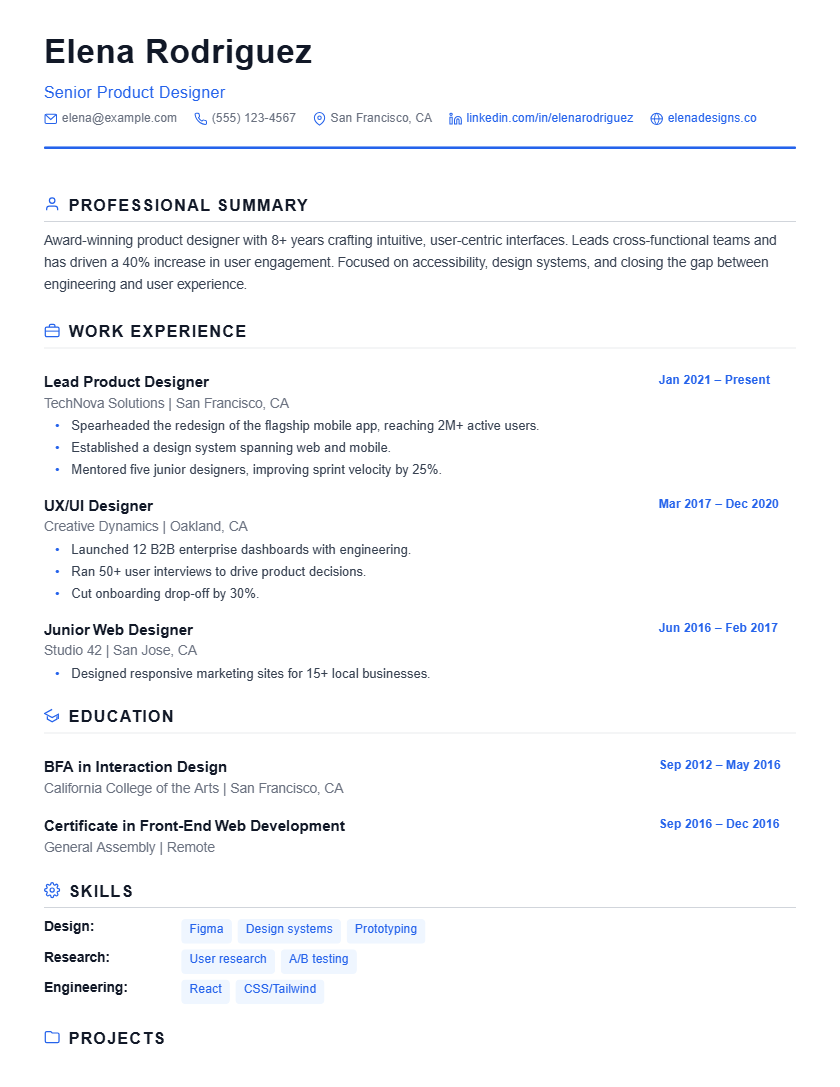
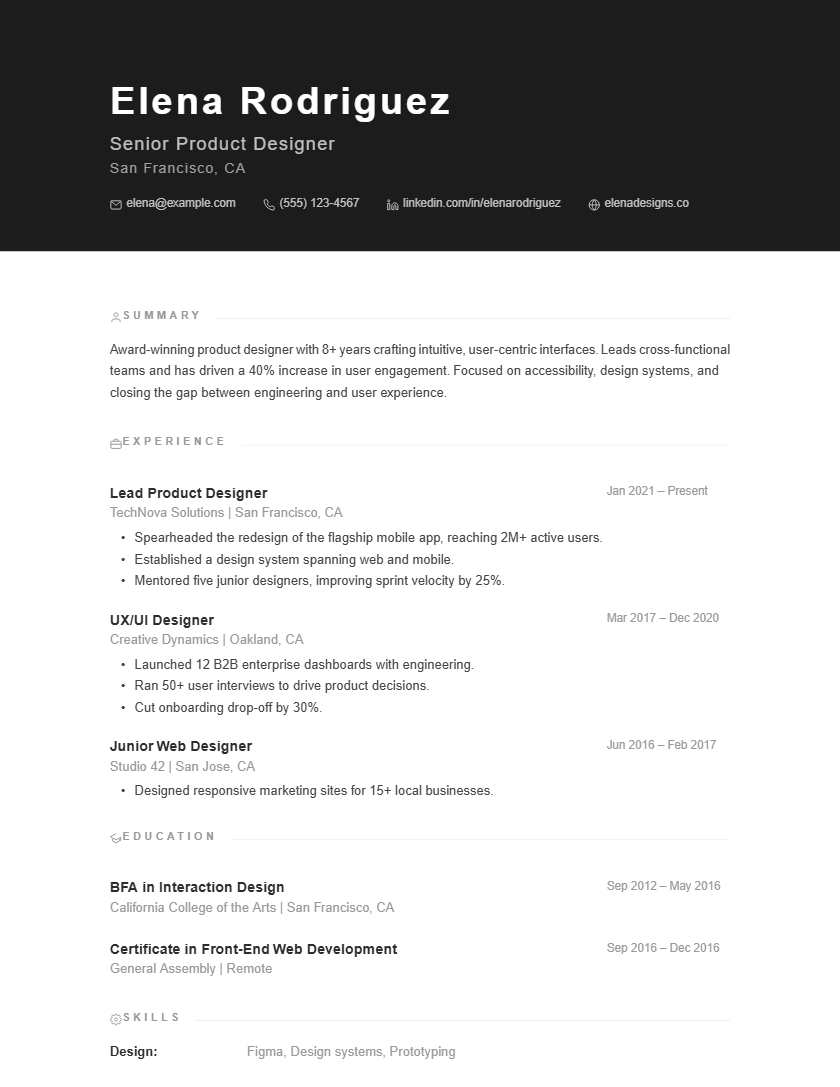
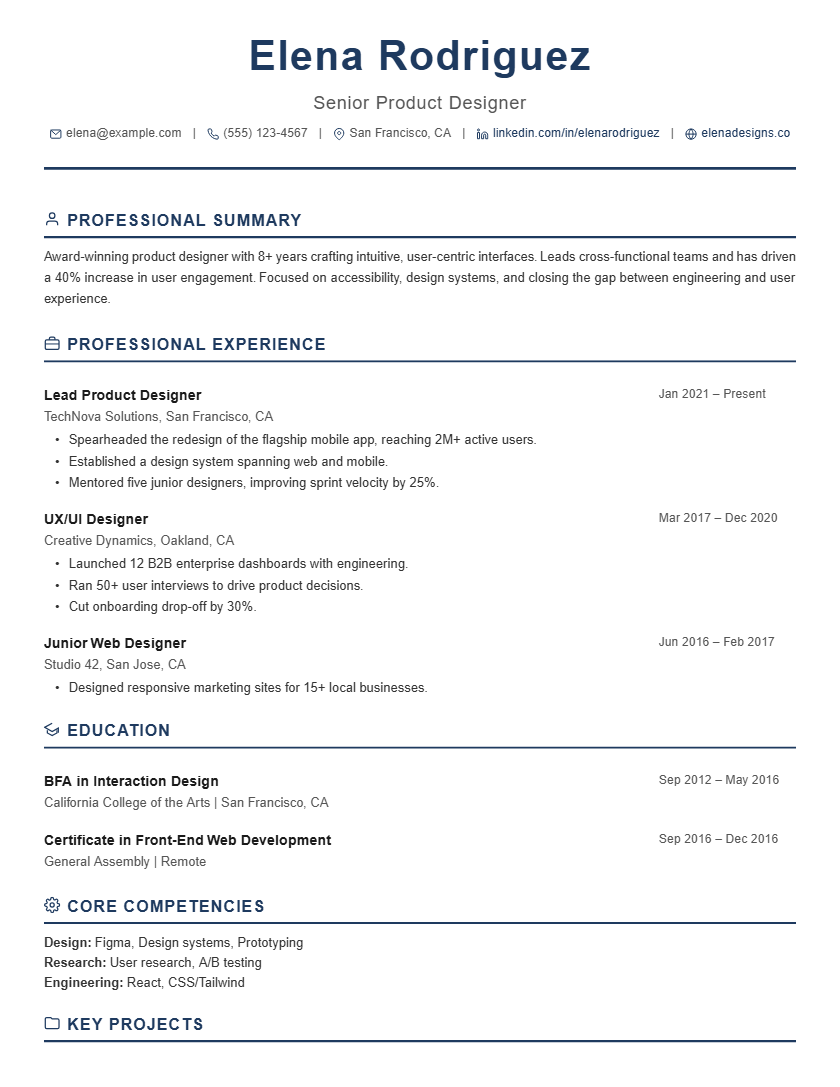
One column and one page, in the order summary, experience, education, skills and certifications. Put the tier or level and the main platforms in the headline, plus a clearance if you hold one. Size the environment with endpoints, users and log sources, then give results as false positives removed, fix times and containment times. Date certifications, since Security+ and CySA+ versions change. This example uses The Jake's template. Standard, Minimal Dark and Executive Classic hold the same content in one column.

Shown above: The Jake's

  • Standard template
    StandardFree
  • Minimal Dark template
    Minimal Dark
  • Executive Classic template
    Executive Classic

09Questions cybersecurity analysts ask

Is entry-level cybersecurity oversaturated?

The field is growing but crowded at the bottom. The BLS projects information security analyst jobs to grow 21 percent from 2025 to 2035, with about 14,100 openings a year, yet practitioners report scores of screened applicants for each junior SOC role. Candidates who get interviews show IT experience, a current certification and hands-on work such as a lab or detections they wrote.

Do I need help desk or IT experience first?

It helps a great deal. The BLS notes that many analysts come from IT departments, often as network and computer systems administrators, and lists less than five years of related experience as typical. Help desk, systems or network work gives you the context that alerts depend on. Count the security tasks you already did there, such as phishing reports or account resets.

Which certifications help most for a SOC analyst?

Security+ is the common starting point, and federal contract roles often require it. CareerOneStop lists 159 certifications from 37 organizations for information security analysts and flags Security+, CISSP, GCIH, GSEC and Microsoft's security operations analyst credential as in demand. CISSP needs five years of experience, so it comes later. Pair any certification with work that shows you can use it.

Will AI replace tier 1 SOC analysts?

It is changing the job more than removing it. Vendors now ship agents that triage phishing reports and some alerts, and security leaders surveyed by ISC2 expect fewer junior roles. Someone still has to validate the agents, handle what they escalate and catch what they miss. Show that work on the resume: cases reviewed, errors caught and the time the tooling saved.

Should I put a home lab or TryHackMe on my resume?

Yes, especially early on. Practitioners who hire say a lab shows what you do on your own time, and at least one detection provider lists platforms like TryHackMe and HackTheBox as preferred. Put it in a projects section with specifics: the tools, the detections you wrote, the attacks you simulated and what they caught. Drop it once real work can fill the space.

Free to start

Build your cybersecurity analyst resume

No card, no trial that turns into a charge.

Sign up free