Software architect resume examples & writing guide for 2026

Three software architect resumes, from first decision records to a principal running the practice, rendered in a real template and annotated line by line. Each one shows what an architecture hiring panel weighs: decisions, trade-offs, systems retired and business results.

By the Resumi editorial teamUpdated 8 min read

Showing the mid-level example

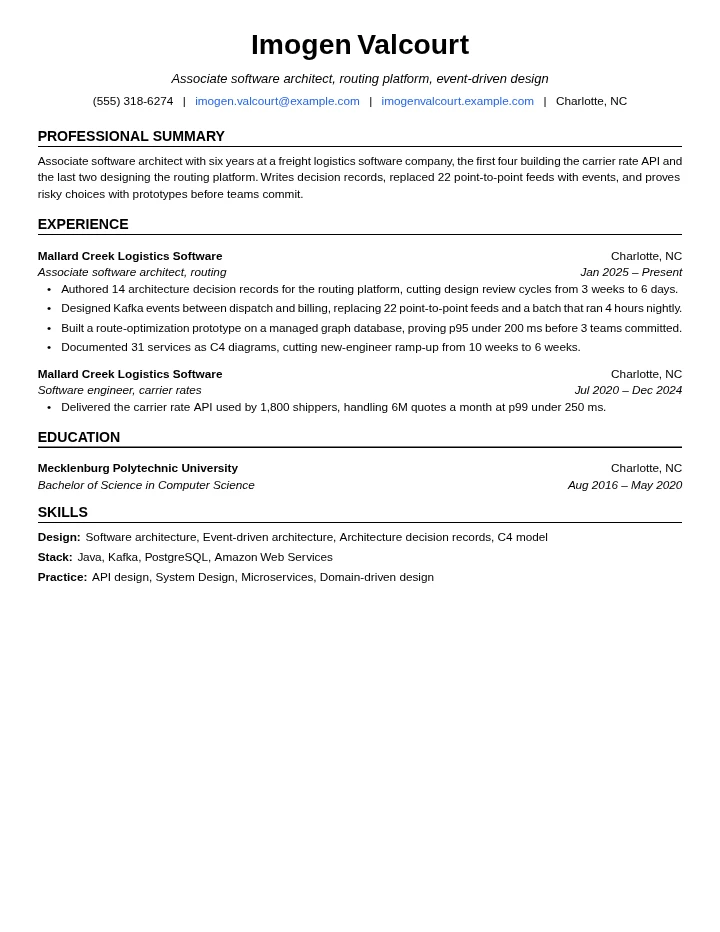
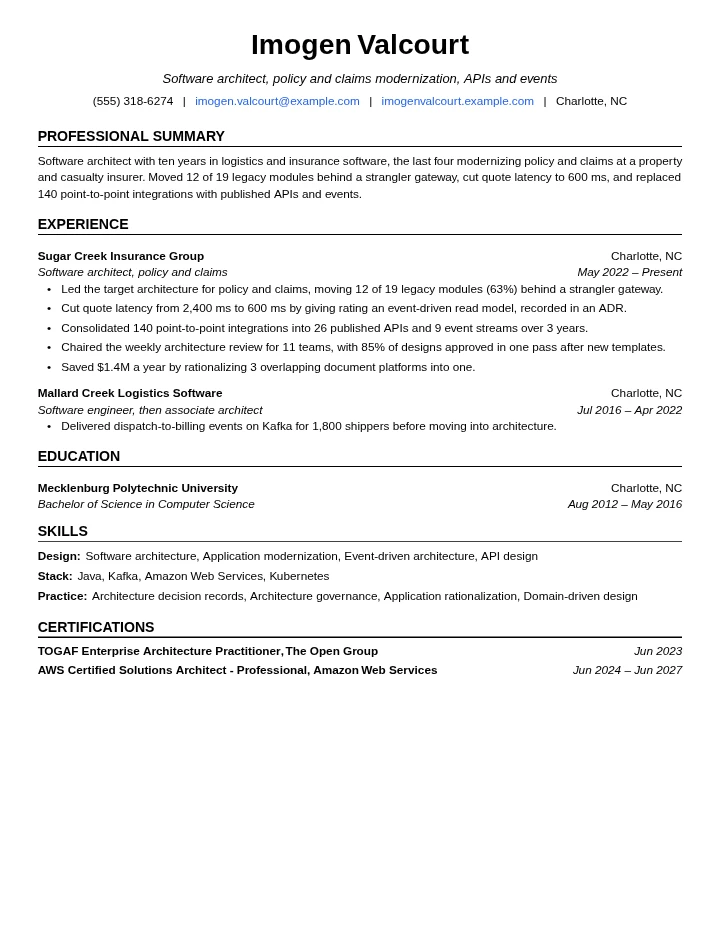
Software architect resume example, mid level, rendered in The Jake's template
Strength: Excellent

Written by the Resumi editorial team for a fictional candidate. Role facts come from O*NET and the U.S. Bureau of Labor Statistics.

Strength band is Resumi’s optimization score, not a ranking any employer sees.

What makes this resume work

Each marker on the page has a note here. Press a marker to jump to its note.

  1. 1

    Modernization in the headline

    Software architect, policy and claims modernization, APIs and events. Enterprise postings this year lead with application modernization, so the headline names the program and the patterns.

  2. 2

    Progress against a target state

    Twelve of 19 legacy modules moved behind a strangler gateway. Defining the target state is the architect's job, and a fraction of the way there shows the plan is real.

  3. 3

    Integrations counted down

    One hundred forty point-to-point integrations consolidated into 26 APIs and nine event streams. Developing system integration architectures is a listed task, and the count shows the scale.

  4. 4

    A trade-off with its result

    Quote latency from 2,400 to 600 milliseconds by giving rating its own read model, recorded in a decision record. It names the decision, the reason and the outcome in one line.

  5. 5

    Governance that sped teams up

    A weekly review for 11 teams, with 85% of designs approved in one pass. Review boards have a reputation for slowing teams, so the first-pass rate shows this one did not.

Build your software architect resume

Free to start · no card

01The example, in full

The resume shown above, as text you can search and copy.

Imogen Valcourt

Software architect, policy and claims modernization, APIs and events

Charlotte, NCimogen.valcourt@example.com(555) 318-6274imogenvalcourt.example.com

Summary

Software architect with ten years in logistics and insurance software, the last four modernizing policy and claims at a property and casualty insurer. Moved 12 of 19 legacy modules behind a strangler gateway, cut quote latency to 600 ms, and replaced 140 point-to-point integrations with published APIs and events.

Experience

Software architect, policy and claims

May 2022 – Present

Sugar Creek Insurance Group · Charlotte, NC

  • Led the target architecture for policy and claims, moving 12 of 19 legacy modules (63%) behind a strangler gateway.
  • Cut quote latency from 2,400 ms to 600 ms by giving rating an event-driven read model, recorded in an ADR.
  • Consolidated 140 point-to-point integrations into 26 published APIs and 9 event streams over 3 years.
  • Chaired the weekly architecture review for 11 teams, with 85% of designs approved in one pass after new templates.
  • Saved $1.4M a year by rationalizing 3 overlapping document platforms into one.

Software engineer, then associate architect

Jul 2016 – Apr 2022

Mallard Creek Logistics Software · Charlotte, NC

  • Delivered dispatch-to-billing events on Kafka for 1,800 shippers before moving into architecture.

Education

Bachelor of Science in Computer Science

Aug 2012 – May 2016

Mecklenburg Polytechnic University · Charlotte, NC

Skills

Design
Software architecture, Application modernization, Event-driven architecture, API design
Stack
Java, Kafka, Amazon Web Services, Kubernetes
Practice
Architecture decision records, Architecture governance, Application rationalization, Domain-driven design

Certifications

TOGAF Enterprise Architecture Practitioner

Jun 2023

The Open Group

AWS Certified Solutions Architect - Professional

Jun 2024

Amazon Web Services

02Market snapshot

Median pay
$116,580 median annual pay for computer occupations, all other, where BLS counts software architects
Typical education
Bachelor's degree is the typical entry education for the occupation group
Job outlook
5% growth for the occupation group from 2025 to 2035, about 24,200 more jobs
Common credentials
58 certifications listed, including The Open Group Architecture Framework

Sources: BLS OES (May 2025) · BLS OOH (2025) · CareerOneStop (2026)

03The same resume at three levels

The tinted row is the level shown above.

  • Entry-level

    0–2 years

    Two years in architecture after four in engineering: decision records with review time cut, an event-driven integration replacing point-to-point feeds, a prototype that proved a latency target before teams committed, and diagrams that shortened ramp-up. The engineering years keep one line with the API's volume and latency.

    Typical titles: Associate software architect, Associate solution architect, Application architect

  • Mid-level

    3–6 years

    The default view. Four years as an architect in the units a hiring panel weighs: modernization progress against a target state, a latency trade-off with its decision record, integrations consolidated, architecture review that teams pass first time, and platforms rationalized with dollars saved. The engineering years keep one line.

    Typical titles: Software architect, Solution architect, Application architect

  • Senior

    7+ years

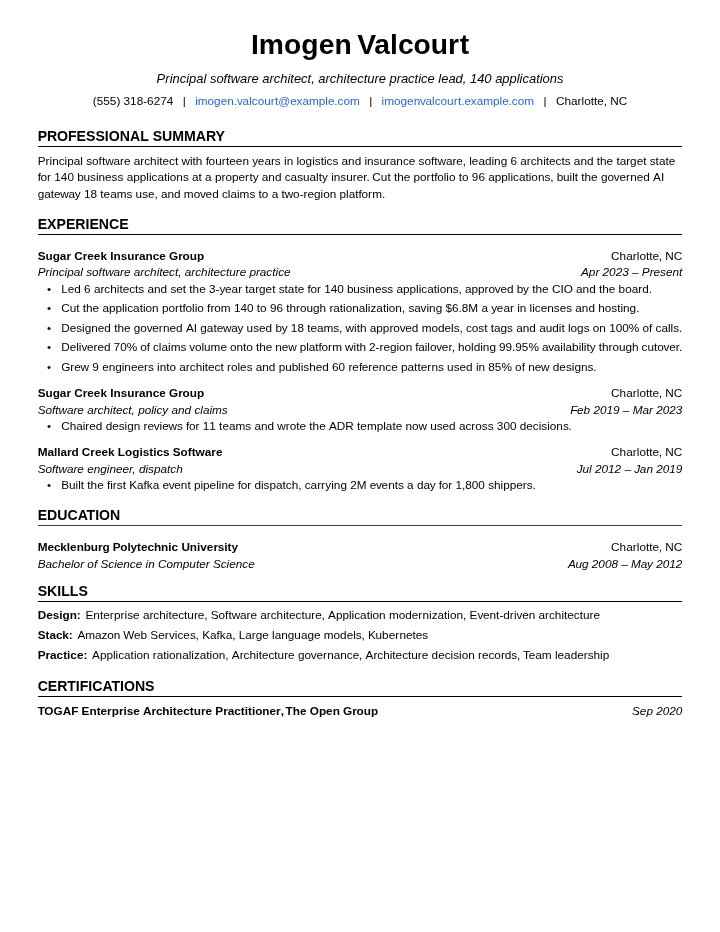
    Practice leadership replaces single programs: six architects and a board-approved target state, a portfolio cut with dollars saved, a governed AI gateway, claims moved onto a two-region platform, and engineers grown into architects with reusable patterns. The earlier architect and engineering years keep one line each.

    Typical titles: Principal software architect, Lead enterprise architect, Chief architect

04Summary

Weak

Visionary software architect with extensive experience designing scalable, robust enterprise solutions and a proven ability to align technology with business strategy.

Strong

Software architect with ten years in logistics and insurance software, the last four modernizing policy and claims at an insurer. Moved 12 of 19 legacy modules behind a strangler gateway and cut quote latency to 600 ms.

A hiring panel reads the domain, the program and the progress before anything else. The strong version gives all three, with a latency result tied to a design choice. The weak version uses the words every architect uses and proves none of them.

05Bullets

Weak

  • Designed scalable microservices architecture for a cloud-based application, improving performance and reducing costs across the platform.

Strong

  • Cut quote latency from 2,400 ms to 600 ms by giving rating an event-driven read model, recorded in an ADR.

Developing software and distributed system architectures is a listed task for the occupation, and a hiring panel wants to see one decision traced to its result. The strong bullet names the trade-off, the measured effect and the record that explains it. A panel can ask what the alternatives were, while the weak bullet names a style and nothing else.

06Skills and keywords

Architecture

  • Software architecture (in the example)
  • Event-driven architecture (in the example)
  • API design (in the example)
  • Domain-driven design (in the example)
  • Application modernization (in the example)
  • Enterprise architecture (in the example)
  • C4 model

Practice and governance

  • Architecture decision records (in the example)
  • Architecture governance (in the example)
  • Application rationalization (in the example)
  • System Design
  • TOGAF Enterprise Architecture Practitioner (in the example)
  • AWS Certified Solutions Architect - Professional (in the example)

Platforms

  • Amazon Web Services (in the example)
  • Kafka (in the example)
  • Kubernetes (in the example)
  • Java (in the example)
  • Microservices
  • Large language models

Filled chips appear in the example above.

Paste a job description and Resumi shows which of these your resume already covers.

Build your software architect resume

07Mistakes to avoid

  1. Architecture styles with no decision

    Fix: Sample resumes say a microservices architecture improved deployment efficiency, without naming the choice or what it replaced. Name one decision per bullet: the option you chose, the alternative you rejected, and the measured result, as the mid example does with its read model.

  2. No record of how decisions were made

    Fix: Architects who write decision records leave a trail a hiring panel can ask about. Count the records you wrote, say where they live and how they changed review time. A practitioner's original format asks for context, decision, status and consequences, so your bullet can too.

  3. Diagrams instead of outcomes

    Fix: Postings ask architects for target states, roadmaps and reduced technical debt. Say how far the roadmap got, such as modules moved, integrations retired or applications cut, rather than listing the diagrams and documents you produced along the way.

  4. Only the engine room, or only the penthouse

    Fix: A widely read architecture essay describes the job as riding between executives and engineers. A resume of only strategy reads as detached, and one of only code reads as a senior developer. Pair a board-level result with a hands-on prototype or a design you reviewed.

  5. A framework certificate as the headline

    Fix: The Open Group says its architecture certification is widely requested in postings, and some insurers and banks do ask for it. It still cannot stand in for decisions you made. List it once with its year, below experience, as the mid and senior examples do.

08Format and template

One column and one page, in the order summary, experience, education, skills, certifications. Put the domain and the main integration style in the headline, and keep latencies, integrations retired, applications cut and dollars saved as text in the bullets. Link to a public talk or decision record only if it is yours and shareable, and keep older roles to one line.

Shown above: The Jake's

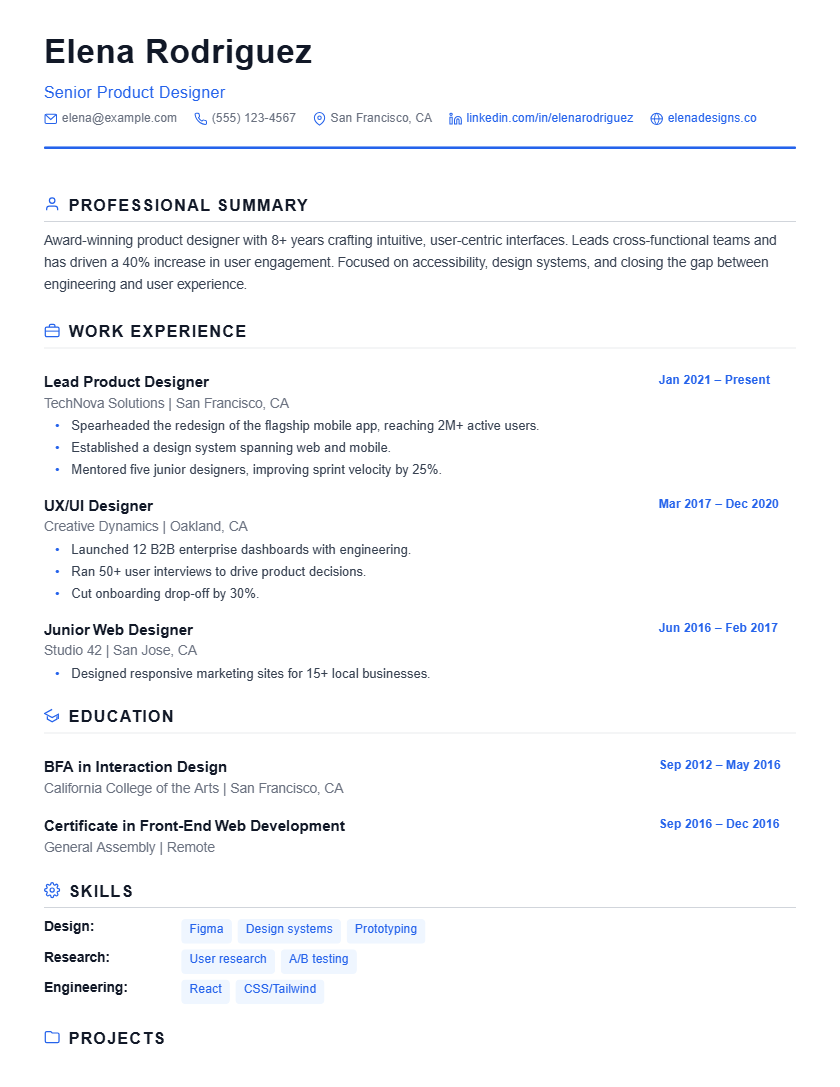
  • Standard template
    StandardFree
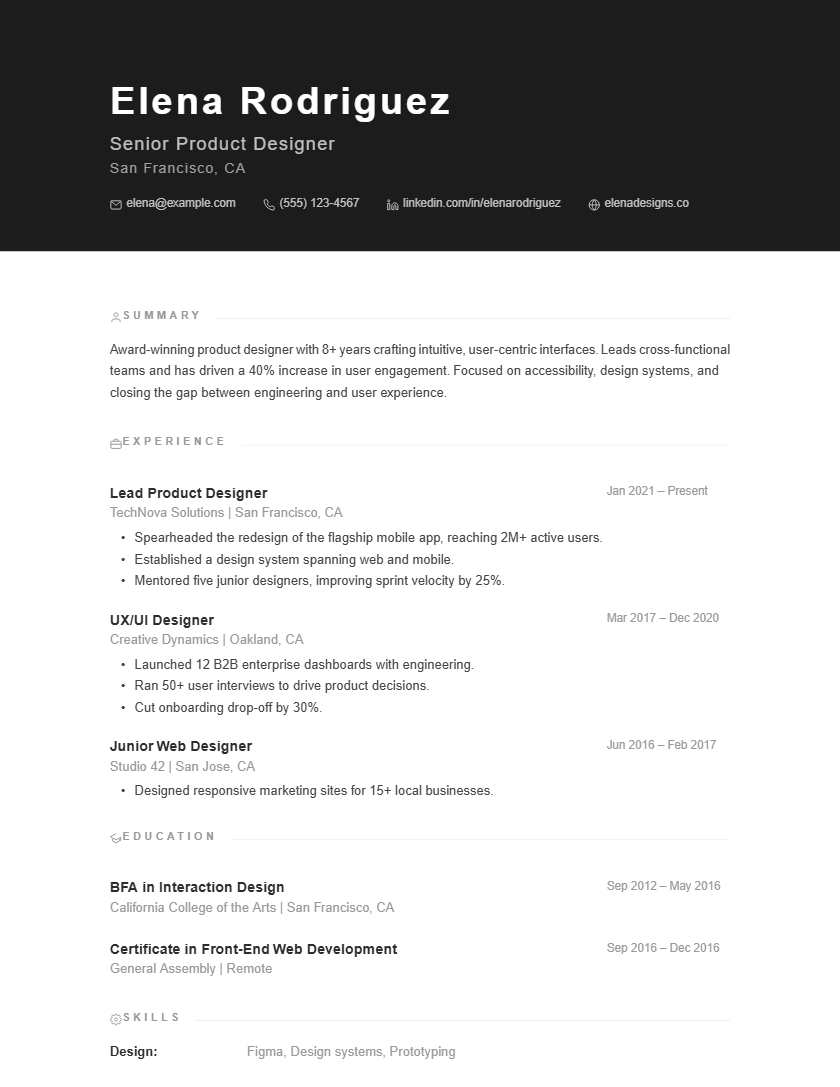
  • Minimal Dark template
    Minimal Dark
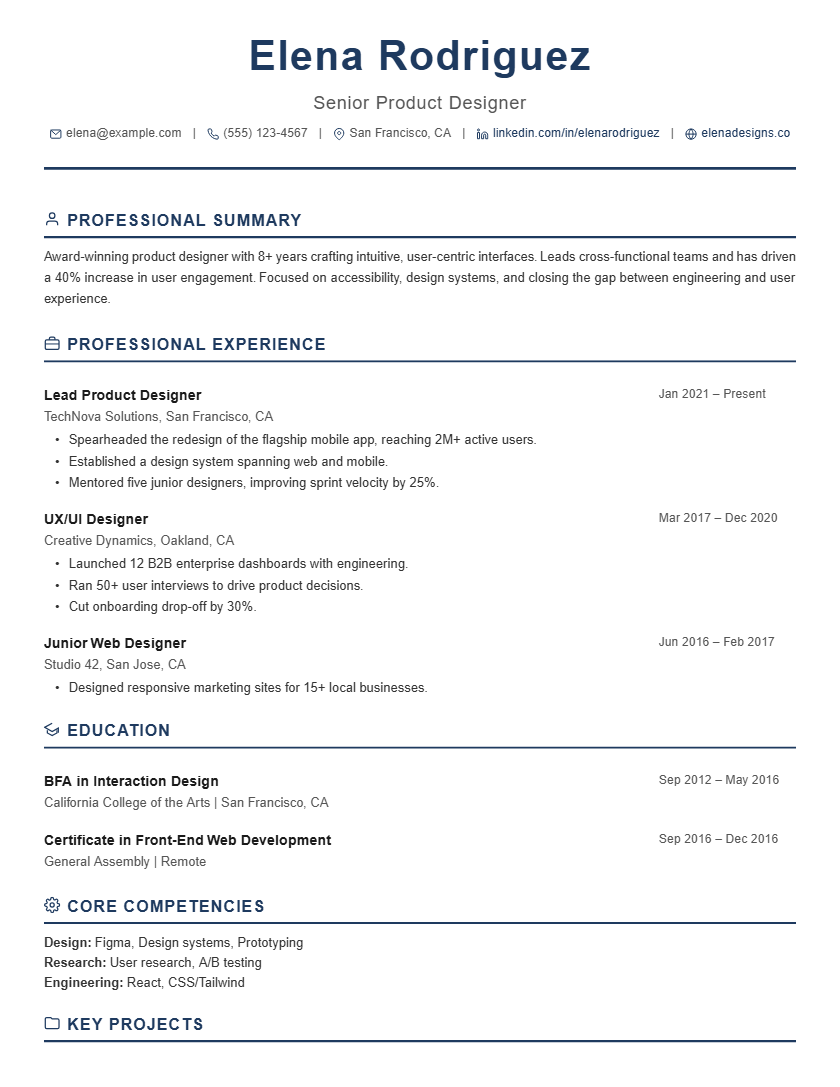
  • Executive Classic template
    Executive Classic

09Questions software architects ask

How many years of experience does a software architect need?

Usually several years of engineering first. The handbook lists a bachelor's degree with no prior experience for the wider occupation group, but architecture postings this year ask for years of hands-on engineering before the architect title. O*NET's sample titles include IT architect, solutions architect and systems architect, and most people reach them from senior developer roles, as the entry example does.

Should a software architect resume still show code?

Yes, in proportion. Postings ask architects for hands-on prototypes and proofs of concept as well as roadmaps, and O*NET's tasks include designing and conducting software tests and collaborating with developers on design choices. Keep one bullet per role that shows you built or proved something, such as a prototype that confirmed a latency target before teams committed to it.

How much do software architects make?

BLS counts software architects in computer occupations, all other, whose May 2025 median was $116,580, or $56.05 an hour in O*NET's figures. The group's largest employers are professional, scientific and technical services, with 26.0 percent of jobs, and the federal government, with 19.9 percent. Architect roles at insurers and banks usually pay well above the group median.

Is TOGAF worth getting for a software architect?

It depends on the employer. CareerOneStop lists 58 certifications for the occupation, including The Open Group Architecture Framework, and enterprise architecture teams at insurers, banks and government agencies often mention it. Product companies rarely do. If your target postings name it, earn it and list it with its year, below your experience. Either way, your decisions and their results carry the resume.

What is the difference between a software architect and an enterprise architect on a resume?

Scope. A software or solution architect's bullets cover one domain: its decisions, integrations, latency and modernization. An enterprise architect's cover the portfolio: applications rationalized, standards set, target states approved by executives and spend cut. Establishing system standards and advising on project costs are both listed tasks for the occupation, and the senior example shows the shift from one to the other.

Free to start

Build your software architect resume

No card, no trial that turns into a charge.

Sign up free