Java developer resume examples & writing guide for 2026

Three Java developer resumes, from first Spring Boot endpoints to a lead engineer running a 42-service platform, rendered in a real template and annotated line by line. Each one counts what a Java hiring manager checks: versions, frameworks, batch windows, latency and upgrades.

By the Resumi editorial teamUpdated 8 min read

Showing the mid-level example

Java developer resume example, mid level, rendered in The Jake's template
Strength: Excellent

Written by the Resumi editorial team for a fictional candidate. Role facts come from O*NET and the U.S. Bureau of Labor Statistics.

Strength band is Resumi’s optimization score, not a ranking any employer sees.

What makes this resume work

Each marker on the page has a note here. Press a marker to jump to its note.

  1. 1

    Platform and frameworks named

    Java developer, recordkeeping platform, Spring Batch and Kafka. Financial services postings ask for domain experience as well as Java, so the headline names both the platform and its stack.

  2. 2

    A batch window shortened

    The nightly contribution batch from five hours to 70 minutes for 1.2M accounts. In recordkeeping, the batch window is the deadline everything else waits on.

  3. 3

    JVM tuning with a percentile

    Trade-posting p99 from 900 to 240 milliseconds at market close by tuning garbage collection. Improving performance is a core task, and naming the collector shows real JVM knowledge.

  4. 4

    Modernization with a price tag

    Fourteen services moved off WebLogic and Java 8 onto Spring Boot 3, retiring $310,000 a year in licenses. Moving off old versions is the leading Java trend, and dollars justify it.

  5. 5

    Files replaced by events

    Contribution events on Kafka to six systems, ending 1,200 manual file checks a year. Regulated finance runs on files and checks, and removing them is a measurable win.

Build your Java developer resume

Free to start · no card

01The example, in full

The resume shown above, as text you can search and copy.

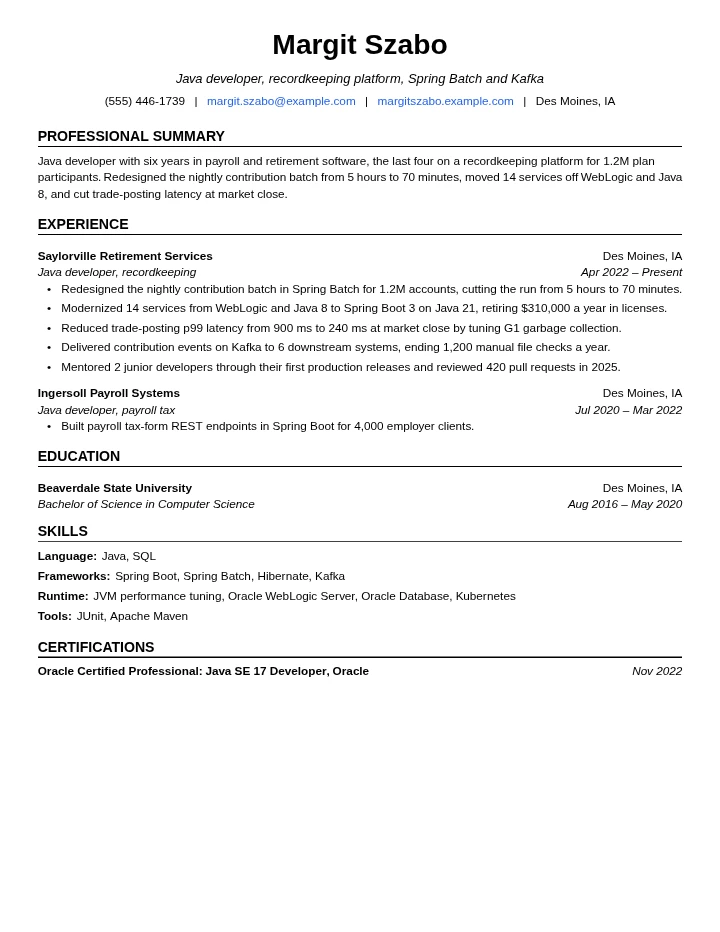
Margit Szabo

Java developer, recordkeeping platform, Spring Batch and Kafka

Des Moines, IAmargit.szabo@example.com(555) 446-1739margitszabo.example.com

Summary

Java developer with six years in payroll and retirement software, the last four on a recordkeeping platform for 1.2M plan participants. Redesigned the nightly contribution batch from 5 hours to 70 minutes, moved 14 services off WebLogic and Java 8, and cut trade-posting latency at market close.

Experience

Java developer, recordkeeping

Apr 2022 – Present

Saylorville Retirement Services · Des Moines, IA

  • Redesigned the nightly contribution batch in Spring Batch for 1.2M accounts, cutting the run from 5 hours to 70 minutes.
  • Modernized 14 services from WebLogic and Java 8 to Spring Boot 3 on Java 21, retiring $310,000 a year in licenses.
  • Reduced trade-posting p99 latency from 900 ms to 240 ms at market close by tuning G1 garbage collection.
  • Delivered contribution events on Kafka to 6 downstream systems, ending 1,200 manual file checks a year.
  • Mentored 2 junior developers through their first production releases and reviewed 420 pull requests in 2025.

Java developer, payroll tax

Jul 2020 – Mar 2022

Ingersoll Payroll Systems · Des Moines, IA

  • Built payroll tax-form REST endpoints in Spring Boot for 4,000 employer clients.

Education

Bachelor of Science in Computer Science

Aug 2016 – May 2020

Beaverdale State University · Des Moines, IA

Skills

Language
Java, SQL
Frameworks
Spring Boot, Spring Batch, Hibernate, Kafka
Runtime
JVM performance tuning, Oracle WebLogic Server, Oracle Database, Kubernetes
Tools
JUnit, Apache Maven

Certifications

Oracle Certified Professional: Java SE 17 Developer

Nov 2022

Oracle

02Market snapshot

Median pay
$135,980 median annual pay for software developers, the occupation BLS uses for Java developers
Typical education
Usually a bachelor's degree in computer and information technology or a related field
Job outlook
Software developers: +10% from 2025 to 2035, adding about 174,700 jobs
Common credentials
Java appears in 25% of 2025 software developer postings, Spring Boot in 5%

Sources: BLS OES (May 2025) · BLS OOH (2025) · O*NET (31.0)

03The same resume at three levels

The tinted row is the level shown above.

  • Entry-level

    0–2 years

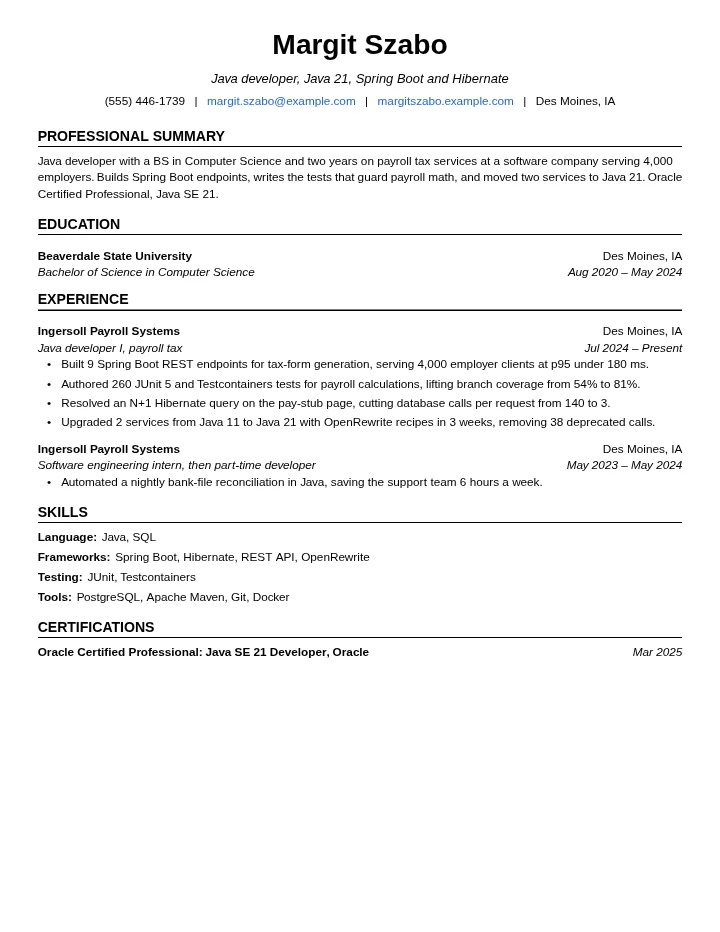
    The degree leads, then two years in four counted bullets: Spring Boot endpoints with their latency, tests on payroll math with coverage, an N+1 query traced and removed, and a version upgrade done with recipes. The internship and part-time year keep one line, and a current Java certification sits at the foot.

    Typical titles: Java developer I, Junior Java developer, Software engineer, Java

  • Mid-level

    3–6 years

    The default view. Six years of Java in the units a lead weighs: a batch window cut, a WebLogic and Java 8 migration with license savings, garbage collection tuned at market close, file transfers replaced with events, and mentoring with review volume. The payroll role keeps one line, and an older Java certification sits beneath.

    Typical titles: Java developer, Java software engineer, Senior Java developer

  • Senior

    7+ years

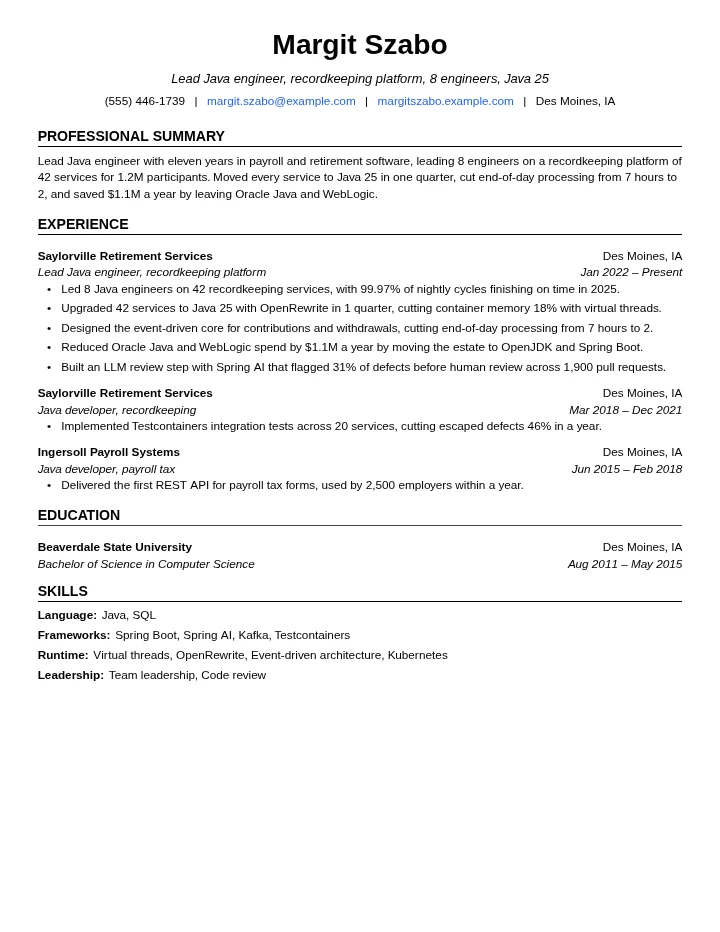
    Platform leadership replaces individual services: eight engineers and 42 services with nightly cycles on time, every service on Java 25, end-of-day processing redesigned, licensing moved to OpenJDK, and AI review measured on real pull requests. The developer and payroll years keep one line each.

    Typical titles: Lead Java engineer, Principal Java developer, Java tech lead

04Summary

Weak

Highly skilled Java developer with extensive experience in Java 8+, Spring, Hibernate and microservices, passionate about writing clean, efficient and scalable code.

Strong

Java developer with six years in payroll and retirement software, the last four on a recordkeeping platform for 1.2M plan participants. Redesigned the nightly contribution batch from 5 hours to 70 minutes and moved 14 services off WebLogic.

A Java hiring manager reads the domain, the platform's scale and what changed before anything else. The strong version gives a batch window and a migration they can ask about. The weak version lists a version range and adjectives anyone could claim.

05Bullets

Weak

  • Developed and maintained Java applications using Spring and Hibernate, improving performance and code quality across several services.

Strong

  • Reduced trade-posting p99 latency from 900 ms to 240 ms at market close by tuning G1 garbage collection.

Modifying existing software to improve performance is a core task for software developers, and on the JVM performance work usually means memory and garbage collection. The strong bullet names the service, the percentile before and after, the moment it mattered and the collector that was tuned. A reviewer can ask how, while the weak bullet gives nothing to ask about.

06Skills and keywords

Language and frameworks

  • Java (in the example)
  • Spring Boot (in the example)
  • Spring Batch (in the example)
  • Hibernate (in the example)
  • Jakarta EE
  • Kafka (in the example)
  • Spring AI

Runtime and modernization

  • JVM performance tuning (in the example)
  • Virtual threads
  • OpenRewrite
  • Oracle WebLogic Server (in the example)
  • Kubernetes (in the example)
  • Oracle Database (in the example)

Testing, build and certification

  • JUnit (in the example)
  • Testcontainers
  • Mockito
  • Apache Maven (in the example)
  • Gradle
  • Oracle Certified Professional: Java SE 17 Developer (in the example)

Filled chips appear in the example above.

Paste a job description and Resumi shows which of these your resume already covers.

Build your Java developer resume

07Mistakes to avoid

  1. Java 8+ instead of a version

    Fix: Sample resumes still list Java 8+ as a skill. Java 17 is now the baseline that major frameworks require, and Java 21 and 25 are the current long-term releases. Name the versions you ran in production and any upgrade you led, with how long it took.

  2. Spring and Hibernate as a list

    Fix: Every Java resume names Spring and Hibernate. Show one thing you did with each: an endpoint and its latency, a batch job and its window, an ORM query you fixed and the calls it saved. The framework only proves anything when it is attached to a result.

  3. No batch window or deadline

    Fix: Financial services postings this year describe intraday and end-of-day processing, and Java runs much of it. If your systems have a nightly or market-close deadline, say how long the run took before and after your change, and how often it finished on time.

  4. Performance gains without a percentile

    Fix: Sample resumes say performance improved by some percentage. Give the percentile before and after, the load it was measured under, and what you changed, such as a query, a cache or the garbage collector. Averages hide the slow requests a reviewer cares about.

  5. Modernization left off

    Fix: Upgrading old Java versions and leaving legacy app servers is the trend Java Champions and consultancies report this year. If you moved services off Java 8, WebLogic or Java EE, count them, name the tooling, and give the cost or support risk removed.

08Format and template

One column and one page, in the order summary, experience, education, skills, certifications. Put the Java version and your main frameworks in the headline, and keep latency percentiles, batch windows, upgrade counts and license savings as text in the bullets. List a Java certification with its version number, and drop older roles to one line before the page runs over.

Shown above: The Jake's

  • Standard template
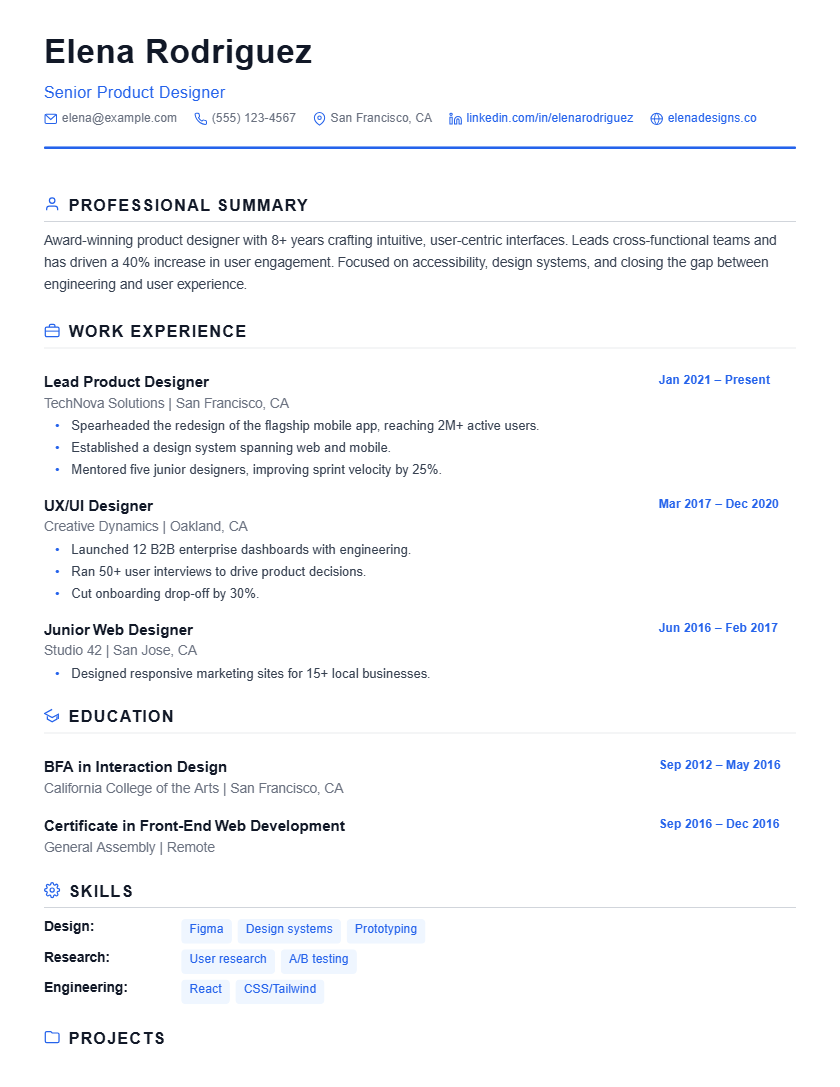
    StandardFree
  • Minimal Dark template
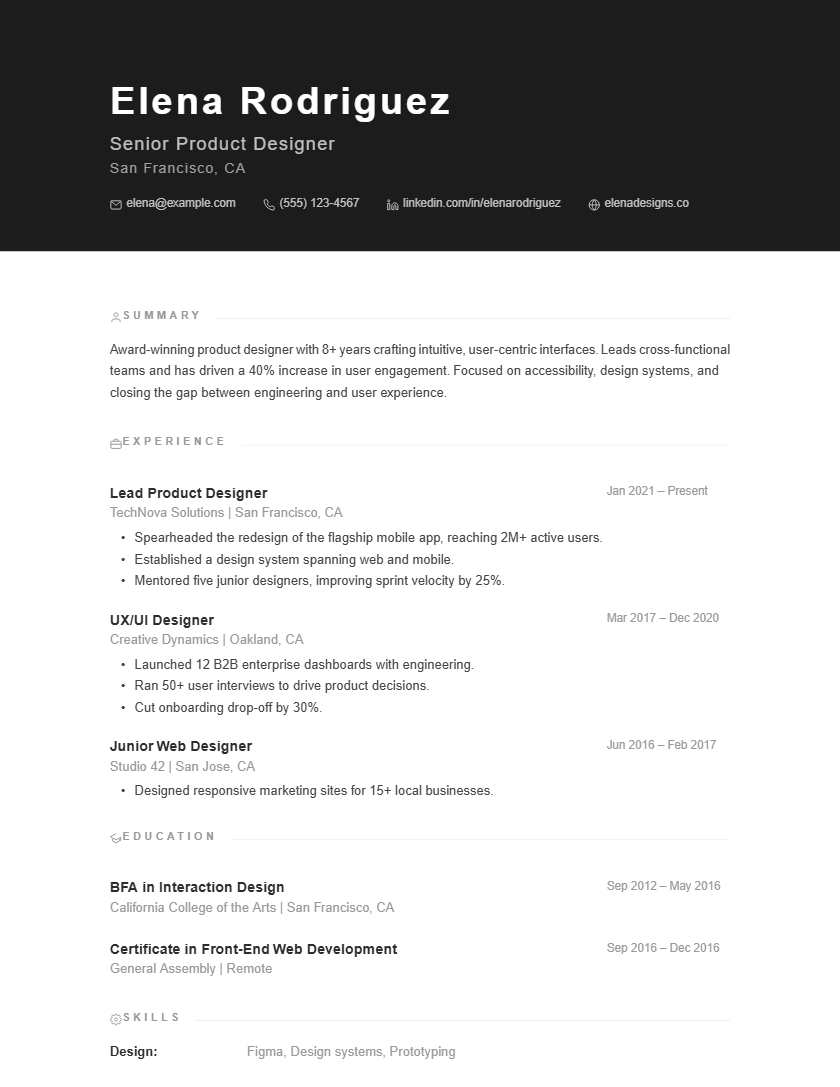
    Minimal Dark
  • Executive Classic template
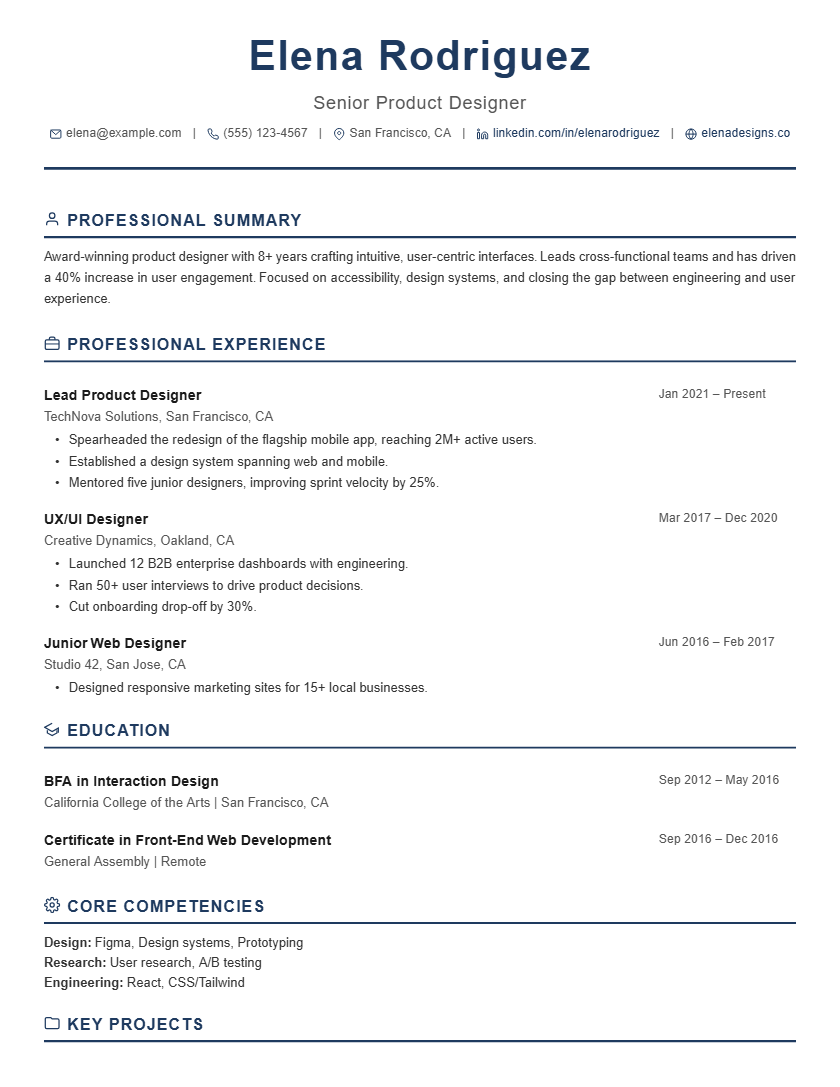
    Executive Classic

09Questions Java developers ask

Which Java version should I put on my resume?

The versions you have run in production, by number. Java 21 and Java 25 are the current long-term support releases, and Java 17 is the minimum major frameworks now require. If you have only worked on Java 8 or 11, say so plainly, and add any upgrade you have done or practiced, as the entry example does with its move from Java 11 to 21.

Is Java still in demand?

Yes, especially in finance and large enterprises. In O*NET's count of 2025 postings for software developers, Java appears in 25 percent, behind only Python at 29 percent, with SQL at 24 percent and Spring Boot at 5 percent. Finance and insurance employs 11 percent of software developers, and the bank and asset manager postings read for this page lean heavily on Java.

How much do Java developers make?

The handbook counts Java developers with software developers, whose May 2025 median was $135,980, with the lowest tenth under $82,460 and the highest tenth over $214,670. Industry moves it: software publishers paid a median $164,550, finance and insurance $135,460 and computer systems design $132,050. Java roles in trading and payments usually sit toward the top of that range.

Is an Oracle Java certification worth it?

For an early-career developer it can help, because the professional exam is hard and tests current language features. CareerOneStop's list of 75 certifications for software developers does not include Oracle's Java credentials, though it does list Pearson's IT Specialist in Java. Employers rarely require one. If you hold one, list the exact name and version, as the entry and mid examples do.

Should a Java developer learn Kotlin or Scala?

It helps if your target employers use them. Some capital markets teams write most of their code in Scala and still hire strong Java developers willing to learn it, and Kotlin is common on newer JVM services. In O*NET's 2025 posting counts, Scala appears in 1 percent of software developer postings. Lead with Java and list a second JVM language only where you shipped with it.

Free to start

Build your Java developer resume

No card, no trial that turns into a charge.

Sign up free