Fashion designer resume examples & writing guide for 2026

Three fashion designer resumes following one designer from assistant on a knit team to leading a womenswear brand's knit and activewear lines, rendered in a real template and annotated line by line. Each counts seasons, styles, sell-through, samples and costing.

By the Resumi editorial teamUpdated 9 min read

Showing the mid-level example

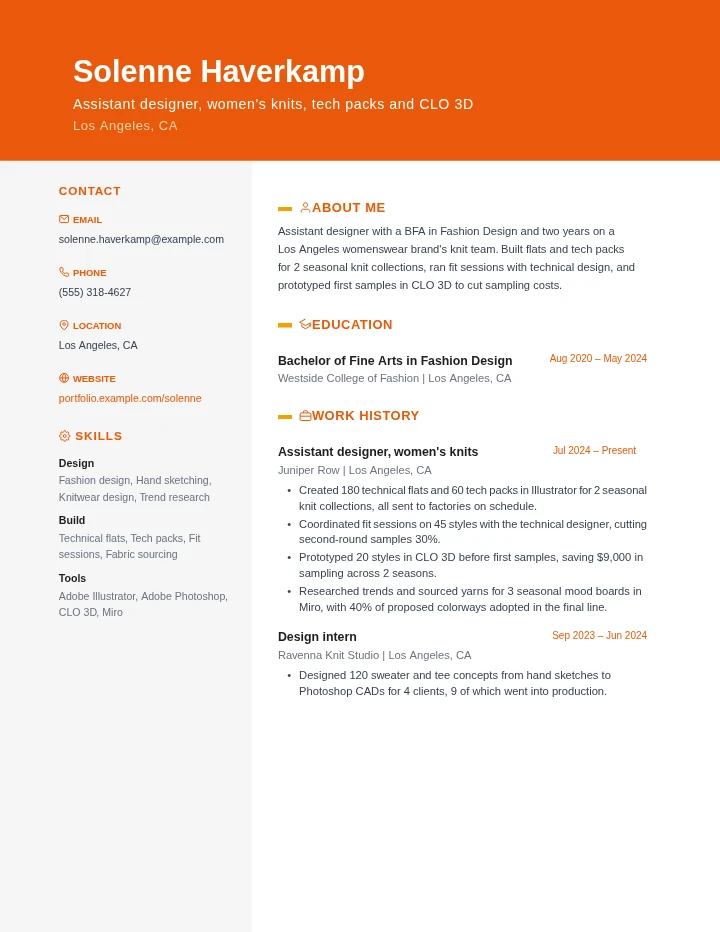
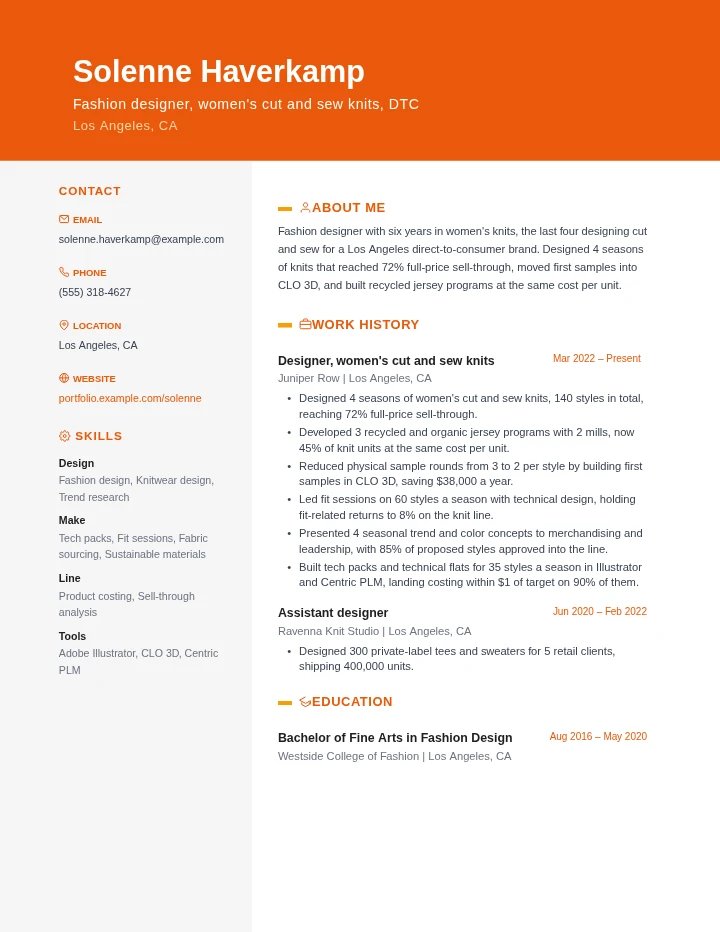
Fashion designer resume example, mid level, rendered in the Orange Creative template
Strength: Excellent

Written by the Resumi editorial team for a fictional candidate. Role facts come from O*NET and the U.S. Bureau of Labor Statistics.

Strength band is Resumi’s optimization score, not a ranking any employer sees.

What makes this resume work

Each marker on the page has a note here. Press a marker to jump to its note.

  1. 1

    Category and channel up top

    Fashion designer, women's cut and sew knits, DTC. Category and channel tell a brand whether this designer has sold to its customer before, which decides most first screens.

  2. 2

    Seasons sold at full price

    Four seasons and 140 styles at 72% full-price sell-through. Sell-through is the measure a merchant and a design director share, so it opens the role instead of a style count alone.

  3. 3

    Recycled jersey at equal cost

    Three recycled and organic jersey programs with two mills, now 45% of knit units at the same cost. BLS ties demand to interest in sustainable materials, and equal cost shows the change paid.

  4. 4

    One sample round removed

    Sample rounds cut from three to two per style by building first samples in CLO 3D, saving $38,000 a year. Selecting materials and production techniques is a core task, and this one has a price.

  5. 5

    Fit returns held down

    Fit sessions on 60 styles a season, fit-related returns held to 8% on the knit line. For a direct-to-consumer brand, returns are the cost of poor fit, so this ties fittings to money.

  6. 6

    Costing landed near target

    Tech packs and flats for 35 styles a season in Illustrator and Centric PLM, with costing within $1 of target on 90% of them. Pricing styles is a listed task that designers rarely show.

Build your fashion designer resume

Free to start · no card

01The example, in full

The resume shown above, as text you can search and copy.

Solenne Haverkamp

Fashion designer, women's cut and sew knits, DTC

Los Angeles, CAsolenne.haverkamp@example.com(555) 318-4627portfolio.example.com/solenne

Summary

Fashion designer with six years in women's knits, the last four designing cut and sew for a Los Angeles direct-to-consumer brand. Designed 4 seasons of knits that reached 72% full-price sell-through, moved first samples into CLO 3D, and built recycled jersey programs at the same cost per unit.

Experience

Designer, women's cut and sew knits

Mar 2022 – Present

Juniper Row · Los Angeles, CA

  • Designed 4 seasons of women's cut and sew knits, 140 styles in total, reaching 72% full-price sell-through.
  • Developed 3 recycled and organic jersey programs with 2 mills, now 45% of knit units at the same cost per unit.
  • Reduced physical sample rounds from 3 to 2 per style by building first samples in CLO 3D, saving $38,000 a year.
  • Led fit sessions on 60 styles a season with technical design, holding fit-related returns to 8% on the knit line.
  • Presented 4 seasonal trend and color concepts to merchandising and leadership, with 85% of proposed styles approved into the line.
  • Built tech packs and technical flats for 35 styles a season in Illustrator and Centric PLM, landing costing within $1 of target on 90% of them.

Assistant designer

Jun 2020 – Feb 2022

Ravenna Knit Studio · Los Angeles, CA

  • Designed 300 private-label tees and sweaters for 5 retail clients, shipping 400,000 units.

Education

Bachelor of Fine Arts in Fashion Design

Aug 2016 – May 2020

Westside College of Fashion · Los Angeles, CA

Skills

Design
Fashion design, Knitwear design, Trend research
Make
Tech packs, Fit sessions, Fabric sourcing, Sustainable materials
Line
Product costing, Sell-through analysis
Tools
Adobe Illustrator, CLO 3D, Centric PLM

02Market snapshot

Median pay
$80,960 median annual pay for fashion designers
Typical education
Bachelor's degree in fine arts or a business field such as fashion design or merchandising, plus a portfolio
Job outlook
Little or no change for fashion designers, 2025–35, with about 2,500 openings a year
Common credentials
No license, and 1 certification listed, the Master Sewing and Design Professional

Sources: BLS OES (May 2025) · BLS OOH (2025) · CareerOneStop (2026)

03The same resume at three levels

The tinted row is the level shown above.

  • Entry-level

    0–2 years

    The degree leads, then two years as an assistant designer in four counted bullets: flats and tech packs sent on schedule, fit sessions that cut second samples, 3D prototypes that saved sampling money, and mood boards whose colorways made the line. The internship keeps one line.

    Typical titles: Assistant designer, Associate designer, Junior designer

  • Mid-level

    3–6 years

    The default view. Six years told in the measures a design director and a merchant share: seasons and styles with full-price sell-through, recycled jersey at the same cost, sample rounds removed with 3D, fit returns held down, concepts approved and costing on target. The studio role keeps one line.

    Typical titles: Designer, Fashion designer, Apparel designer

  • Senior

    7+ years

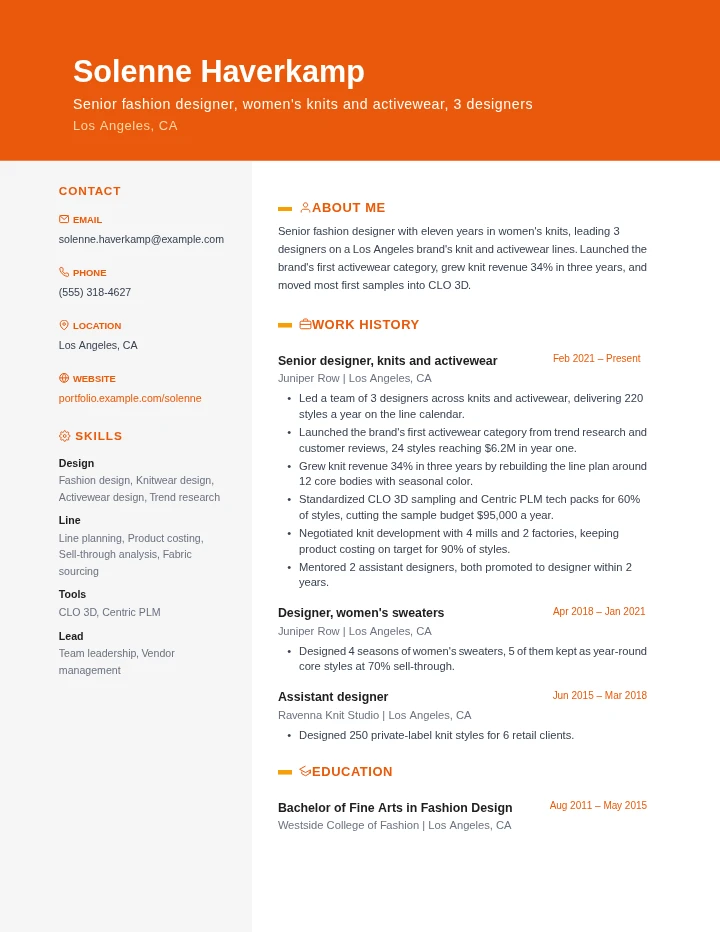
    Leading the line replaces designing every style: three designers and a yearly style count, a new activewear category with its first-year sales, knit revenue grown through the line plan, 3D sampling made standard, costing held with mills, and designers promoted. Earlier roles keep one line each.

    Typical titles: Senior designer, Design manager, Associate design director

04Summary

Weak

Creative and passionate fashion designer with a keen eye for detail and a love of color, texture and timeless style.

Strong

Fashion designer with six years in women's knits, the last four designing cut and sew for a Los Angeles direct-to-consumer brand. Designed 4 seasons of knits that reached 72% full-price sell-through.

A design director reads for the category, the seasons and how the line sold before opening the portfolio. The strong version names women's knits, the kind of brand, the season count and full-price sell-through. The weak version claims taste, which only the portfolio can prove.

05Bullets

Weak

  • Worked closely with the technical design team on fittings and samples to make sure garments fit well.

Strong

  • Reduced physical sample rounds from 3 to 2 per style by building first samples in CLO 3D, saving $38,000 a year.

Examining sample garments on and off models and modifying designs is one of the occupation's highest-rated tasks, and apparel postings this year ask for 3D software. The strong bullet names the tool, the sample round removed and the saving. The weak bullet describes attending fittings, which every apparel designer does each week and no reviewer can compare.

06Skills and keywords

Design

  • Fashion design (in the example)
  • Knitwear design (in the example)
  • Trend research (in the example)
  • Hand sketching
  • Technical flats (in the example)
  • Activewear design

Development

  • Tech packs (in the example)
  • Fit sessions (in the example)
  • Fabric sourcing (in the example)
  • Sustainable materials (in the example)
  • Pattern making
  • Draping

Line and business

  • Product costing (in the example)
  • Sell-through analysis (in the example)
  • Line planning

Tools

  • Adobe Illustrator (in the example)
  • CLO 3D (in the example)
  • Centric PLM (in the example)
  • Browzwear
  • Adobe Photoshop

Filled chips appear in the example above.

Paste a job description and Resumi shows which of these your resume already covers.

Build your fashion designer resume

07Mistakes to avoid

  1. Sales growth with no line named

    Fix: Competitor samples claim sales growth every season without naming the category, the channel or how it was measured. Name the line, the number of seasons and the measure a merchant reads, such as full-price sell-through or units shipped.

  2. Portfolio link left off the resume

    Fix: An apparel posting read for this page requires a portfolio and asks for its link on the resume itself, and recruiters list it with the contact details. Put it in the contact block, where a reviewer looks first, not only in the cover letter.

  3. School garments and no CADs

    Fix: A corporate fashion recruiter says CADs are what hiring managers most want to see, and that candidates send portfolios of handmade and school work instead. Count the flats and tech packs you built, and match the portfolio to the brand.

  4. Software shown as icons

    Fix: A fashion recruitment agency's advice this year is that a CV needs no design icons, software images or graphs. Write each tool as text in the sidebar and again in the bullet where you used it, so people and screening software can both read it.

  5. Fittings with no result

    Fix: Postings describe reviewing samples, attending fittings and working with technical and production teams. Every designer does that, so give the result: sample rounds removed, fit-related returns held down or costing kept on target.

08Format and template

One page with the portfolio link in the header, where fashion recruiters look for it. Lead each role with the category, the seasons and the measure a merchant reads, such as sell-through, then give fit, sampling and costing results. Write software as text in the sidebar rather than as icons or rating bars, so screening software and recruiters can both read it. This example uses Orange Creative. The same content works in Standard, Pink Accent and Red & Gray Modern.

Shown above: Orange Creative

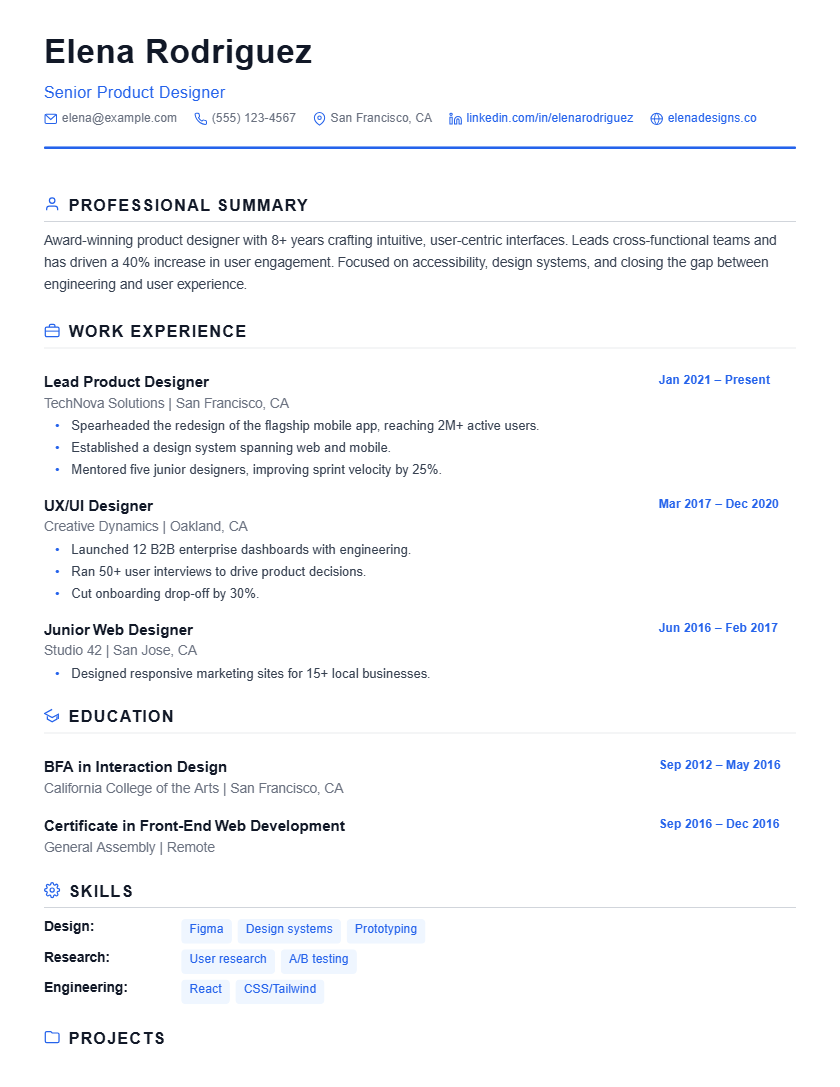
  • Standard template
    StandardFree
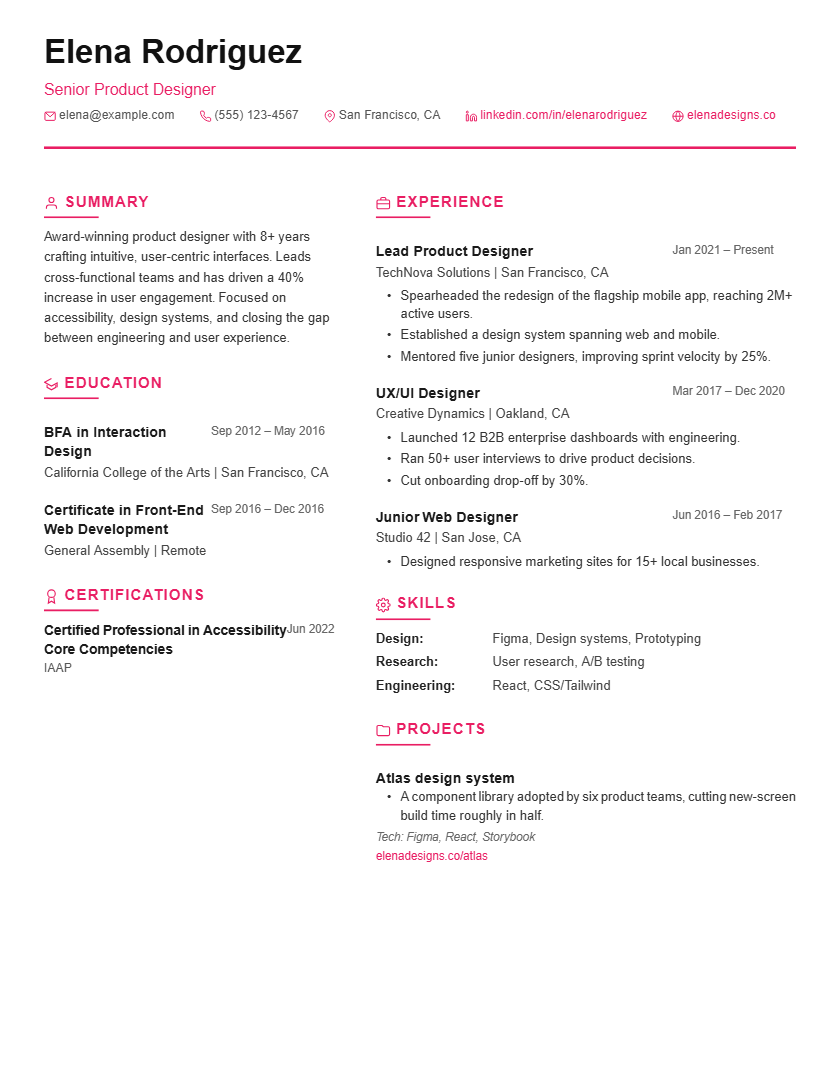
  • Pink Accent template
    Pink Accent
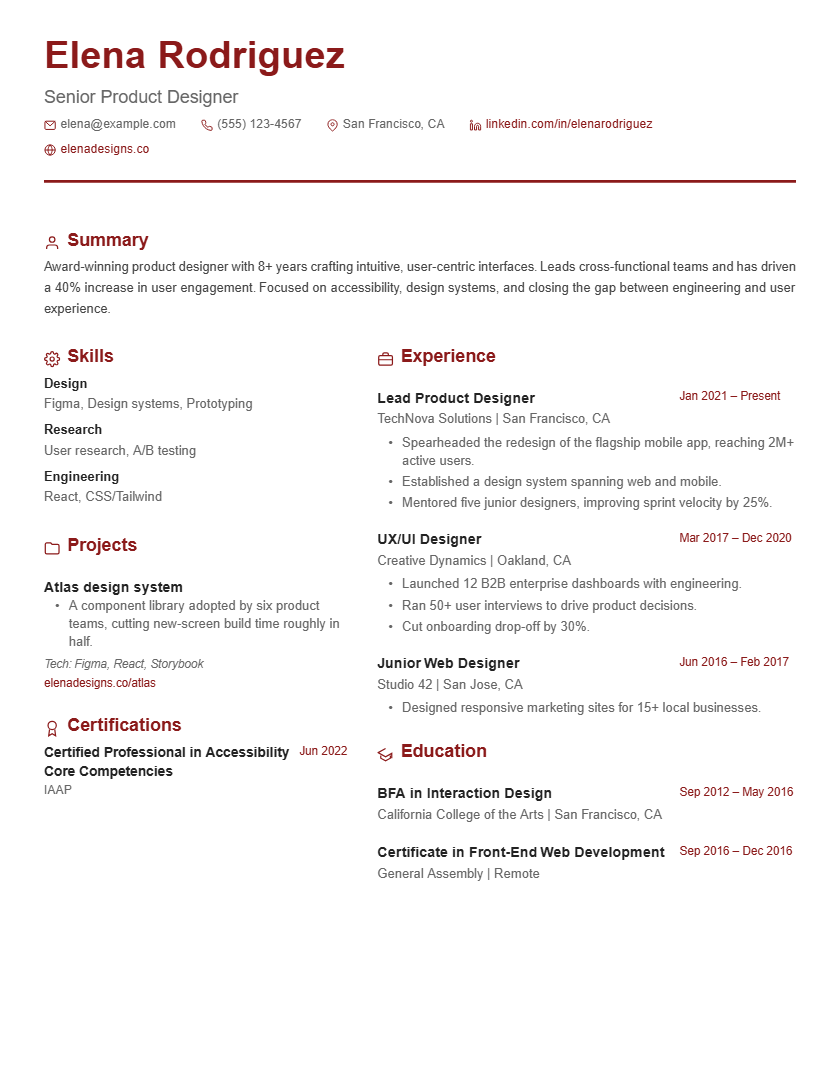
  • Red & Gray Modern template
    Red & Gray Modern

09Questions fashion designers ask

Do fashion designers need a degree?

Usually. BLS says fashion designers typically have a bachelor's degree in a fine arts or business field such as fashion design or fashion merchandising, and that a portfolio is essential. O*NET's respondents were split: 51 percent said a new hire needs a bachelor's degree and 44 percent an associate degree. BLS adds that designers often gain experience through internships or as assistant designers, so list those clearly at entry level.

How much do fashion designers make?

The May 2025 median for fashion designers was $80,960, with the lowest tenth under $39,490 and the highest tenth over $146,870. By industry, management of companies paid a median $105,350, apparel wholesalers $91,020, apparel manufacturing $79,040 and retail trade $43,020. Self-employed designers are the largest group, at 36 percent of the occupation, so freelance and contract work belongs on the resume too.

What software do fashion designers use?

Adobe tools first. O*NET's count of 2025 postings for fashion designers names Adobe Illustrator in 50 percent and Photoshop in 37 percent. That count does not list 3D garment or product lifecycle software, but apparel postings read for this page ask for CLO 3D or Browzwear and for tech packs built in PLM systems. Name each tool in the sidebar and in the bullet where you used it.

Where do most fashion designers work?

BLS says most fashion designers work in New York and California. By employer, self-employed designers make up 36 percent, retail trade 20 percent, apparel wholesalers 16 percent, management of companies 11 percent and apparel manufacturing 7 percent. If you design private label for a wholesaler, say so in the headline, because a brand reads that work differently from a branded line.

What should a fashion design portfolio include?

CADs and process. A corporate fashion recruiter says CADs are what hiring managers most want to see, because most corporate design work is CADing, and that assistant designer portfolios should show wearable, producible garments. A fashion recruitment agency advises sending a short teaser of a few projects first, with your name on every page. Show mood boards, sketches and tech packs beside the finished looks.

Free to start

Build your fashion designer resume

No card, no trial that turns into a charge.

Sign up free