Interior designer resume examples & writing guide for 2026

Three commercial interior designer resumes at junior, mid and senior level, each rendered in a real template and marked up note by note. Every one names the phase, the square footage and the FF&E budget a studio director checks first.

By the Resumi editorial teamUpdated 8 min read

Showing the mid-level example

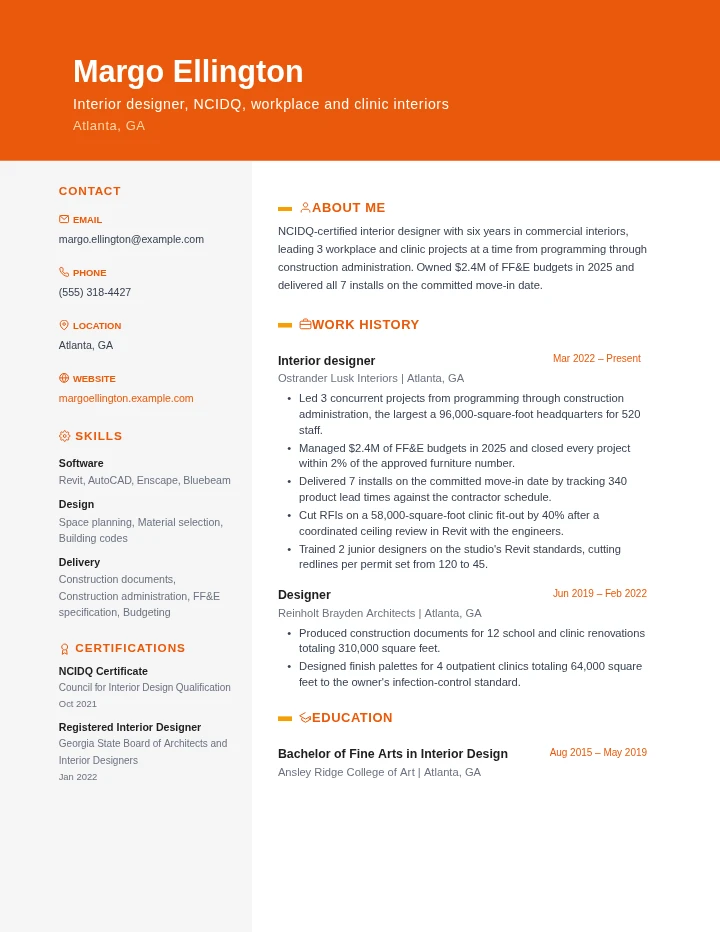
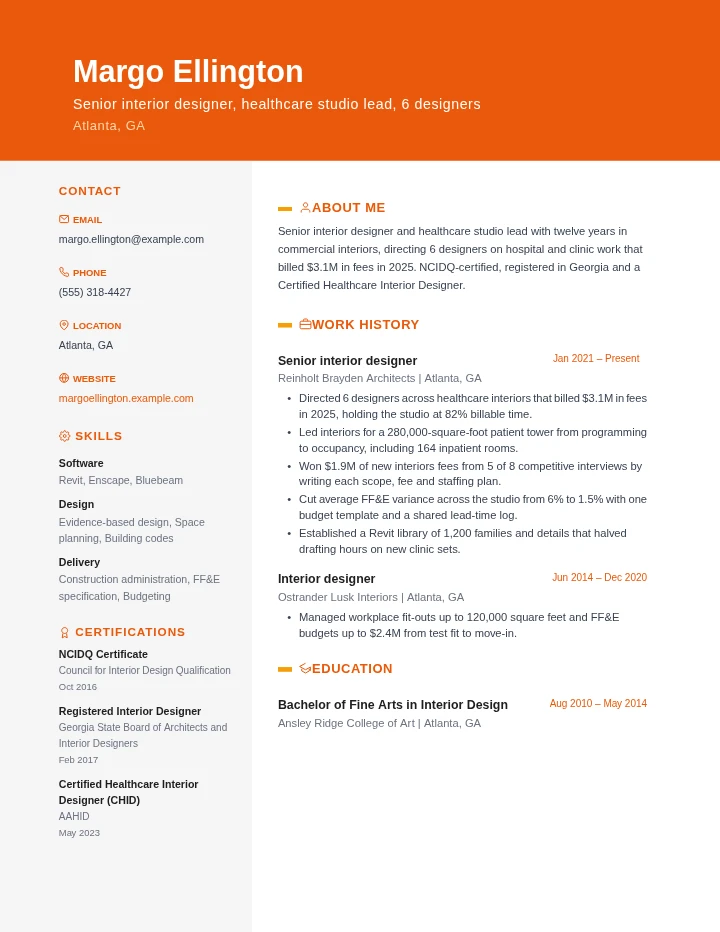
Interior designer resume example, mid level, rendered in the Orange Creative template
Strength: Excellent

Written by the Resumi editorial team for a fictional candidate. Role facts come from O*NET and the U.S. Bureau of Labor Statistics.

Strength band is Resumi’s optimization score, not a ranking any employer sees.

What makes this resume work

Each marker on the page has a note here. Press a marker to jump to its note.

  1. 1

    Credential and sector together

    NCIDQ plus workplace and clinic interiors in one line. A reviewer sorting commercial candidates checks for the certificate and the sector before anything else, and both sit where the eye lands.

  2. 2

    Phases named, start to finish

    Programming through construction administration. Mid-level postings ask for a designer who can carry a job through every phase, and naming the first and last phase says it in six words.

  3. 3

    An FF&E budget, held

    Two point four million dollars of furniture, fixtures and equipment, every project closed within two percent. Owning the budget is what separates this level from production support.

  4. 4

    Fewer RFIs from coordination

    A coordinated ceiling review cut requests for information by forty percent. It shows Revit used for coordination with engineers, which is the reason commercial firms ask for it over drafting software.

  5. 5

    Earlier firm, school and clinic work

    Twelve renovations and four outpatient clinics in two lines. The healthcare finish work at the earlier firm is what makes a later move into a healthcare studio believable, so it stays while the rest is cut.

  6. 6

    Certificate and state registration

    The NCIDQ Certificate and the Georgia registration sit together in the sidebar. In a regulated state the registration is what lets a designer use the protected title, so it earns its own row.

Build your interior designer resume

Free to start · no card

01The example, in full

The resume shown above, as text you can search and copy.

Margo Ellington

Interior designer, NCIDQ, workplace and clinic interiors

Atlanta, GAmargo.ellington@example.com(555) 318-4427margoellington.example.com

Summary

NCIDQ-certified interior designer with six years in commercial interiors, leading 3 workplace and clinic projects at a time from programming through construction administration. Owned $2.4M of FF&E budgets in 2025 and delivered all 7 installs on the committed move-in date.

Experience

Interior designer

Mar 2022 – Present

Ostrander Lusk Interiors · Atlanta, GA

  • Led 3 concurrent projects from programming through construction administration, the largest a 96,000-square-foot headquarters for 520 staff.
  • Managed $2.4M of FF&E budgets in 2025 and closed every project within 2% of the approved furniture number.
  • Delivered 7 installs on the committed move-in date by tracking 340 product lead times against the contractor schedule.
  • Cut RFIs on a 58,000-square-foot clinic fit-out by 40% after a coordinated ceiling review in Revit with the engineers.
  • Trained 2 junior designers on the studio's Revit standards, cutting redlines per permit set from 120 to 45.

Designer

Jun 2019 – Feb 2022

Reinholt Brayden Architects · Atlanta, GA

  • Produced construction documents for 12 school and clinic renovations totaling 310,000 square feet.
  • Designed finish palettes for 4 outpatient clinics totaling 64,000 square feet to the owner's infection-control standard.

Education

Bachelor of Fine Arts in Interior Design

Aug 2015 – May 2019

Ansley Ridge College of Art · Atlanta, GA

Skills

Software
Revit, AutoCAD, Enscape, Bluebeam
Design
Space planning, Material selection, Building codes
Delivery
Construction documents, Construction administration, FF&E specification, Budgeting

Certifications

NCIDQ Certificate

Oct 2021

Council for Interior Design Qualification
Registered Interior Designer

Jan 2022

Georgia State Board of Architects and Interior Designers

02Market snapshot

Median pay
$67,190 median annual pay, with the top 10 percent above $114,140
Typical education
Bachelor's degree typical, with no prior experience or on-the-job training expected
Job outlook
+3% growth, 2025–35, about as fast as average, with about 7,700 openings a year
Common credentials
29 state licenses listed, with titles that vary by state. NCIDQ is the core certification of 16

Sources: BLS OES (May 2025) · BLS OOH (2025) · CareerOneStop (2026)

03The same resume at three levels

The tinted row is the level shown above.

  • Entry-level

    0–2 years

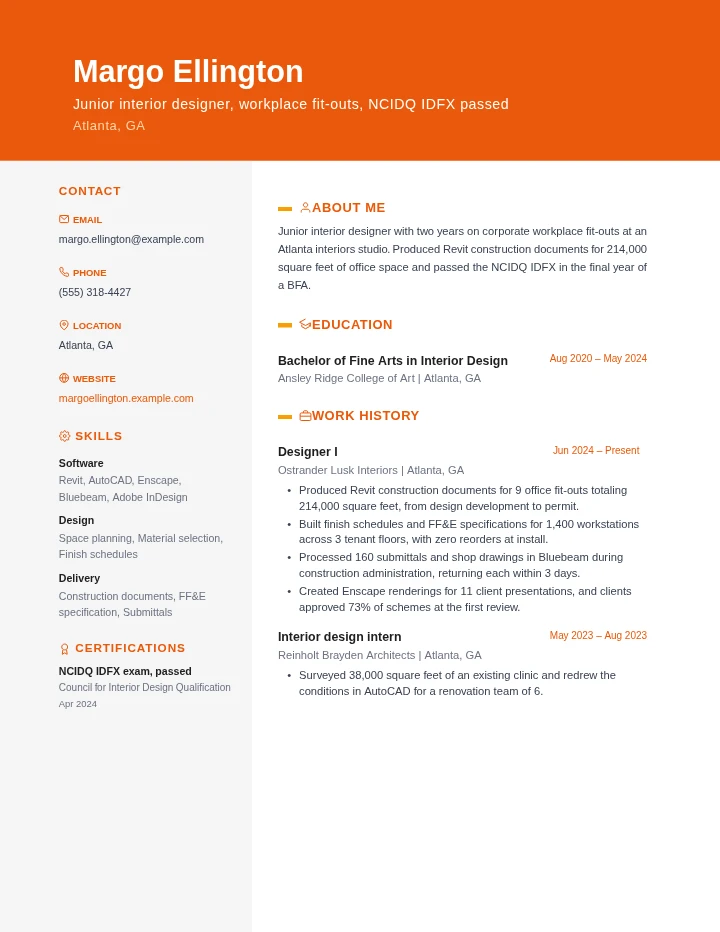
    Education sits above experience and the headline carries the exam section already passed. The bullets measure production: square feet documented, workstations specified, submittals returned and schemes approved. The internship shrinks to a single surveying line with its footage, and the sidebar lists the software a studio screens for.

    Typical titles: Junior interior designer, Designer I, Interior design coordinator

  • Mid-level

    3–7 years

    Ownership replaces production. The headline adds the NCIDQ, the summary names the phases carried, and the bullets own a furniture budget, a move-in date and a coordination result. Training two juniors appears with a measurable effect. The earlier firm keeps two lines.

    Typical titles: Interior designer, Interior designer III, Project designer

  • Senior

    8+ years

    Scope moves from projects to a studio: designers directed, fees billed, billable time held and interviews won. The patient tower carries its room count, a studio-wide budget fix shows management, and the workplace years shrink to one line. The healthcare credential joins the sidebar.

    Typical titles: Senior interior designer, Project interior designer, Interiors studio director

04Summary

Weak

Creative and passionate interior designer who transforms client visions into beautiful, functional spaces through a keen eye for color, texture and detail.

Strong

NCIDQ-certified interior designer with six years in commercial interiors, leading 3 workplace and clinic projects at a time from programming through construction administration. Owned $2.4M of FF&E budgets in 2025 and delivered all 7 installs on the committed move-in date.

The strong version gives the credential, the sector, the phases and two numbers a studio director can test. The weak one describes taste, which the portfolio has to prove anyway, and says nothing about budgets, drawings or schedules.

05Bullets

Weak

  • Responsible for selecting furniture and finishes and coordinating with vendors and contractors on various projects.

Strong

  • Delivered 7 installs on the committed move-in date by tracking 340 product lead times against the contractor schedule.

Procurement is where interiors projects slip, and this bullet says how the slip was prevented and gives the count behind it. A studio director can ask which items ran late and what was substituted, and the answer will show whether the claim holds. The weak version lists duties every designer shares and leaves the reader guessing whether any project finished on time.

06Skills and keywords

Software

  • Revit (in the example)
  • AutoCAD (in the example)
  • Enscape (in the example)
  • Bluebeam (in the example)
  • SketchUp
  • Adobe InDesign
  • Adobe Photoshop

Design

  • Space planning (in the example)
  • Material selection (in the example)
  • Building codes (in the example)
  • Evidence-based design
  • Finish schedules

Delivery

  • Construction documents (in the example)
  • Construction administration (in the example)
  • FF&E specification (in the example)
  • Budgeting (in the example)
  • Submittals
  • Punch List

Credentials

  • NCIDQ Certificate (in the example)
  • Registered Interior Designer (in the example)
  • Certified Healthcare Interior Designer (CHID)
  • Certified Kitchen and Bath Designer (CKBD)

Filled chips appear in the example above.

Paste a job description and Resumi shows which of these your resume already covers.

Build your interior designer resume

07Mistakes to avoid

  1. A resume designed like a mood board

    Fix: Recruiters who place interior designers say the resume should read plainly and the portfolio should carry the design. Custom fonts, color blocks and a photo slow the scan and add nothing. Keep one page of bullets and put the craft in the portfolio link.

  2. Team projects with no part named

    Fix: Every commercial job is a team job, and a firm partner reading hundreds of applications wants to know what you drew. Say which phase you carried and what you produced: the test fit, the construction set, the finish schedule, the submittals.

  3. AutoCAD alone, sent to commercial firms

    Fix: Commercial and healthcare postings ask for Revit almost without exception, while residential studios still run on AutoCAD and SketchUp. Match the software line to the sector you are applying to, and show Revit used for a real set, not a class.

  4. NCIDQ progress left vague

    Fix: Most firms list the NCIDQ as preferred, so they look for it. Write exactly where you stand: sections passed with dates, the certificate once you hold it, and the state registration beside it. Studying for the exam is not a credential.

  5. Projects with no scale

    Fix: Square feet, headcount, FF&E budget and the move-in date are the units studios size work in. A bullet that says you designed a headquarters tells a director nothing until it says how large it was and whether it opened on time.

08Format and template

Keep the resume plain and let the portfolio carry the design. Put the portfolio link in the header and the NCIDQ and any state registration where a reviewer checks credentials. Write square feet, budgets and phases as text rather than inside images, so nothing is lost when a firm's system reads the file. This example uses Orange Creative. The same content works in Standard, Pink Accent and Red & Gray Modern.

Shown above: Orange Creative

  • Standard template
    StandardFree
  • Pink Accent template
    Pink Accent
  • Red & Gray Modern template
    Red & Gray Modern

09Questions interior designers ask

Should I list NCIDQ exam sections before I hold the certificate?

Yes, with the section name and the date: IDFX passed, then IDPX and IDIX as you clear them. Firms list the certificate as preferred, so partial progress is worth showing, and the fundamentals section can be taken in the final year of school. Put it in the headline or the certifications block, not both. Stop listing sections once you hold the full NCIDQ Certificate, and write that instead.

Can I call myself a registered interior designer?

Only if your state has granted you that title. CareerOneStop lists 29 state licenses for the occupation, and the protected titles differ: registered, certified or plain interior designer, and commercial interior designer in one state. Write the title your board issued, name the board so the state is clear, and use plain interior designer everywhere else. A firm will check the registration before it lets you sign drawings.

Do I need Revit if I already know AutoCAD?

For commercial, healthcare and education work, yes. Across 2025 postings for the occupation, AutoCAD appeared in 24 percent, Revit in 22 percent and SketchUp in 18 percent, and the commercial postings read for this page asked for Revit nearly every time. Residential studios lean on AutoCAD and SketchUp. List what the target firm uses, and show it on a real project.

How long before I can sit for the full NCIDQ?

The licensing exam generally needs a bachelor's degree in interior design and two years of full-time work experience, which is why juniors take the fundamentals section first. Put the section already passed on the resume, and put the expected date for the rest in a cover letter rather than as a claim on the page. Firms that pay exam fees will ask about your timeline in the interview.

How do I move from residential to commercial interiors?

Rewrite residential work in commercial units. Give square feet, the furniture budget, the number of trades coordinated and the lead times managed. Name the drawing sets you produced and any code review you did. Add Revit on a real project before applying, because commercial firms screen on it, and choose portfolio work that shows construction documents rather than styling alone.

Free to start

Build your interior designer resume

No card, no trial that turns into a charge.

Sign up free