Speech-language pathologist resume examples & writing guide for 2026

Three speech-language pathologist resumes at clinical fellow, experienced and coordinator level, rendered in a real template and annotated note by note. Each one names the credential, license, setting and caseload, and counts what the school counts.

By the Resumi editorial teamUpdated 8 min read

Showing the mid-level example

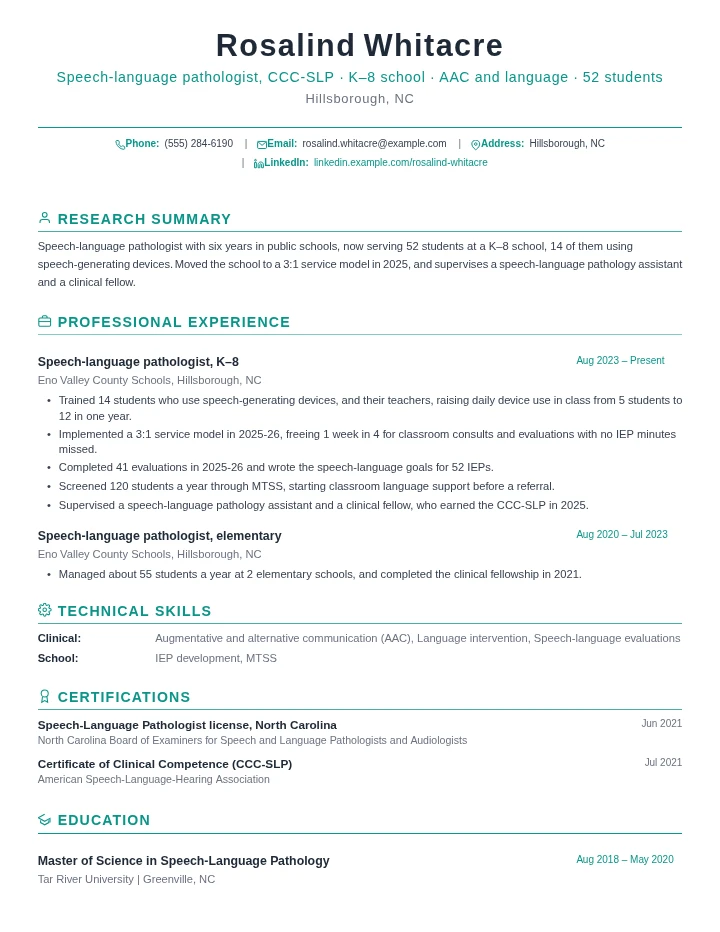
Speech-language pathologist resume example, mid level, rendered in the Green Academic template
Strength: Strong

Written by the Resumi editorial team for a fictional candidate. Role facts come from O*NET and the U.S. Bureau of Labor Statistics.

Strength band is Resumi’s optimization score, not a ranking any employer sees.

What makes this resume work

Each marker on the page has a note here. Press a marker to jump to its note.

  1. 1

    Specialty in the headline

    AAC and language at a K–8 school. Districts place SLPs by school level and student need, and naming device users tells a reader this clinician can take the complex cases.

  2. 2

    A service model that changed

    The school moved to a 3:1 model in 2025. Changing how services are delivered, not only delivering them, is the step from carrying a caseload to shaping one.

  3. 3

    Device use in class

    Daily device use from 5 students to 12. A speech-generating device only helps if a student uses it in class, so the change counts more than the number of devices issued.

  4. 4

    Time freed, minutes kept

    One week in 4 freed for consults and evaluations, with no IEP minutes missed. The second half matters, because a model that drops required minutes would fail an audit.

  5. 5

    Supervision with a result

    An assistant and a clinical fellow, and the fellow earned the CCC-SLP. Supervising others is the path to lead roles, and the fellow's certificate shows the mentoring worked.

01The example, in full

The resume shown above, as text you can search and copy.

Rosalind Whitacre

Speech-language pathologist, CCC-SLP · K–8 school · AAC and language · 52 students

Hillsborough, NCrosalind.whitacre@example.com(555) 284-6190linkedin.example.com/rosalind-whitacre

Summary

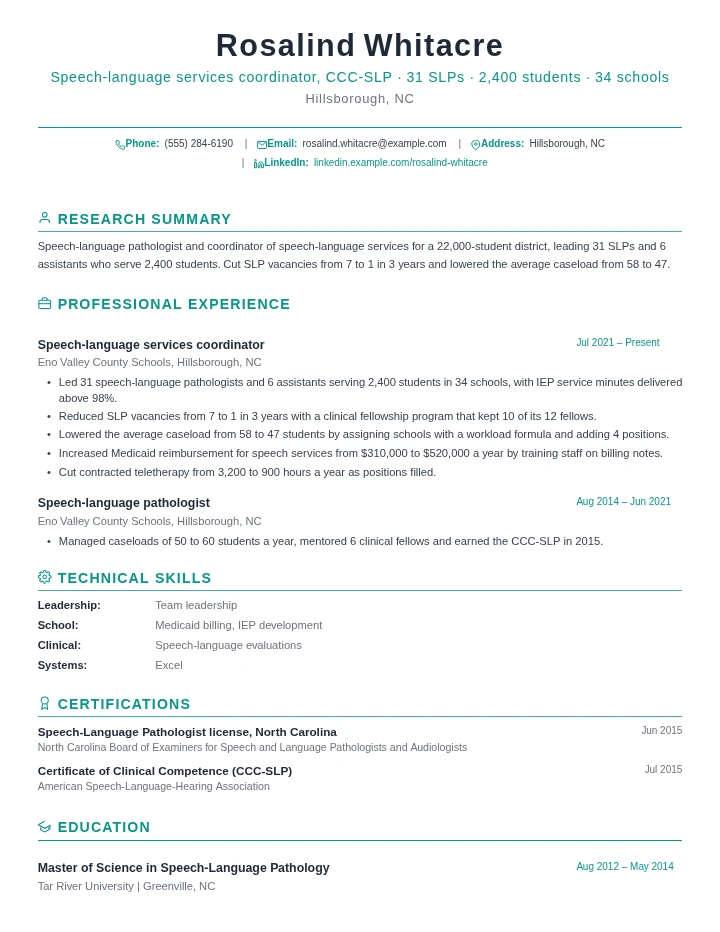
Speech-language pathologist with six years in public schools, now serving 52 students at a K–8 school, 14 of them using speech-generating devices. Moved the school to a 3:1 service model in 2025, and supervises a speech-language pathology assistant and a clinical fellow.

Experience

Speech-language pathologist, K–8

Aug 2023 – Present

Eno Valley County Schools · Hillsborough, NC

  • Trained 14 students who use speech-generating devices, and their teachers, raising daily device use in class from 5 students to 12 in one year.
  • Implemented a 3:1 service model in 2025-26, freeing 1 week in 4 for classroom consults and evaluations with no IEP minutes missed.
  • Completed 41 evaluations in 2025-26 and wrote the speech-language goals for 52 IEPs.
  • Screened 120 students a year through MTSS, starting classroom language support before a referral.
  • Supervised a speech-language pathology assistant and a clinical fellow, who earned the CCC-SLP in 2025.

Speech-language pathologist, elementary

Aug 2020 – Jul 2023

Eno Valley County Schools · Hillsborough, NC

  • Managed about 55 students a year at 2 elementary schools, and completed the clinical fellowship in 2021.

Education

Master of Science in Speech-Language Pathology

Aug 2018 – May 2020

Tar River University · Greenville, NC

Skills

Clinical
Augmentative and alternative communication (AAC), Language intervention, Speech-language evaluations
School
IEP development, MTSS

Certifications

Speech-Language Pathologist license, North Carolina

Jun 2021

North Carolina Board of Examiners for Speech and Language Pathologists and Audiologists

Certificate of Clinical Competence (CCC-SLP)

Jul 2021

American Speech-Language-Hearing Association
02Market snapshot

Median pay
$97,870 median annual pay, and $83,120 in schools
Typical education
Master's degree in speech-language pathology, plus a state license
Job outlook
17% growth from 2025 to 2035, much faster than average
Common credentials
All states require a license, after supervised clinical experience and an exam

Sources: BLS OES (May 2025) · BLS OOH (2025)

03The same resume at three levels

The tinted row is the level shown above.

  • Entry-level

    0–2 years

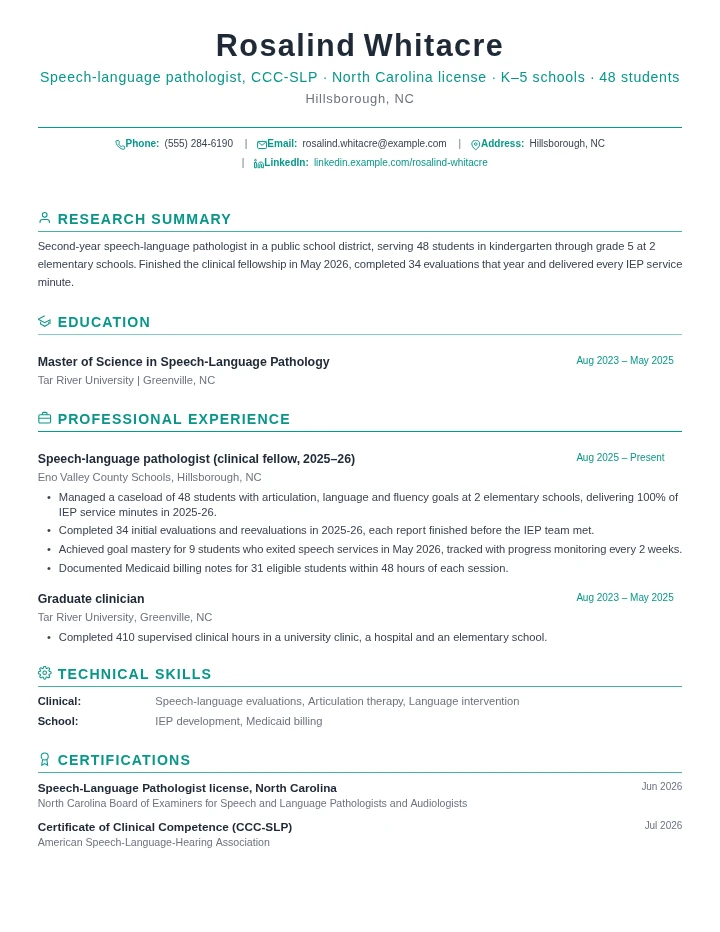
    Education sits above the jobs, and the headline gives the certificate, the license state, the grades and the caseload. Bullets cover service minutes, evaluations, goals met and Medicaid notes. Graduate clinic work folds to one line with its supervised hours and placements.

    Typical titles: Speech-language pathologist, School speech-language pathologist, Clinical fellow, speech-language pathology

  • Mid-level

    3–6 years

    The headline names the school level, the specialty and the caseload. Bullets give device use in class, a new service model, evaluations and IEP goals, MTSS screening and supervision. The elementary years fold to one line with the caseload and the year the fellowship ended.

    Typical titles: Speech-language pathologist, School-based SLP, AAC specialist, speech-language pathology

  • Senior

    7+ years

    Scope replaces caseload: the size of the program, service-minute compliance across 34 schools, vacancies filled, the average caseload, Medicaid reimbursement and contracted teletherapy hours. The seven clinician years fold to one line with their caseloads, the clinical fellows mentored and the year the certificate was earned.

    Typical titles: Speech-language services coordinator, Lead speech-language pathologist, Related services coordinator

04Summary

Weak

Dedicated and compassionate speech-language pathologist passionate about helping students find their voice and reach their full communication potential.

Strong

Speech-language pathologist with six years in public schools, now serving 52 students at a K–8 school, 14 of them using speech-generating devices. Moved the school to a 3:1 service model in 2025, and supervises a speech-language pathology assistant and a clinical fellow.

The setting, the grades, the caseload, the device users, a change in service model and supervision. A special education director can compare each with their own staff. The weak version promises a voice for students without a setting, a caseload or a result.

05Bullets

Weak

  • Provided speech and language therapy to students with communication disorders.

Strong

  • Trained 14 students who use speech-generating devices, and their teachers, raising daily device use in class from 5 students to 12 in one year.

A named group, the people trained, a measure that matters in class and a time frame. A director can ask how use was counted and what changed for the students who did not start using the device. The weak bullet describes what the license already permits, so every applicant in the pile could send it unchanged.

06Skills and keywords

Clinical

  • Speech-language evaluations (in the example)
  • Language intervention (in the example)
  • Augmentative and alternative communication (AAC) (in the example)
  • Articulation therapy
  • Fluency therapy
  • Dysphagia management

School

  • IEP development (in the example)
  • MTSS (in the example)
  • Progress monitoring
  • Medicaid billing

Licenses and certifications

  • Speech-Language Pathologist license (in the example)
  • Certificate of Clinical Competence (CCC-SLP) (in the example)
  • Basic Life Support (BLS)

Filled chips appear in the example above.

Paste a job description and Resumi shows which of these your resume already covers.

Build your speech-language pathologist resume

07Mistakes to avoid

  1. No setting or age group named

    Fix: Schools, outpatient pediatrics, hospitals, skilled nursing and home health are different jobs on one license. Put your setting and the ages you serve in the headline, because they decide which of your numbers a hiring manager can read.

  2. A caseload number and nothing else

    Fix: Caseload is the number of students. Workload is the evaluations, IEP meetings, notes, billing and device programming behind them. Give the caseload, then the evaluations, IEPs and minutes delivered, so the reader sees the whole job.

  3. Invented progress percentages

    Fix: A claim like improved communication by 40% matches no measure an SLP keeps, and a supervisor will ask which test produced it. Use the measures you record, such as goals met, students exited or device use, with the number of students.

  4. Credential status left unclear

    Fix: Write CCC-SLP after your name only once you hold it. A clinical fellow should say so and give the expected date. List the state license and its state, and note a temporary license during the fellowship year, because postings screen on all three.

  5. Duties copied from the posting

    Fix: Conducted evaluations and provided therapy describe the license, not you. Replace each duty with a count and a result: evaluations finished before the meeting, minutes delivered, students who met their goals, or a model you changed.

08Format and template

One column, reverse-chronological order and standard section headings, with every figure written as text. Put CCC-SLP, the license state, your setting and caseload in the headline. Name the ages, the disorders you treat most and the measures your setting uses. List the license and certificate with dates. This example uses Green Academic. The same content works in Standard, Warm Classic and Beige Border.

Shown above: Green Academic

  • Standard template
    StandardFree
  • Warm Classic template
    Warm Classic
  • Beige Border template
    Beige Border

09Questions speech-language pathologists ask

What does CCC-SLP mean on a resume?

CCC-SLP is the Certificate of Clinical Competence in Speech-Language Pathology from the American Speech-Language-Hearing Association. It is separate from the state license, so list both with dates. In North Carolina, for example, the license requires a master's degree, at least 400 hours of supervised clinical work, nine months of supervised full-time practice and an exam, with a temporary license during that supervised year. Write CF-SLP until the certificate arrives.

Should a school SLP list caseload size on a resume?

Yes, with the grades and the number of schools beside it. Practitioner writers point out that a caseload number hides the workload behind it, and a reader will compare your number with their own staff. Add the workload behind it: evaluations completed, IEPs written, minutes delivered and students who met their goals. That shows how well the caseload was served, not only how large it was.

How should a clinical fellow write a speech-language pathologist resume?

Put education first, then your clinical placements with their settings and total supervised hours. List the state license, or the temporary license for the fellowship year, and the expected date of your certificate. Many school and clinic postings say clinical fellows are welcome, so make your fellowship status and mentor plan easy to find. Give any numbers you have, such as students served or evaluations written in placement.

What numbers should a medical speech-language pathologist use instead?

Use the measures a hospital or nursing facility keeps. Count bedside swallow evaluations, instrumental studies such as modified barium swallow studies and endoscopic swallow evaluations, patients seen a day, and productivity against the target. Hospital postings ask for instrumental swallow skills by name, so state how many studies you have completed. Add diet changes made safely, aphasia and cognition patients treated, and any students you supervised.

Does Medicaid billing belong on a school SLP resume?

Yes, in one line. School postings ask SLPs to keep Medicaid billing records and therapy notes for eligible students, and trade press reports that districts rely on Medicaid money to pay health and therapy staff. A bullet showing notes completed on time, or reimbursement that grew after you trained staff, tells a director you protect a funding stream they depend on.

How do I move from school SLP to lead SLP or coordinator?

Show the parts of leadership you already do. Supervising assistants and clinical fellows, mentoring new staff, changing a service model and tracking workload all count. Give numbers for each. Practitioner leaders argue for staff with caseload and enrollment data, so a resume showing that you gathered that data, and what changed afterward, reads as ready for a district or regional role.

Free to start

Build your speech-language pathologist resume

No card, no trial that turns into a charge.

Sign up free