Physical therapist resume examples & writing guide for 2026

Three physical therapist resumes at new graduate, specialist and clinic director level, rendered in a real template and taken apart line by line. Each names the setting first, writes the credentials in the profession's order, and counts the work in that setting's currency.

By the Resumi editorial teamUpdated 10 min read

Showing the mid-level example

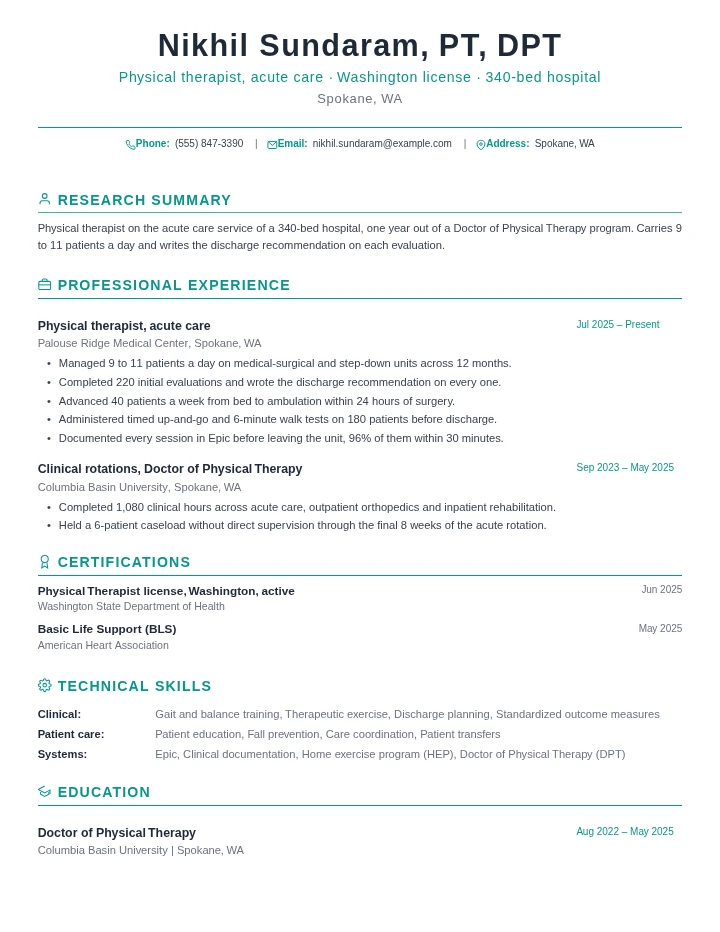
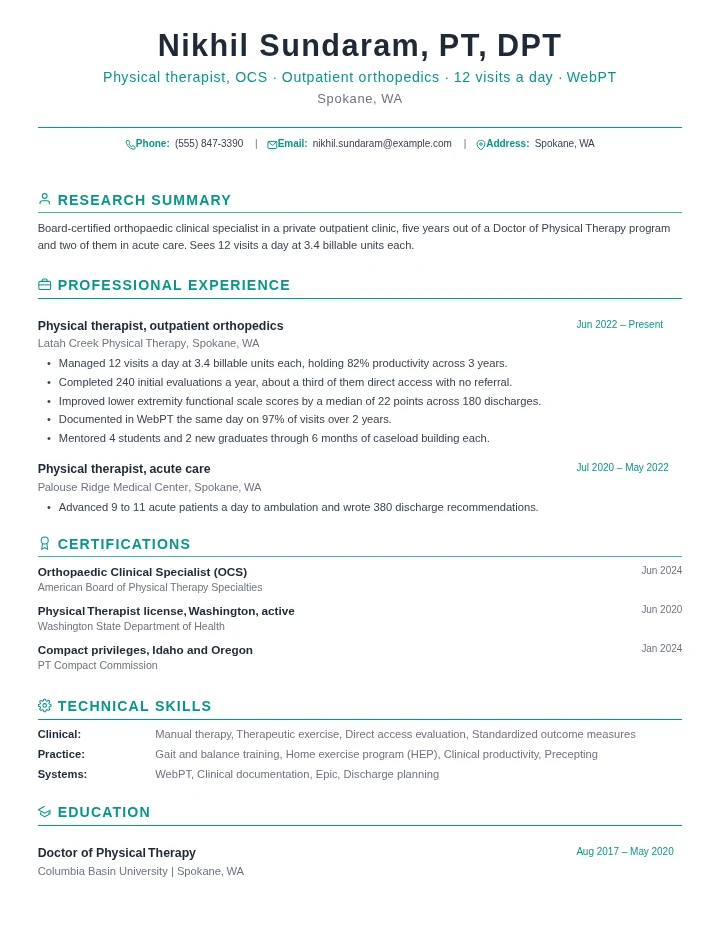
Physical therapist resume example, mid level, rendered in the Green Academic template
Strength: Excellent

Written by the Resumi editorial team for a fictional candidate. Role facts come from O*NET and the U.S. Bureau of Labor Statistics.

Strength band is Resumi’s optimization score, not a ranking any employer sees.

What makes this resume work

Each marker on the page has a note here. Press a marker to jump to its note.

  1. 1

    Specialty and setting together

    Board-certified orthopaedic specialist in outpatient orthopedics. The certification only means something next to the setting it is practiced in, and the two together answer the posting's first requirement.

  2. 2

    Visits and units, both

    Twelve visits a day at 3.4 billable units each. Visits are the schedule and units are the billing, and an outpatient director reads both because they decide staffing and revenue separately.

  3. 3

    Direct access, quantified

    About a third of 240 evaluations a year taken with no referral. Direct access exists in every state in some form, and the share says this therapist screened for referral rather than waiting to be sent one.

  4. 4

    Outcomes with the instrument

    A median 22-point change on a named functional scale across 180 discharges. Recovery rate is not a measure this field keeps. A standardized instrument with a denominator is, and it survives a follow-up question.

  5. 5

    The acute years, one line

    Nine to 11 patients a day and 380 discharge recommendations, kept to a single line. The earlier setting is worth keeping because it shows the same therapist working in a currency this one does not use.

  6. 6

    Compact privileges, listed apart

    Idaho and Oregon named under the compact rather than folded into the license line. A privilege is not a license, it lives only while the home license is active, and the distinction is the profession's own.

Build your physical therapist resume

Free to start · no card

01The example, in full

The resume shown above, as text you can search and copy.

Nikhil Sundaram, PT, DPT

Physical therapist, OCS · Outpatient orthopedics · 12 visits a day · WebPT

Spokane, WAnikhil.sundaram@example.com(555) 847-3390

Summary

Board-certified orthopaedic clinical specialist in a private outpatient clinic, five years out of a Doctor of Physical Therapy program and two of them in acute care. Sees 12 visits a day at 3.4 billable units each.

Experience

Physical therapist, outpatient orthopedics

Jun 2022 – Present

Latah Creek Physical Therapy · Spokane, WA

  • Managed 12 visits a day at 3.4 billable units each, holding 82% productivity across 3 years.
  • Completed 240 initial evaluations a year, about a third of them direct access with no referral.
  • Improved lower extremity functional scale scores by a median of 22 points across 180 discharges.
  • Documented in WebPT the same day on 97% of visits over 2 years.
  • Mentored 4 students and 2 new graduates through 6 months of caseload building each.

Physical therapist, acute care

Jul 2020 – May 2022

Palouse Ridge Medical Center · Spokane, WA

  • Advanced 9 to 11 acute patients a day to ambulation and wrote 380 discharge recommendations.

Education

Doctor of Physical Therapy

Aug 2017 – May 2020

Columbia Basin University · Spokane, WA

Skills

Clinical
Manual therapy, Therapeutic exercise, Direct access evaluation, Standardized outcome measures
Practice
Gait and balance training, Home exercise program (HEP), Clinical productivity, Precepting
Systems
WebPT, Clinical documentation, Epic, Discharge planning

Certifications

Orthopaedic Clinical Specialist (OCS)

Jun 2024

American Board of Physical Therapy Specialties

Physical Therapist license, Washington, active

Jun 2020

Washington State Department of Health

Compact privileges, Idaho and Oregon

Jan 2024

PT Compact Commission

02Market snapshot

Median pay
$102,760 median annual pay, $49.40 an hour
Typical education
A doctoral or professional degree. A Doctor of Physical Therapy from an accredited program, with no prior work experience needed
Job outlook
+12% employment change, 2025-35, much faster than average. About 13,400 openings a year
Common credentials
Licensed in every state after a qualifying exam. Some states add a law exam and a background check, and continuing education keeps the license

Sources: BLS OES (May 2025) · BLS OOH (2025)

03The same resume at three levels

The tinted row is the level shown above.

  • Entry-level

    0–2 years

    The credentials run in the order the profession sets, the setting leads, and each bullet uses an acute care unit rather than an outpatient one. The rotations sit in the experience section with their hours, which is what turns a new graduate's page from a course list into a record of work.

    Typical titles: Physical therapist, Acute care physical therapist, Staff physical therapist

  • Mid-level

    3–6 years

    Visits and units sit together because they answer different questions, and 82% productivity is stated rather than left for the interview. The outcome figure carries the instrument and the discharge count behind it, and the mentoring is counted in months rather than described as a strength.

    Typical titles: Physical therapist, Orthopaedic clinical specialist, Senior physical therapist

  • Senior

    7+ years

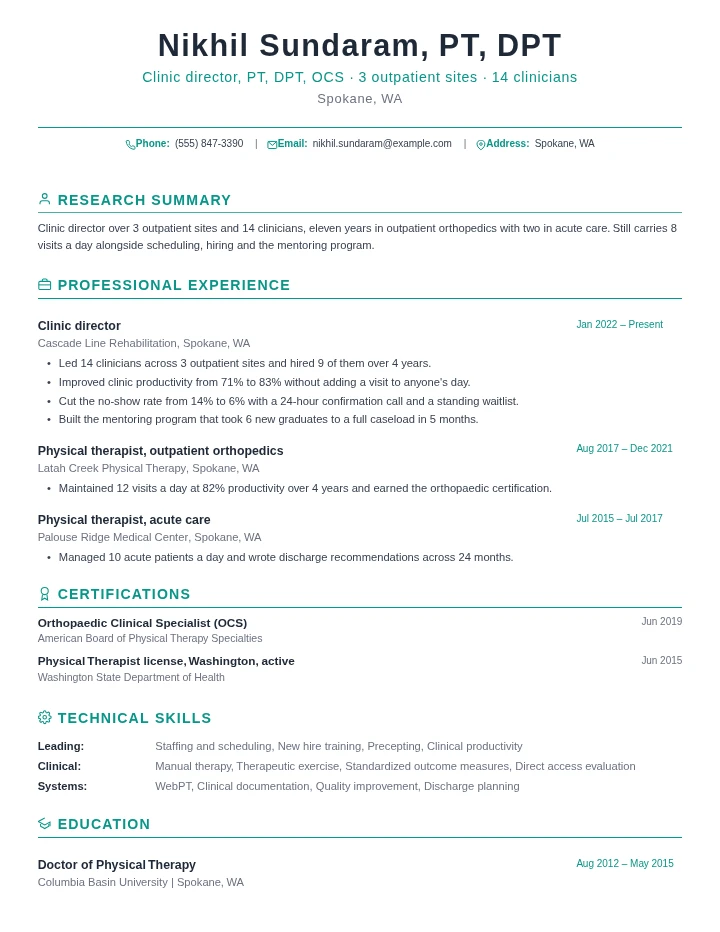
    The director numbers come first and the caseload stays visible underneath, because these roles are a split rather than a promotion out of treating. Productivity and no-shows each carry the mechanism that moved them, and the two earlier seats hold one line apiece.

    Typical titles: Clinic director, Director of rehabilitation, Lead physical therapist

04Summary

Weak

Compassionate and patient-centered physical therapist with a proven track record of improving patient outcomes and a strong commitment to evidence-based practice in fast-paced clinical settings.

Strong

Board-certified orthopaedic clinical specialist in a private outpatient clinic, five years out of a Doctor of Physical Therapy program and two of them in acute care. Sees 12 visits a day at 3.4 billable units each.

Specialty, setting, years, the prior setting, and the daily schedule with the billing behind it. An outpatient director can staff against every part of that. The weak version names no setting at all, which is the one thing that decides whether this resume belongs in their pile.

05Bullets

Weak

  • Provided skilled physical therapy services to a diverse patient population, developing individualized treatment plans and collaborating with the interdisciplinary team to optimize patient outcomes.

Strong

  • Improved lower extremity functional scale scores by a median of 22 points across 180 discharges.

A named instrument, a median rather than a mean, and the number of discharges it was measured over. Competitor samples for this occupation almost all reach for a recovery rate or a percentage improvement in recovery time, and no physical therapist keeps either number, which is why a clinic director discounts the whole page when they see one. A standardized outcome measure is the field's own evidence, and giving the denominator lets the reader check the claim instead of trusting it. The weak bullet describes what the license permits, which means every applicant could send it unchanged.

06Skills and keywords

Clinical

  • Manual therapy (in the example)
  • Therapeutic exercise (in the example)
  • Gait and balance training (in the example)
  • Standardized outcome measures (in the example)
  • Home exercise program (HEP) (in the example)
  • Dry needling

Practice

  • Direct access evaluation (in the example)
  • Clinical productivity (in the example)
  • Discharge planning (in the example)
  • Precepting (in the example)
  • Care coordination
  • Quality improvement

Systems

  • WebPT (in the example)
  • Epic (in the example)
  • Clinical documentation (in the example)
  • Patient education
  • Fall prevention
  • Patient transfers

Credentials

  • Physical Therapist (PT) license (in the example)
  • Orthopaedic Clinical Specialist (OCS) (in the example)
  • PT Compact privilege (in the example)
  • Doctor of Physical Therapy (DPT) (in the example)
  • Basic Life Support (BLS)
  • Certified Hand Therapist (CHT)

Filled chips appear in the example above.

Paste a job description and Resumi shows which of these your resume already covers.

Build your physical therapist resume

07Mistakes to avoid

  1. Credentials written out of order

    Fix: The profession puts the practice credential first, then the highest physical therapy degree, then other regulated credentials, then academic degrees, then specialist certification. So it is PT, DPT, OCS, and never DPT on its own. A therapist with a master's still leads with PT.

  2. No setting anywhere on the page

    Fix: Outpatient orthopedics, acute care, inpatient rehabilitation, skilled nursing, home health and schools are six different jobs on one license. Name yours in the first line, because it decides which of your numbers the reader can even interpret.

  3. One setting's currency used in another

    Fix: Visits and units belong to outpatient, minutes and the Part A split to skilled nursing, points to home health, caseload and coverage to acute care, and students to schools. They do not convert. Keep each setting's metric inside that setting and translate the clinical content instead.

  4. Recovery rates and improvement percentages

    Fix: No physical therapist keeps a recovery rate, and a clinic director knows it, so an invented one costs the whole page. Use the instruments the field actually administers, name the measure, give the change and the number of episodes it covers.

  5. Continuing education frozen at graduation

    Fix: Clinic owners ask what course you took most recently, and a certifications block that stops at the license reads as an answer. List recent coursework with its year, because it is simultaneously a competence signal and a licensing requirement in every state.

08Format and template

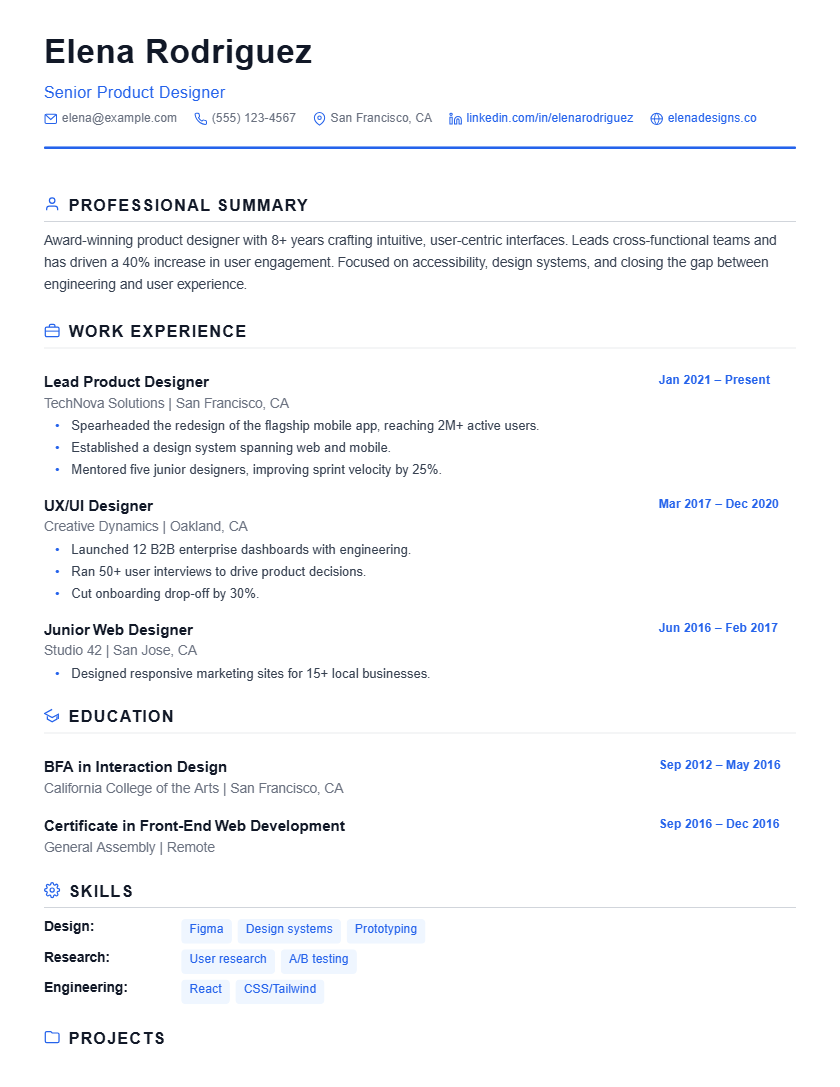
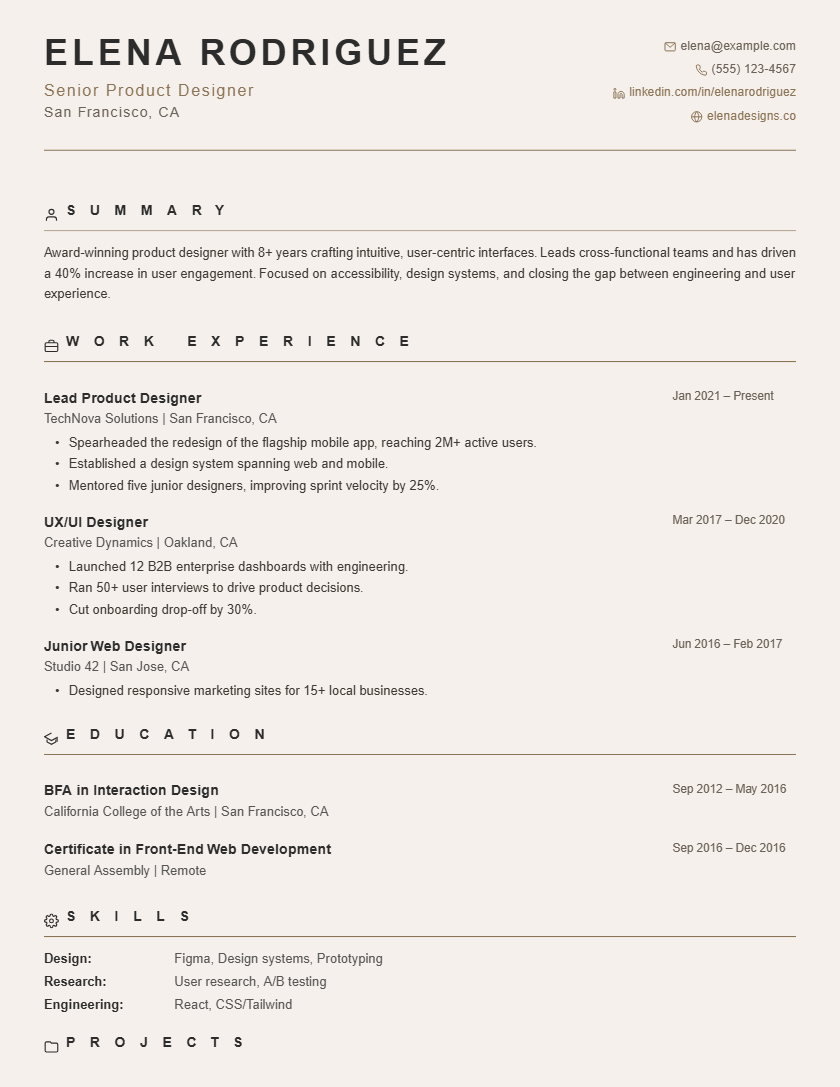
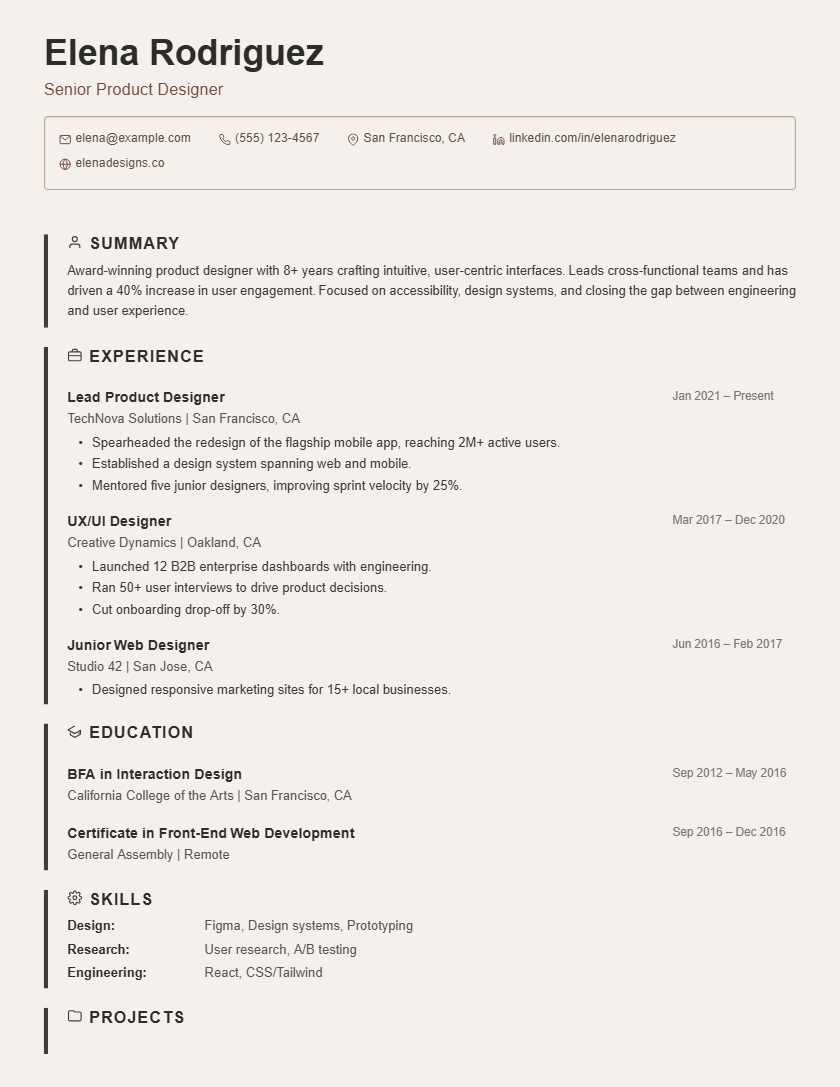
Single column, standard headings, no photo, one page for most clinical applications. The license state and status, the credentials in order, and the setting all belong above the fold, because those three decide whether the rest is read. This example uses Green Academic, which gives each credential its own dated row and leaves the doctorate visible at the bottom. The same content works in Standard, Warm Classic and Beige Border, all single column. A travel therapist is the one exception worth making, where assignment dates and a longer license list justify a second page.

Shown above: Green Academic

  • Standard template
    StandardFree
  • Warm Classic template
    Warm Classic
  • Beige Border template
    Beige Border

09Questions physical therapists ask

How do I write my credentials after my name?

PT comes first, always, then your highest physical therapy degree, then any other government-regulated credential, then other academic degrees, then specialist certification. So it reads PT, DPT, OCS. A therapist with a master's writes PT, MPT and is not disadvantaged by it. Writing DPT alone is wrong by the profession's own rule and is what a hiring manager notices first, because several states protect the initials for licensed practitioners.

What numbers belong on a physical therapist resume?

Whichever ones your setting keeps. Outpatient counts visits a day, billable units per visit, productivity percentage and evaluations a week. Acute care counts daily caseload, evaluations, coverage and the discharge recommendation. Skilled nursing counts minutes and the payment split. Home health counts visits or points. Schools count students on the caseload. Add the standardized outcome measures you administer and the documentation timeliness you held, and leave out anything you could not name a report for.

I am a new graduate. What goes in the experience section?

Your clinical rotations, written as jobs. Give the facility type, the setting, the length in weeks or hours, the patient population and what you carried by the end, including any caseload you ran without direct supervision. Name the documentation system, because that is the cheapest way to shorten your onboarding in a reader's mind. Do not list passing the national exam as a certification. Your license already implies it, and the licensure line with its state and date is what the employer checks.

How do I list a compact privilege?

Separately from your license, because it is not one. Your home state license goes on its own line with the state, the status and the date. The privileges go on a second line naming the states they cover. The distinction matters in practice: a privilege exists only while the home license stays active, so letting the home license lapse cancels every privilege at once. If you are a travel therapist, this two-line form is also what keeps a long list readable.

How do I move between settings when my numbers do not transfer?

Translate the clinical content and leave the metric behind. Evaluation volume, diagnosis mix, complexity, the outcome measures you administer and the systems you documented in all carry across. Visits, units, minutes, points and student caseloads do not, so keep each one inside the setting it belongs to rather than converting it into something the new reader will mistrust. Then use the target setting's own vocabulary from the posting, and say what you have already done in that setting even if it was a rotation.

How long should a physical therapist resume be?

One page for a staff or specialist role, and one is usually enough for a director too if earlier seats keep a single line each. The exception is travel: assignment-based work needs the facility, the agency, the dates and the facility type for each contract, plus a licence and privilege list that can run long, and recruiters in that market do not expect it on one page. A curriculum vitae belongs to faculty and research posts, where publications and teaching are the point.

Free to start

Build your physical therapist resume

No card, no trial that turns into a charge.

Sign up free