Occupational therapist resume examples & writing guide for 2026

Three occupational therapist resumes at new graduate, experienced and manager level, rendered in a real template and annotated note by note. Every one names the license and setting, and measures function the way the setting does.

By the Resumi editorial teamUpdated 8 min read

Showing the mid-level example

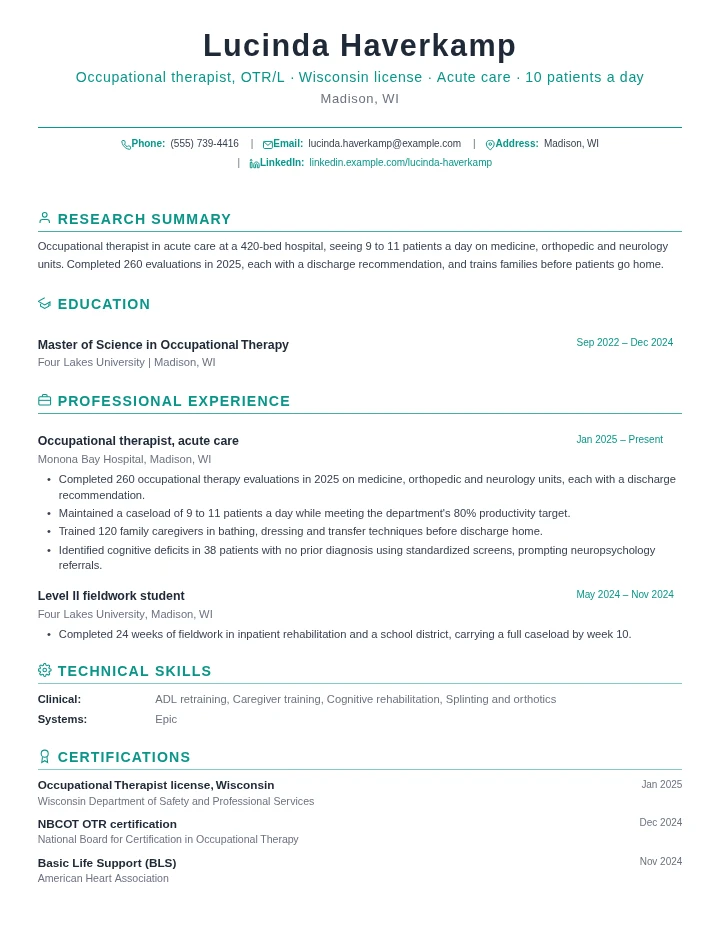
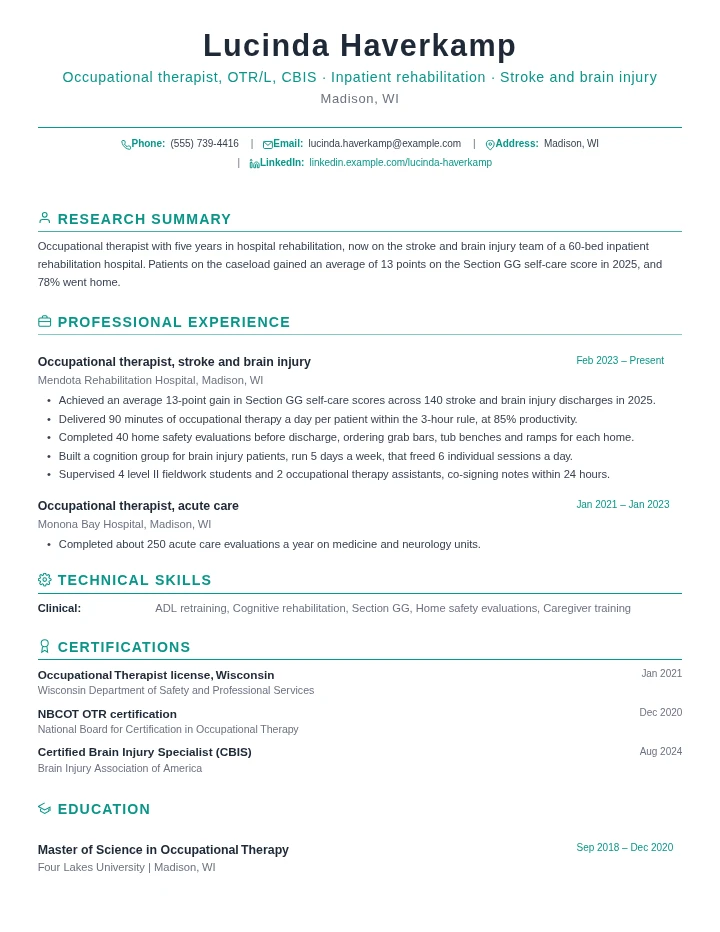
Occupational therapist resume example, mid level, rendered in the Green Academic template
Strength: Strong

Written by the Resumi editorial team for a fictional candidate. Role facts come from O*NET and the U.S. Bureau of Labor Statistics.

Strength band is Resumi’s optimization score, not a ranking any employer sees.

What makes this resume work

Each marker on the page has a note here. Press a marker to jump to its note.

  1. 1

    Specialty team in the headline

    CBIS, inpatient rehabilitation, stroke and brain injury. A rehabilitation hospital hires onto teams by diagnosis, and the headline says which team this therapist can join on day one.

  2. 2

    Outcomes the setting reports

    A 13-point Section GG self-care gain and 78% going home. Inpatient rehabilitation hospitals report both measures, so a manager can compare them with their own unit.

  3. 3

    Gains with a denominator

    The average gain across 140 discharges in a year. A number of patients behind the average shows the result is a pattern, not one good case.

  4. 4

    Home visits before discharge

    Forty home safety evaluations, each with equipment ordered. Getting the home ready is often what decides whether a patient can leave for home rather than a facility.

  5. 5

    Supervision of others

    Four fieldwork students and 2 assistants, notes co-signed within 24 hours. Supervising assistants and students is the step toward lead roles, and timely co-signatures are a compliance matter.

01The example, in full

The resume shown above, as text you can search and copy.

Lucinda Haverkamp

Occupational therapist, OTR/L, CBIS · Inpatient rehabilitation · Stroke and brain injury

Madison, WIlucinda.haverkamp@example.com(555) 739-4416linkedin.example.com/lucinda-haverkamp

Summary

Occupational therapist with five years in hospital rehabilitation, now on the stroke and brain injury team of a 60-bed inpatient rehabilitation hospital. Patients on the caseload gained an average of 13 points on the Section GG self-care score in 2025, and 78% went home.

Experience

Occupational therapist, stroke and brain injury

Feb 2023 – Present

Mendota Rehabilitation Hospital · Madison, WI

  • Achieved an average 13-point gain in Section GG self-care scores across 140 stroke and brain injury discharges in 2025.
  • Delivered 90 minutes of occupational therapy a day per patient within the 3-hour rule, at 85% productivity.
  • Completed 40 home safety evaluations before discharge, ordering grab bars, tub benches and ramps for each home.
  • Built a cognition group for brain injury patients, run 5 days a week, that freed 6 individual sessions a day.
  • Supervised 4 level II fieldwork students and 2 occupational therapy assistants, co-signing notes within 24 hours.

Occupational therapist, acute care

Jan 2021 – Jan 2023

Monona Bay Hospital · Madison, WI

  • Completed about 250 acute care evaluations a year on medicine and neurology units.

Education

Master of Science in Occupational Therapy

Sep 2018 – Dec 2020

Four Lakes University · Madison, WI

Skills

Clinical
ADL retraining, Cognitive rehabilitation, Section GG, Home safety evaluations, Caregiver training

Certifications

Occupational Therapist license, Wisconsin

Jan 2021

Wisconsin Department of Safety and Professional Services

NBCOT OTR certification

Dec 2020

National Board for Certification in Occupational Therapy

Certified Brain Injury Specialist (CBIS)

Aug 2024

Brain Injury Association of America

02Market snapshot

Median pay
$100,330 median annual pay, and $106,300 in home health care
Typical education
Master's degree in occupational therapy, plus a state license
Job outlook
15% growth from 2025 to 2035, much faster than average
Common credentials
All states require a license, after an accredited program and a qualifying exam

Sources: BLS OES (May 2025) · BLS OOH (2025)

03The same resume at three levels

The tinted row is the level shown above.

  • Entry-level

    0–2 years

    Education sits above the jobs, and the headline gives the credential, the license state, the setting and the caseload. Bullets cover evaluations with recommendations, productivity, caregiver training and cognitive screening. Fieldwork folds to one line with its weeks and settings.

    Typical titles: Occupational therapist, Acute care occupational therapist, Staff occupational therapist

  • Mid-level

    3–6 years

    The headline adds the brain injury credential and the specialty team. Bullets give self-care gains with a patient count, therapy minutes within the 3-hour rule, home safety evaluations, a cognition group and supervision. The acute care years fold to one line with evaluations a year.

    Typical titles: Occupational therapist, inpatient rehabilitation, Senior occupational therapist, Neuro rehab occupational therapist

  • Senior

    7+ years

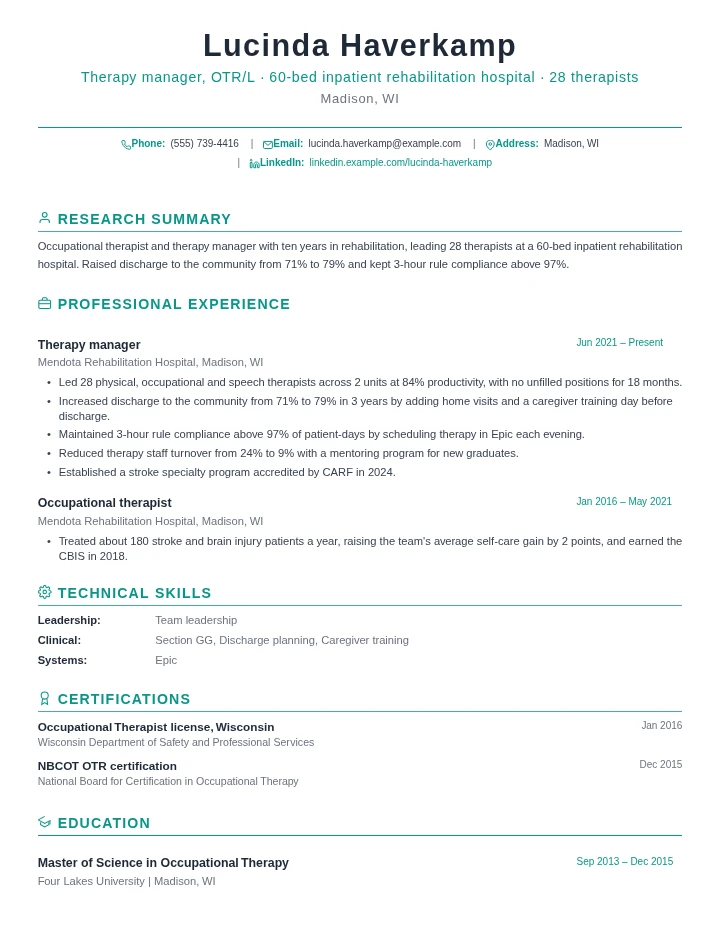
    Scope replaces caseload: the department's size and productivity, discharge to the community, 3-hour rule compliance, turnover and an accredited stroke program. The earlier occupational therapist years fold to one line with the brain injury credential and the year it was earned.

    Typical titles: Therapy manager, Rehabilitation manager, Director of rehabilitation

04Summary

Weak

Compassionate and dedicated occupational therapist passionate about helping patients achieve independence and improve their quality of life through individualized, evidence-based care.

Strong

Occupational therapist with five years in hospital rehabilitation, now on the stroke and brain injury team of a 60-bed inpatient rehabilitation hospital. Patients on the caseload gained an average of 13 points on the Section GG self-care score in 2025, and 78% went home.

The setting, the team, the hospital's size, a self-care outcome and the share going home. A rehab director can compare these with their own unit. The weak version promises independence without a setting, a patient group or a measure.

05Bullets

Weak

  • Provided occupational therapy services to patients to improve their activities of daily living.

Strong

  • Achieved an average 13-point gain in Section GG self-care scores across 140 stroke and brain injury discharges in 2025.

A named measure, an average, the number of discharges and the patient group. A director can ask how the scores were taken, which patients gained least and what changed for them. The weak bullet describes what the license already permits, with no setting, no measure and no patient count, so every applicant in the pile could send it unchanged.

06Skills and keywords

Clinical

  • ADL retraining (in the example)
  • Cognitive rehabilitation (in the example)
  • Caregiver training (in the example)
  • Home safety evaluations (in the example)
  • Section GG (in the example)
  • Splinting and orthotics
  • Discharge planning

Systems

  • Epic
  • Excel

Licenses and certifications

  • Occupational Therapist license (in the example)
  • NBCOT OTR certification (in the example)
  • Certified Brain Injury Specialist (CBIS) (in the example)
  • Basic Life Support (BLS)

Filled chips appear in the example above.

Paste a job description and Resumi shows which of these your resume already covers.

Build your occupational therapist resume

07Mistakes to avoid

  1. No setting named

    Fix: Acute care, inpatient rehabilitation, skilled nursing, home health, outpatient and schools are different jobs on one license. Name your setting in the headline, because it decides which of your numbers a hiring manager can read.

  2. Duties instead of results

    Fix: Listing evaluations and treatment plans describes the license. Give the outcome instead, such as a self-care score change, the share of patients going home, or caregivers trained, with the number of patients behind it.

  3. Invented outcome percentages

    Fix: A claim like improved patient function by 40% does not match any measure OTs keep, and a director will ask which tool produced it. Use the measures your setting records, name them, and give the number of patients.

  4. License and certification left vague

    Fix: Write OTR/L after your name and list the state license, NBCOT certification and specialty credentials with dates. NBCOT certification renews every three years with 36 units of professional development, so a current date matters.

  5. Productivity hidden or exaggerated

    Fix: Most settings track productivity, and directors read it. Give your figure against the target, and keep the caseload beside it, so a high number reads as efficient care rather than rushed visits.

08Format and template

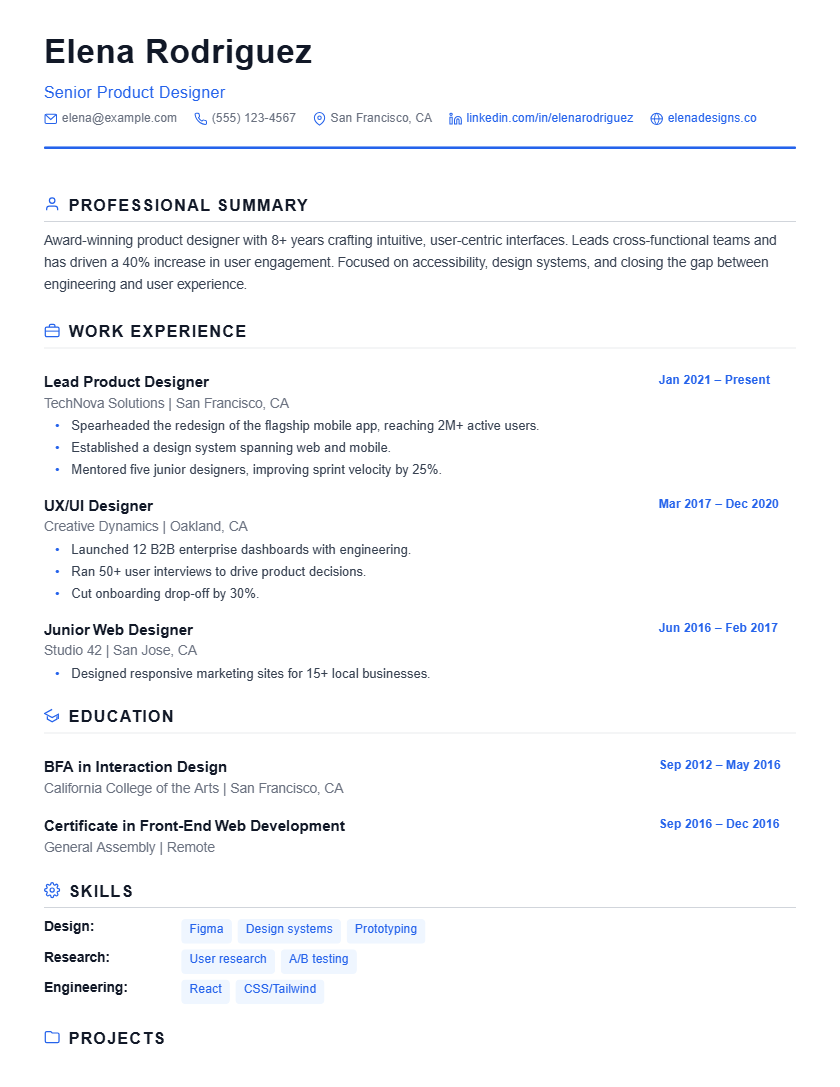
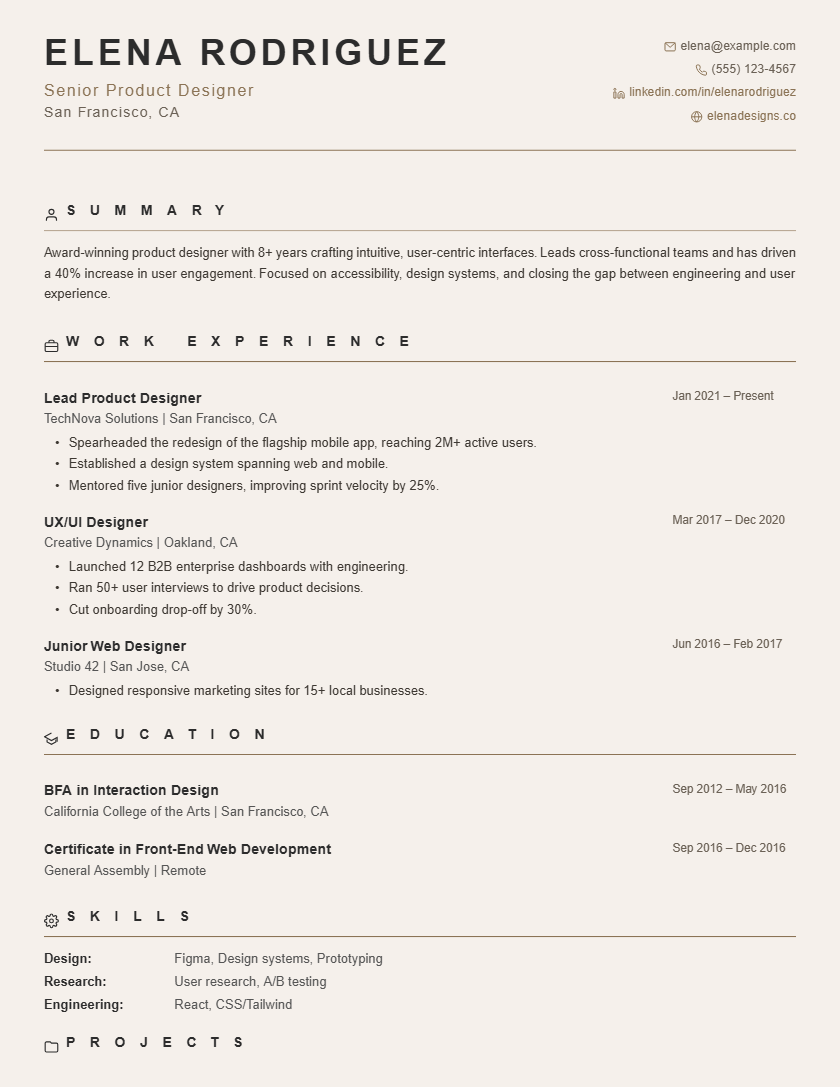
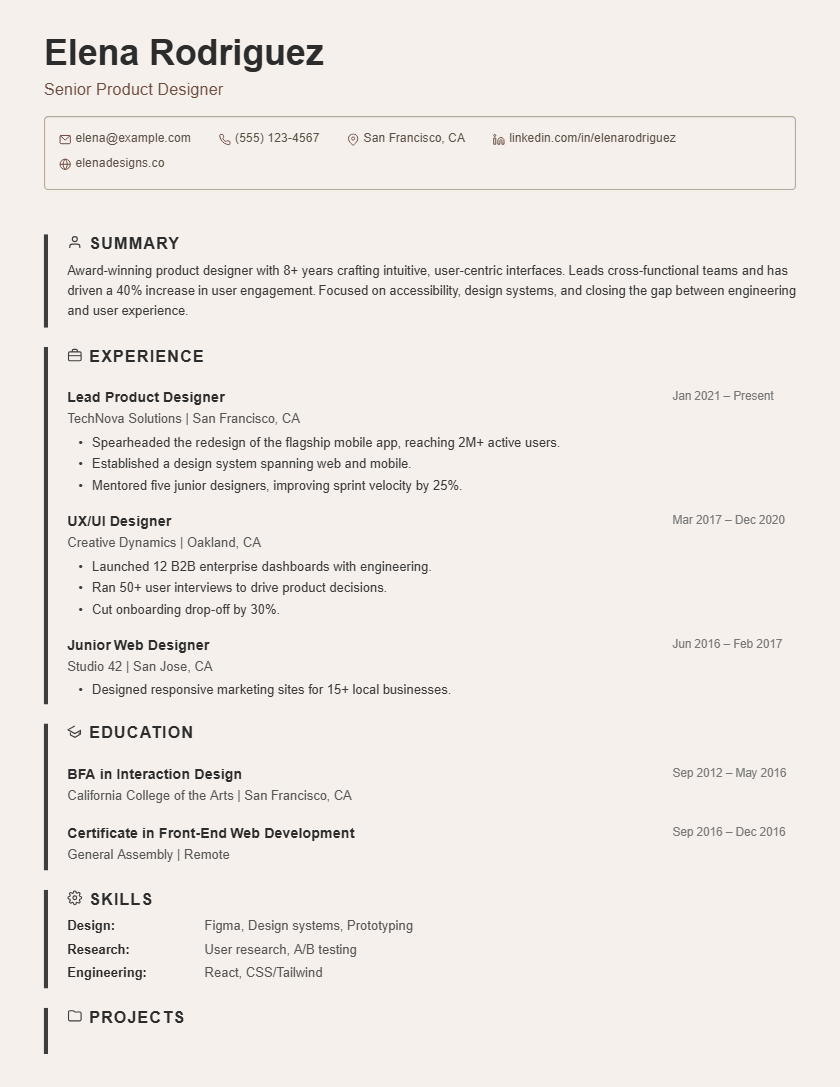
One column, reverse-chronological order and standard section headings, with every figure written as text. Put OTR/L, the license state and your setting in the headline. Name the patient groups and the measures your setting uses. List the license, NBCOT certification and specialty credentials with dates. This example uses Green Academic. The same content works in Standard, Warm Classic and Beige Border.

Shown above: Green Academic

  • Standard template
    StandardFree
  • Warm Classic template
    Warm Classic
  • Beige Border template
    Beige Border

09Questions occupational therapists ask

What does OTR/L mean on a resume?

OTR means Occupational Therapist, Registered, the credential from the National Board for Certification in Occupational Therapy, and the L means licensed by a state. Write OTR/L after your name and in your headline. List the state license and NBCOT certification separately in a certifications section with dates. NBCOT certification renews every three years with at least 36 units of professional development.

What numbers should an occupational therapist put on a resume?

Use the measures your setting keeps. Acute care: patients a day, evaluations and discharge recommendations. Inpatient rehabilitation: self-care score gains, discharge to the community and therapy minutes. Skilled nursing and home health: productivity and visits. Schools: caseload and goals met. Add caregivers trained, home evaluations and supervision. Always give the number of patients behind an average, so the reader can tell a pattern from a single good case.

How should a new graduate occupational therapist write a resume?

Put education first, then fieldwork. Give each level II placement its setting and length, and say when you carried a full caseload. List the state license, NBCOT certification and BLS with dates, or the date you expect them. Postings for new graduates ask mainly for the degree, the license or eligibility, and BLS, so make those easy to find at the top.

Should an occupational therapist list productivity on a resume?

If you work in a setting that tracks it, yes. Give your figure and the target, and put your caseload beside it so the reader can see the work behind the number. Practitioner writers note that targets vary widely by setting and employer, so give context. A therapist who met a target while keeping strong outcomes shows both efficiency and care.

Which certifications help an occupational therapist?

The state license and NBCOT certification come first, and most hospitals also require Basic Life Support. Specialty credentials depend on your patients: the Certified Brain Injury Specialist for neuro rehabilitation, hand therapy certification for outpatient hand clinics, and others for pediatrics or driver rehabilitation. List them with dates, and name them in your headline when they match the posting, because a matching credential is often the first filter.

How do I move from occupational therapist to therapy manager?

Show the parts of management you already do. Supervising assistants and fieldwork students, mentoring new graduates, building groups or programs, and improving a unit measure all count. Give numbers for each. Manager postings ask for staffing, productivity and compliance results, so a resume showing that you moved a unit metric, with the numbers before and after, reads as ready for the role.

Free to start

Build your occupational therapist resume

No card, no trial that turns into a charge.

Sign up free