Customer success manager resume examples & writing guide for 2026

Three customer success manager resumes at SMB, mid-market and team-leader level, rendered in a real template and annotated note by note. Every one sizes the book in accounts and annual recurring revenue, then gives gross and net retention on it.

By the Resumi editorial teamUpdated 8 min read

Showing the mid-level example

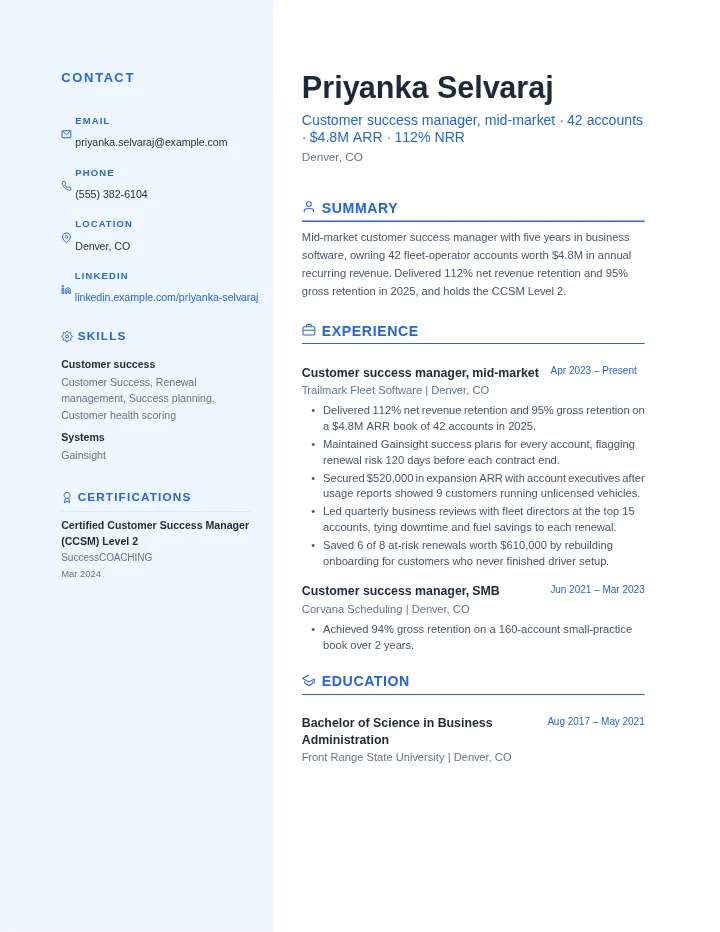
Customer success manager resume example, mid level, rendered in the Blue Professional template
Strength: Strong

Written by the Resumi editorial team for a fictional candidate. Role facts come from O*NET and the U.S. Bureau of Labor Statistics.

Strength band is Resumi’s optimization score, not a ranking any employer sees.

What makes this resume work

Each marker on the page has a note here. Press a marker to jump to its note.

  1. 1

    Segment, book and NRR together

    Mid-market, 42 accounts, $4.8M and 112% net revenue retention. The segment matters because account counts and retention norms differ between SMB, mid-market and enterprise books.

  2. 2

    Certification placed after the numbers

    CCSM Level 2 at the end of the summary. A certification shows method, but hiring managers look for retention and expansion first, so it supports the numbers rather than leading them.

  3. 3

    Gross and net side by side

    Ninety-five percent gross and 112% net. Net retention can hide churn behind a few large upsells, so a reader who sees both knows the book was kept as well as grown.

  4. 4

    Expansion found in the data

    Five hundred and twenty thousand dollars from 9 customers running unlicensed vehicles. The bullet shows how the opportunity was found, and that the CSM worked it with the account executives.

  5. 5

    Renewals saved with the cause named

    Six of 8 at-risk renewals saved, worth $610,000, by fixing unfinished setup. Naming the root cause shows the save came from solving a problem, not from a discount.

01The example, in full

The resume shown above, as text you can search and copy.

Priyanka Selvaraj

Customer success manager, mid-market · 42 accounts · $4.8M ARR · 112% NRR

Denver, COpriyanka.selvaraj@example.com(555) 382-6104linkedin.example.com/priyanka-selvaraj

Summary

Mid-market customer success manager with five years in business software, owning 42 fleet-operator accounts worth $4.8M in annual recurring revenue. Delivered 112% net revenue retention and 95% gross retention in 2025, and holds the CCSM Level 2.

Experience

Customer success manager, mid-market

Apr 2023 – Present

Trailmark Fleet Software · Denver, CO

  • Delivered 112% net revenue retention and 95% gross retention on a $4.8M ARR book of 42 accounts in 2025.
  • Maintained Gainsight success plans for every account, flagging renewal risk 120 days before each contract end.
  • Secured $520,000 in expansion ARR with account executives after usage reports showed 9 customers running unlicensed vehicles.
  • Led quarterly business reviews with fleet directors at the top 15 accounts, tying downtime and fuel savings to each renewal.
  • Saved 6 of 8 at-risk renewals worth $610,000 by rebuilding onboarding for customers who never finished driver setup.

Customer success manager, SMB

Jun 2021 – Mar 2023

Corvana Scheduling · Denver, CO

  • Achieved 94% gross retention on a 160-account small-practice book over 2 years.

Education

Bachelor of Science in Business Administration

Aug 2017 – May 2021

Front Range State University · Denver, CO

Skills

Customer success
Customer Success, Renewal management, Success planning, Customer health scoring
Systems
Gainsight

Certifications

Certified Customer Success Manager (CCSM) Level 2

Mar 2024

SuccessCOACHING

02Market snapshot

Median pay
$104,920 median annual pay for technical and scientific products sales representatives
Typical education
Bachelor's degree typical for technical and scientific products
Job outlook
1% growth for the technical and scientific group, 2025 to 2035
Common credentials
No license required. Sales certifications such as Certified Sales Professional are optional

Sources: BLS OES (May 2025) · BLS OOH (2025)

03The same resume at three levels

The tinted row is the level shown above.

  • Entry-level

    0–2 years

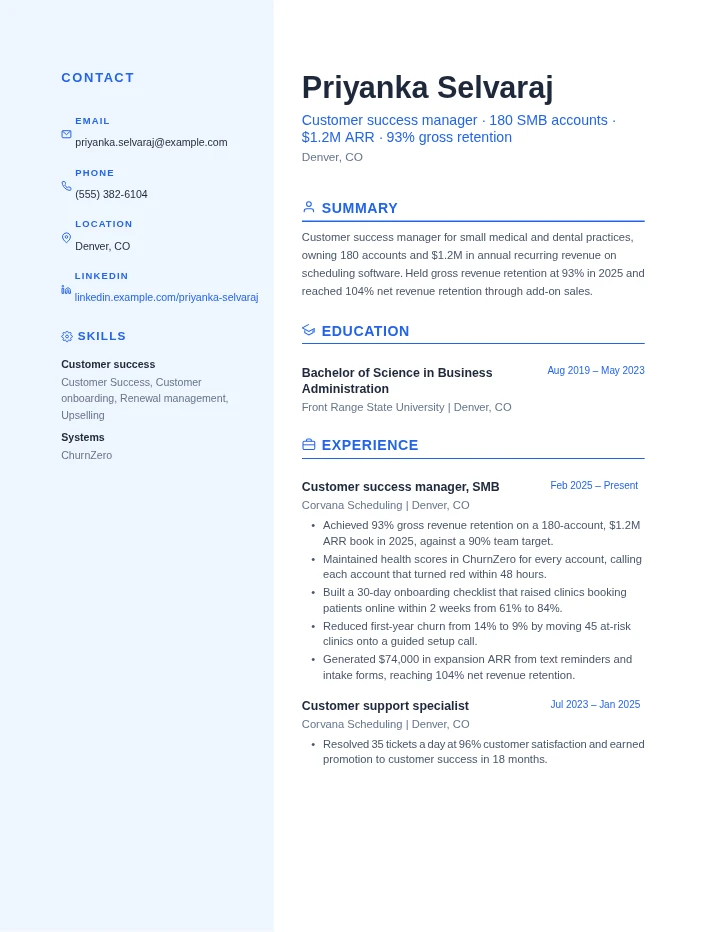
    Education sits above the jobs, and the headline gives accounts, recurring revenue and gross retention. Bullets cover retention against target, health scores in the success platform, onboarding outcomes, first-year churn and expansion. The support years fold to one line with satisfaction and a promotion.

    Typical titles: Customer success manager, SMB, Customer success associate, Onboarding specialist

  • Mid-level

    3–6 years

    The headline adds the segment and net retention. Bullets give gross and net retention, success plans with renewal risk flagged early, expansion found in usage data, business reviews with fleet directors and renewals saved. The SMB years fold to one line with retention on a larger book.

    Typical titles: Customer success manager, Mid-market customer success manager, Account manager

  • Senior

    7+ years

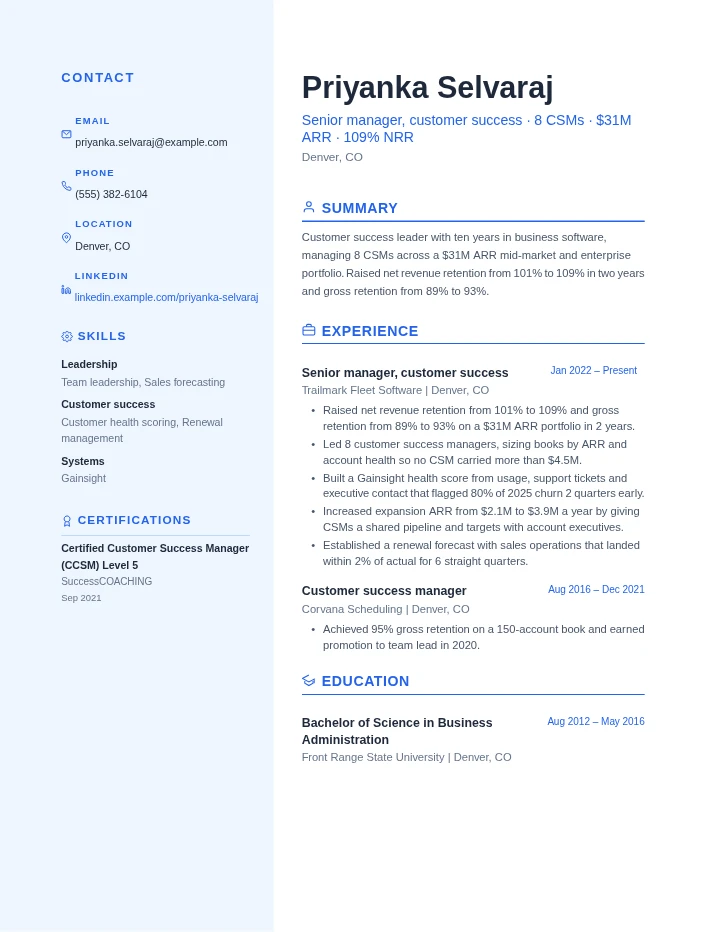
    Scope replaces the personal book: the portfolio's gross and net retention, the team and how books were sized, a health score that predicted churn, expansion with account executives and a renewal forecast. The earlier CSM years fold to one line with retention and a promotion.

    Typical titles: Senior manager, customer success, Director of customer success, Customer success team lead

04Summary

Weak

Customer-obsessed success professional passionate about building lasting relationships, driving adoption and delivering exceptional experiences that turn customers into advocates.

Strong

Mid-market customer success manager with five years in business software, owning 42 fleet-operator accounts worth $4.8M in annual recurring revenue. Delivered 112% net revenue retention and 95% gross retention in 2025, and holds the CCSM Level 2.

The segment, the book in accounts and recurring revenue, both retention numbers and a certification. A hiring manager can compare this book with the one they need covered in one read. The weak version promises advocates without a customer, a renewal or a number.

05Bullets

Weak

  • Worked closely with customers to ensure satisfaction, drive product adoption and identify upsell opportunities.

Strong

  • Saved 6 of 8 at-risk renewals worth $610,000 by rebuilding onboarding for customers who never finished driver setup.

A count of renewals at risk and saved, their value and the cause that was fixed. A hiring manager can ask how the risk was spotted so early and what exactly changed in onboarding. The weak bullet names no account, no renewal and no result, so it could describe almost any customer-facing job in any industry at all.

06Skills and keywords

Customer success

  • Customer Success (in the example)
  • Renewal management (in the example)
  • Success planning (in the example)
  • Customer health scoring (in the example)
  • Customer onboarding
  • Upselling

Commercial

  • Net revenue retention (in the example)
  • Quarterly business reviews (in the example)
  • Account Management
  • Sales forecasting

Systems

  • Gainsight (in the example)
  • ChurnZero
  • Salesforce
  • SQL

Filled chips appear in the example above.

Paste a job description and Resumi shows which of these your resume already covers.

Build your customer success manager resume

07Mistakes to avoid

  1. No book size

    Fix: Give the number of accounts and the recurring revenue you own, and the segment, such as SMB, mid-market or enterprise. A retention figure means little until the reader knows whether it covers 20 large accounts or 300 small ones.

  2. Only net retention reported

    Fix: Net revenue retention can look strong while customers leave, if a few accounts expand a lot. Give gross retention beside it, so a hiring manager can see you kept the book as well as grew it.

  3. Activities listed instead of outcomes

    Fix: Calls held and business reviews run are activities. Say what changed for the customer and for the company: renewals saved, adoption raised, onboarding finished faster, or expansion signed. Postings now ask for retention and expansion ownership in plain terms.

  4. Churn reduced with no baseline

    Fix: A drop in churn needs a start, an end and a period, and ideally the segment. Fourteen percent to 9% first-year churn on small clinics tells a reader far more than reduced churn by a third.

  5. Certification leading the resume

    Fix: Certifications show you know the method, but hiring managers screen on renewals, retention and expansion. List them in a certifications section and mention one in the summary at most, after the numbers.

08Format and template

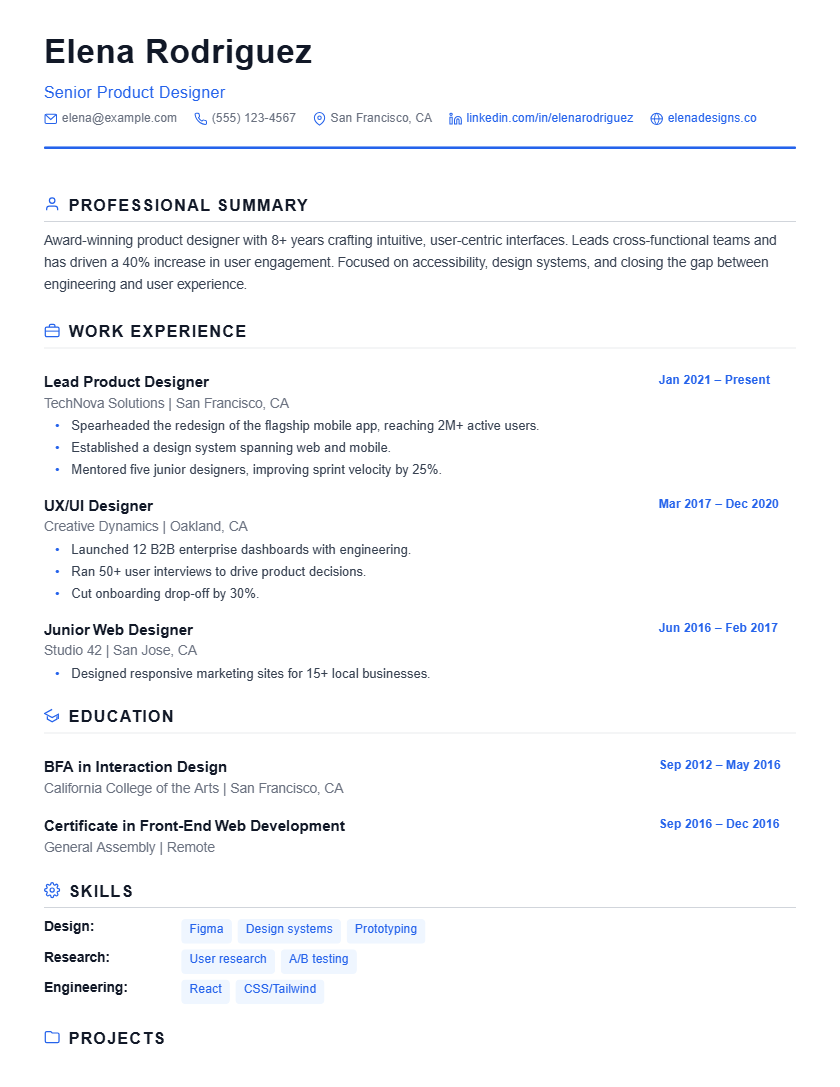
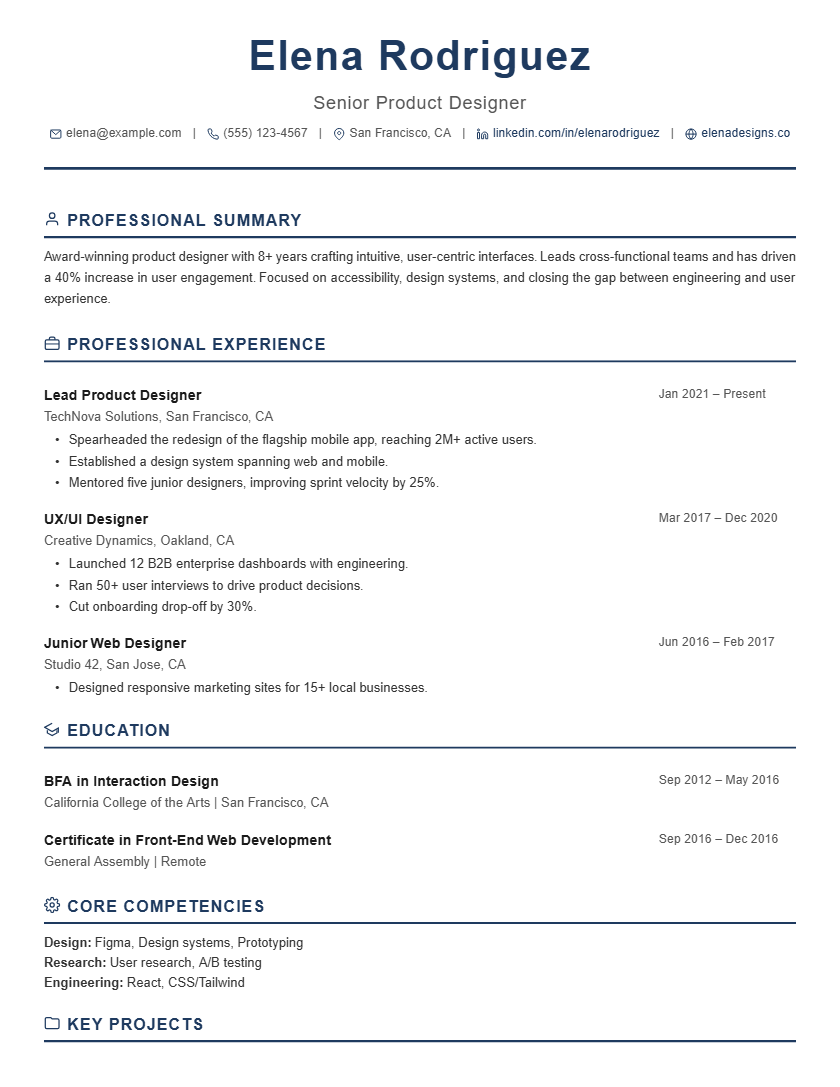
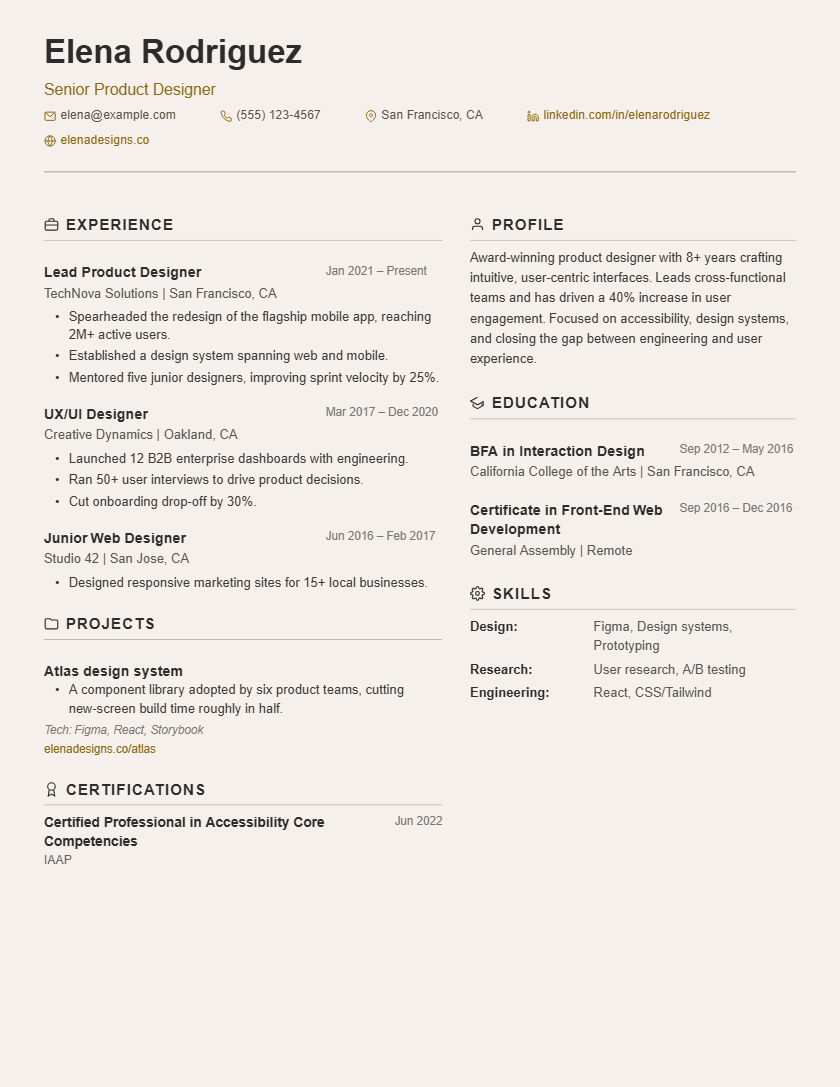
Reverse-chronological order, standard section headings, and every figure written as text. Put the segment, the book and a retention number in the headline. Write ARR in full once, as annual recurring revenue, then use the short form. Name the success platform you used, such as Gainsight or ChurnZero. This example uses Blue Professional. The same content works in Standard, Executive Classic and Beige Two-Column.

Shown above: Blue Professional

  • Standard template
    StandardFree
  • Executive Classic template
    Executive Classic
  • Beige Two-Column template
    Beige Two-Column

09Questions customer success managers ask

What metrics should a customer success manager put on a resume?

Start with your book: accounts, annual recurring revenue and segment. Then give gross revenue retention, net revenue retention and expansion revenue, each with a period. Add onboarding outcomes, churn with a baseline, renewals saved and forecast accuracy where they apply. Postings from software companies name renewals, retention, adoption and expansion again and again, so those numbers carry the most weight with a hiring manager.

What is the difference between gross and net revenue retention?

Gross revenue retention measures how much recurring revenue you kept from existing customers, counting losses and downgrades but not upsells, so it can never pass 100%. Net revenue retention adds expansion, so it can. A book can show strong net retention while losing many customers, if a few grew a lot. That is why a resume showing both figures reads as more honest than one alone.

Is a customer success certification worth getting?

It can help, especially early on. SuccessCOACHING's CCSM runs in five levels, each with about 18 hours of training and a proctored exam. A certification shows you know the method, but hiring managers still decide on retention, renewals and expansion. List it in a certifications section, and if you mention it in the summary, put it after the numbers rather than in front of them.

How do I move from support into customer success?

Show the customer outcomes you already affect. Tickets resolved, satisfaction scores, accounts you helped keep, onboarding calls you ran and product feedback you passed on all count. Many CSM postings ask for a year or two of support, onboarding or account work, so the move is common. Ask to shadow a CSM's business reviews, and add any renewal or expansion you influenced to your resume.

Should a CSM resume show sales or quota numbers?

Yes, if you carried them. Many CSM roles now share renewal and expansion targets with account executives, and some pay commission on them. Give the target and how you did against it, such as expansion ARR against plan. If you had no quota, show the expansion you surfaced and the account executives you worked with, so the reader can see your commercial work.

How many accounts does a customer success manager usually manage?

It depends on the segment and the company, and postings rarely give a number. Small-business books hold many accounts of low value, and enterprise books a few large ones. The old rule of one CSM per $1M in recurring revenue is now described as unreliable, so state your own book plainly. Give the account count and the recurring revenue together, and the reader can place you.

Free to start

Build your customer success manager resume

No card, no trial that turns into a charge.

Sign up free