Welder resume examples & writing guide for 2026

Three welder resumes at structural, pipe and crew-lead level, rendered in a real template and pulled apart line by line. Each one opens with a qualification block, because almost every employer tests you anyway and the page decides which coupon gets cut.

By the Resumi editorial teamUpdated 10 min read

Showing the mid-level example

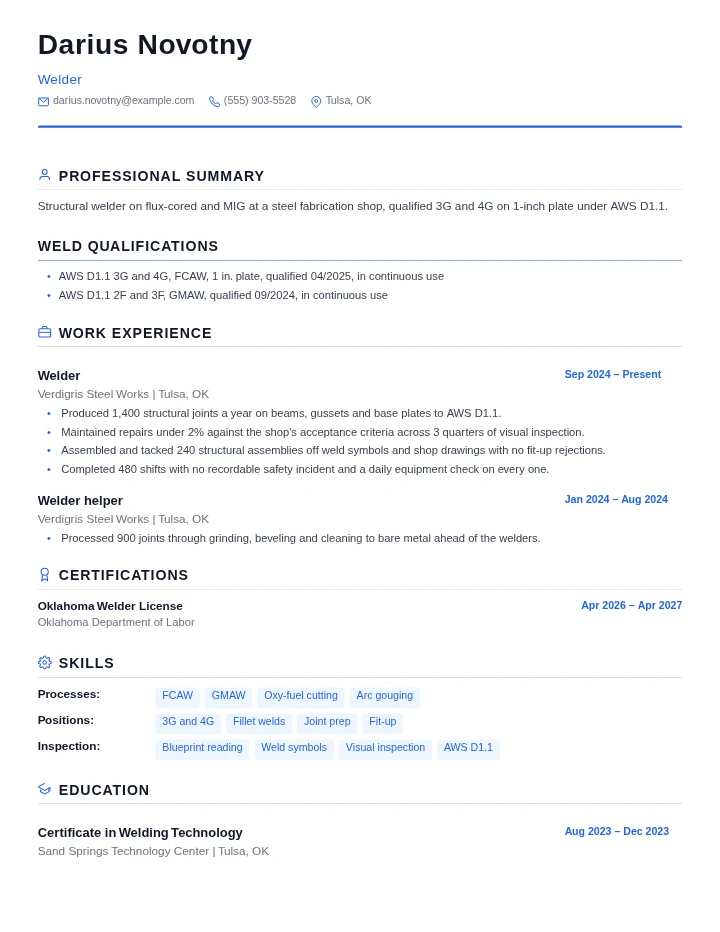
Welder resume example, mid level, rendered in the Standard template
Strength: Excellent

Written by the Resumi editorial team for a fictional candidate. Role facts come from O*NET and the U.S. Bureau of Labor Statistics.

Strength band is Resumi’s optimization score, not a ranking any employer sees.

What makes this resume work

Each marker on the page has a note here. Press a marker to jump to its note.

  1. 1

    Two processes on one joint

    TIG root with flux-cored fill and cap is how pipe actually gets welded, and naming the split shows the reader which half of the joint this welder owns rather than a vague list of processes.

  2. 2

    Diameter, schedule, alloy

    Six inch schedule forty, carbon steel and 316L. A 6G qualification covers every position on plate and pipe, but the reader still wants the size and the metal, because that is what their work is made of.

  3. 3

    Radiography, with the criteria

    Under three percent repairs against the code's own acceptance criteria. Naming the standard is what stops a percentage reading as invented, and a shop foreman recognizes an invented one instantly.

  4. 4

    Tests passed first time

    Four qualification tests, all first attempt, one of them a 6G stainless coupon. Nobody publishes a pass rate for the trade, so a first-attempt record is a scarce and entirely checkable claim.

  5. 5

    The transferable credential named

    The certified welder program is performance-tested at an accredited facility and is not tied to an employer or a project, which makes it the one credential here that actually travels between shops.

Build your welder resume

Free to start · no card

01The example, in full

The resume shown above, as text you can search and copy.

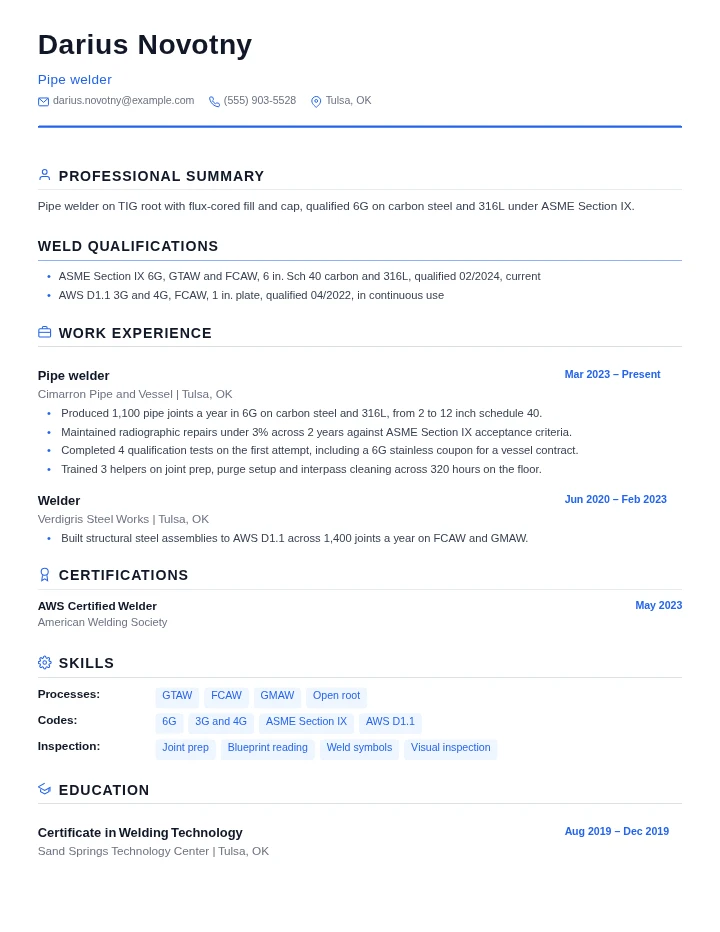
Darius Novotny

Pipe welder

Tulsa, OKdarius.novotny@example.com(555) 903-5528

Summary

Pipe welder on TIG root with flux-cored fill and cap, qualified 6G on carbon steel and 316L under ASME Section IX.

Experience

Pipe welder

Mar 2023 – Present

Cimarron Pipe and Vessel · Tulsa, OK

  • Produced 1,100 pipe joints a year in 6G on carbon steel and 316L, from 2 to 12 inch schedule 40.
  • Maintained radiographic repairs under 3% across 2 years against ASME Section IX acceptance criteria.
  • Completed 4 qualification tests on the first attempt, including a 6G stainless coupon for a vessel contract.
  • Trained 3 helpers on joint prep, purge setup and interpass cleaning across 320 hours on the floor.

Welder

Jun 2020 – Feb 2023

Verdigris Steel Works · Tulsa, OK

  • Built structural steel assemblies to AWS D1.1 across 1,400 joints a year on FCAW and GMAW.

Education

Certificate in Welding Technology

Aug 2019 – Dec 2019

Sand Springs Technology Center · Tulsa, OK

Skills

Processes
GTAW, FCAW, GMAW, Open root
Codes
6G, 3G and 4G, ASME Section IX, AWS D1.1
Inspection
Joint prep, Blueprint reading, Weld symbols, Visual inspection

Certifications

AWS Certified Welder

May 2023

American Welding Society

02Market snapshot

Median pay
$53,750 median annual pay for welders, cutters, solderers and brazers, or $25.84 an hour
Typical education
A high school diploma is typical entry, with moderate-term on-the-job training
Job outlook
Projected to grow 2 percent from 2025 to 2035, with about 40,300 openings a year
Common credentials
No national license, and the finder returns only 8 state records for the occupation

Sources: BLS OOH (2026) · CareerOneStop (2026)

03The same resume at three levels

The tinted row is the level shown above.

  • Entry-level

    0–2 years

    The qualification block sits above the work history on all three levels, which is unusual and deliberate. Almost every serious employer weld-tests the candidate anyway, so the resume is not proof of skill. Its job is to tell the foreman which coupon to cut, and that answer is process, position, material and code.

    Typical titles: Welder, Fabrication welder, Welder helper

  • Mid-level

    3–6 years

    Pipe work is where the qualification block earns its place. A 6G test covers every position on both plate and pipe, so naming it is efficient, but the diameter, the schedule and the alloy still have to be there. Repairs are the one performance number here, and it carries the standard it was judged against.

    Typical titles: Pipe welder, Welder fitter, Combination welder

  • Senior

    7+ years

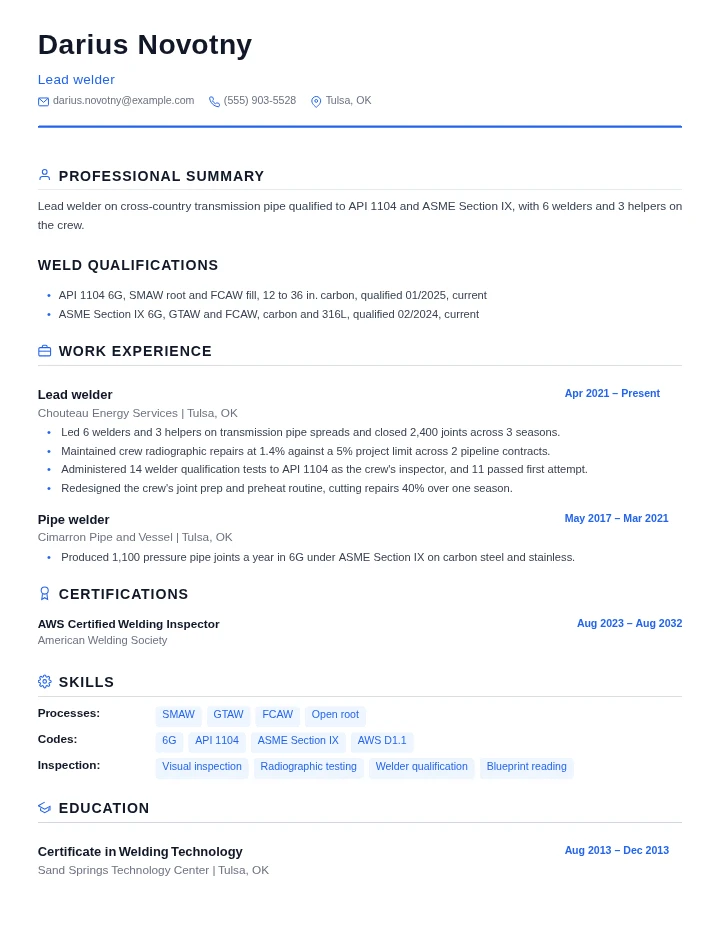
    At crew level the numbers stop being about one welder. Repairs are reported for the whole spread against a contract limit, tests are administered rather than taken, and the prep routine is something this welder rebuilt for other people. The inspector credential is what makes all three claims readable.

    Typical titles: Lead welder, Welding foreman, Certified welding inspector

04Summary

Weak

Skilled and safety-conscious welder with extensive hands-on experience in a variety of welding processes and a strong attention to detail in fast-paced fabrication environments.

Strong

Pipe welder on TIG root with flux-cored fill and cap, qualified 6G on carbon steel and 316L under ASME Section IX. AWS Certified Welder, with both processes in continuous use since qualifying.

Process split, position, materials, code and continuity, in two sentences. A foreman can decide from that alone which coupon to cut. The weak version names no process, no position, no code and no metal, which means the reader learns nothing they could act on and has to phone to find out.

05Bullets

Weak

  • Responsible for performing welding operations on a variety of metals and materials while following all safety procedures and quality standards in the shop.

Strong

  • Maintained radiographic repairs under 3% across 2 years against ASME Section IX acceptance criteria.

A percentage that names the standard it was judged against, over a period long enough to mean something. Shop foremen see invented quality percentages constantly and discount them, so the acceptance criteria is the part doing the work. The weak bullet restates the occupation's own definition, which the job title above it already supplied, and every welder in the stack can say it.

06Skills and keywords

Processes

  • GTAW (in the example)
  • FCAW (in the example)
  • GMAW (in the example)
  • SMAW

Codes

  • ASME Section IX (in the example)
  • AWS D1.1 (in the example)
  • API 1104

Prep and layout

  • Joint Prep (in the example)
  • Blueprint Reading (in the example)
  • Weld Symbols (in the example)

Inspection

  • Visual Inspection (in the example)
  • Radiographic Testing (in the example)
  • Certified Welding Inspector

Filled chips appear in the example above.

Paste a job description and Resumi shows which of these your resume already covers.

Build your welder resume

07Mistakes to avoid

  1. Treating a code qualification as a certification you own

    Fix: They are different objects. A qualification is a demonstration, recorded on a performance qualification record the employer prepares and keeps. It usually does not travel with you, which is why the next shop retests. List it as a qualification.

  2. An undated qualification, or a date with no continuity

    Fix: Both major code families tie validity to running the process at least once every six months, documented by the employer. A qualification listed with a five-year-old date is a claim the code says is false. Write the month and whether you have run it since.

  3. Naming the letters without the code

    Fix: D1.1 is structural steel, D1.5 is bridge work under a separate and stricter code, D17.1 is aerospace, Section IX is pressure and API 1104 is pipeline. Naming the wrong one is worse than naming none, because it says you have not read the document.

  4. Invented quality percentages

    Fix: No published benchmark exists for weld test pass rate, repair rate, radiographic pass rate or arc-on time. A number that sounds like an industry figure was invented by somebody. Get yours from your qualification records, your weld log or your inspector, and print the acceptance criteria beside it.

  5. One resume aimed at every segment

    Fix: Shipyards talk in class levels and coupon materials, pipeline in API 1104 and root and hot pass, aerospace in D17.1 and purge and borescope, production in fixtures and cycle time. No single page sounds native in all four. Pick the segment before you write the bullets.

08Format and template

Summary, then a qualification block, then the work history. That order is unusual and it is the point: the block is what a foreman reads first, and it tells them which test to set up. Certifications come after the history, because a license and a transferable credential are different objects from a code qualification and should not sit in the same list. Head the resume with the exact title the posting uses. This example uses Standard. The same content works in Brown Sidebar, Blue Professional and Executive Classic.

Shown above: Standard

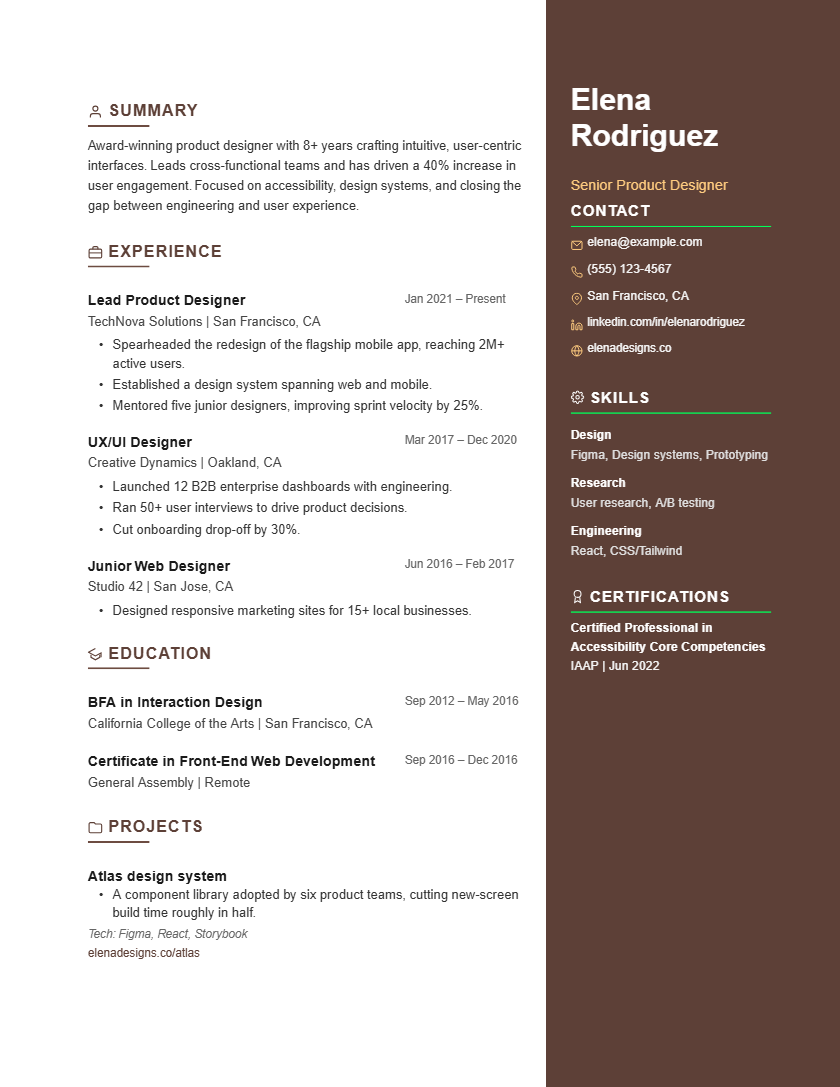
  • Brown Sidebar template
    Brown Sidebar
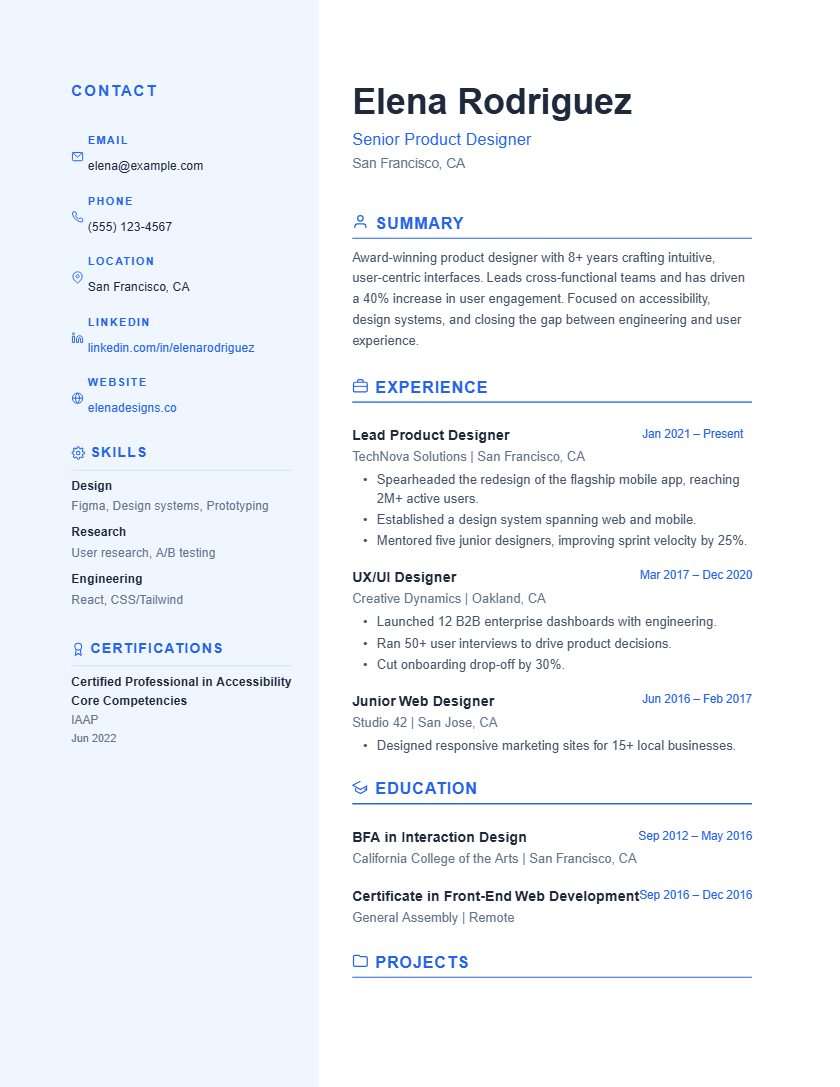
  • Blue Professional template
    Blue Professional
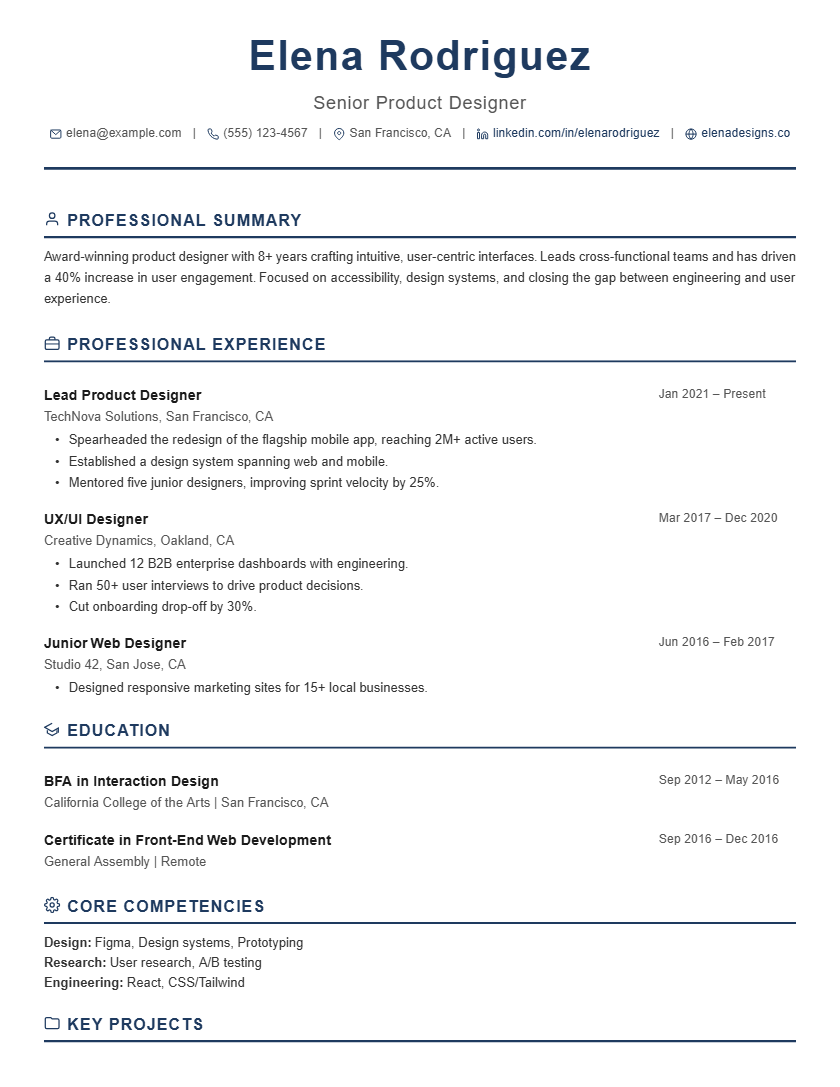
  • Executive Classic template
    Executive Classic

09Questions welders ask

Are my welding certifications actually mine?

Usually not, and this is the most useful thing to understand about the credentials section. A code qualification is a demonstration that you produced a weld meeting a standard, and the written verification of it is a record the employer prepares and holds. The employer carries legal responsibility for the welds, which is why the next shop retests you rather than accepting the paperwork. The exception is the certified welder program run by the welding society, which is performance-tested at an accredited facility and is explicitly not tied to an employer, a project or a location.

How long does a welding qualification last?

It expires from disuse rather than from age. Both of the major code families require that you use the qualified process at least once every six months, with the employer documenting it, or the qualification lapses. That means a welder coming back from a layoff, a stretch in another trade, or a long run on a different process is, on paper, no longer qualified. Write the month you qualified and say whether the process has been in continuous use since. A bare date five years old invites the one question you do not want asked.

I do not have a repair rate or a pass rate. What do I use?

Ask, because nobody publishes these and any figure that sounds like an industry standard was made up. Your own records hold the real ones: how many qualification tests you have taken and how many you passed first attempt, what your inspector recorded against your stencil, how many joints of what diameter and position you closed in a season, the thickness and alloy range you have run. If your shop tracks arc time, ask for it. A smaller number you can defend beats an impressive one a foreman can disprove in the booth.

Do I need a license to weld?

In most states, no. The national license finder returns only eight records for this occupation, and they are narrow: a handful of states license welders as individuals, one licenses a field welder for its transport department, and at least one entry is a welding contractor business license rather than a personal one. So a license, a transferable credential and a code qualification are three different things, and a resume that files them all under certifications loses information. Check your own state labor department, and list a state license as a license.

How do I earn more without changing trades?

Change segment rather than collecting certificates inside the same shop. The federal wage data shows the same occupation averaging over twice as much in air transportation, natural gas distribution and crude oil pipeline work as in the fabricated metal shops that employ the most welders. Pipe, pressure, bridge and field work pay for positions that are hard to hold and for travel most people will not do. The certificate matters because it gets you into those segments, not because it moves the rate inside the one you are in.

Is there really a welder shortage?

Not by headcount, and writing as though there is will date your resume. The handbook projects 2 percent growth over 2025 to 2035, describes it as slower than average, and the occupation carries no bright outlook flag, with the outlook labeled below average elsewhere. What is real is churn: roughly 40,300 openings a year, almost all of them replacing people who left. That changes what the resume is for. You are competing against the last person who held the booth, so evidence that you pass tests, hold qualifications current and do not generate repairs is what converts.

Free to start

Build your welder resume

No card, no trial that turns into a charge.

Sign up free