Carpenter resume examples & writing guide for 2026

Three carpenter resumes at framing, commercial interior and lead level, rendered in a real template and pulled apart line by line. Each one answers the question a superintendent asks first, which is what you can run without being watched.

By the Resumi editorial teamUpdated 9 min read

Showing the mid-level example

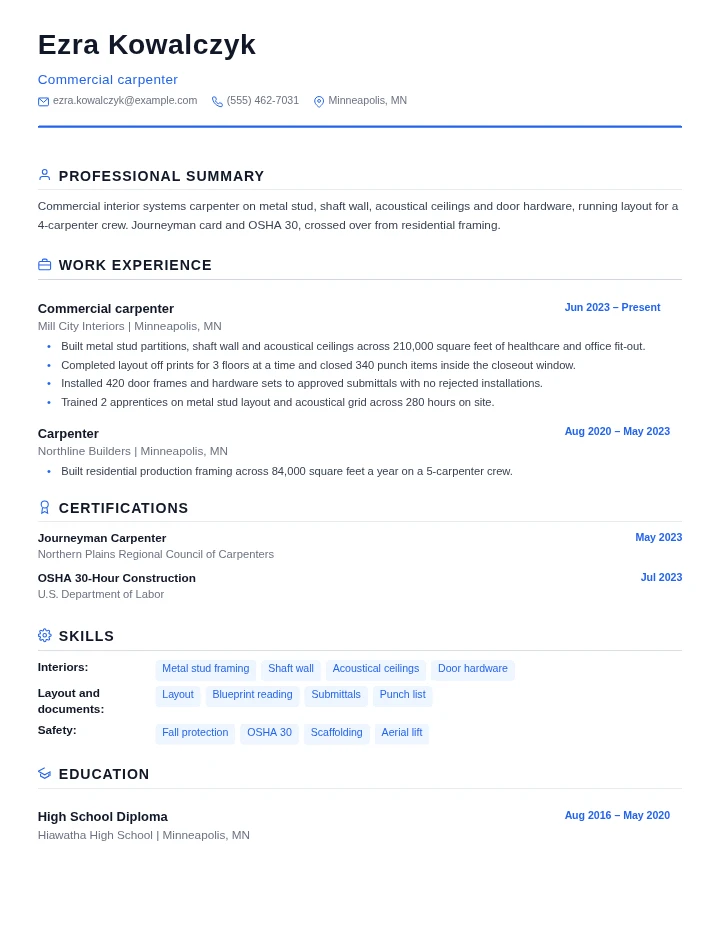
Carpenter resume example, mid level, rendered in the Standard template
Strength: Excellent

Written by the Resumi editorial team for a fictional candidate. Role facts come from O*NET and the U.S. Bureau of Labor Statistics.

Strength band is Resumi’s optimization score, not a ranking any employer sees.

What makes this resume work

Each marker on the page has a note here. Press a marker to jump to its note.

  1. 1

    Commercial vocabulary, used correctly

    Metal stud, shaft wall, acoustical ceilings, door hardware. Residential and commercial barely share a language, and using the right one is how a commercial superintendent decides this resume is aimed at them.

  2. 2

    The crossover said plainly

    Crossed over from residential framing. Saying so is better than hiding it, because the segments pay differently and a hirer who finds the residential history later will wonder what else was left out.

  3. 3

    Building type, not just sector

    Healthcare and office fit-out. A healthcare interior is a different job from a warehouse, and hiring guidance says contractors match against the specific project type rather than against commercial in general.

  4. 4

    Installed to the submittal

    Four hundred and twenty frames and hardware sets, to approved submittals, none rejected. Naming the document the work was measured against is what separates a commercial carpenter from a good residential one.

  5. 5

    The residential line kept

    One line for three years of production framing, with its square footage intact. Keeping the earlier segment rather than deleting it is what makes the crossover legible instead of looking like a gap.

Build your carpenter resume

Free to start · no card

01The example, in full

The resume shown above, as text you can search and copy.

Ezra Kowalczyk

Commercial carpenter

Minneapolis, MNezra.kowalczyk@example.com(555) 462-7031

Summary

Commercial interior systems carpenter on metal stud, shaft wall, acoustical ceilings and door hardware, running layout for a 4-carpenter crew. Journeyman card and OSHA 30, crossed over from residential framing.

Experience

Commercial carpenter

Jun 2023 – Present

Mill City Interiors · Minneapolis, MN

  • Built metal stud partitions, shaft wall and acoustical ceilings across 210,000 square feet of healthcare and office fit-out.
  • Completed layout off prints for 3 floors at a time and closed 340 punch items inside the closeout window.
  • Installed 420 door frames and hardware sets to approved submittals with no rejected installations.
  • Trained 2 apprentices on metal stud layout and acoustical grid across 280 hours on site.

Carpenter

Aug 2020 – May 2023

Northline Builders · Minneapolis, MN

  • Built residential production framing across 84,000 square feet a year on a 5-carpenter crew.

Education

High School Diploma

Aug 2016 – May 2020

Hiawatha High School · Minneapolis, MN

Skills

Interiors
Metal stud framing, Shaft wall, Acoustical ceilings, Door hardware
Layout and documents
Layout, Blueprint reading, Submittals, Punch list
Safety
Fall protection, OSHA 30, Scaffolding, Aerial lift

Certifications

Journeyman Carpenter

May 2023

Northern Plains Regional Council of Carpenters

OSHA 30-Hour Construction

Jul 2023

U.S. Department of Labor

02Market snapshot

Median pay
$60,580 median annual pay for carpenters, or $29.12 an hour
Typical education
No degree needed: 52 percent hold a high school diploma and 18 percent less than that
Job outlook
Projected to grow 4 percent from 2025 to 2035, adding 35,000 jobs
Common credentials
No state licenses a carpenter, and all 9 records the finder returns are contractor licenses

Sources: BLS OOH (2026) · O*NET (2026) · CareerOneStop (2026)

03The same resume at three levels

The tinted row is the level shown above.

  • Entry-level

    0–2 years

    Nothing on this page is invented. No published benchmark exists for square footage framed, doors hung or callbacks, so every figure here comes from somewhere a builder already keeps records: the schedule, the inspection log, the time cards. A number the reader cannot defend is worth less than no number.

    Typical titles: Carpenter, Framing carpenter, Carpenter apprentice

  • Mid-level

    3–6 years

    Crossing from residential to commercial is less about new craft than new vocabulary and a new documentation habit. So this page spends itself on the words a commercial superintendent screens for, the building types they match against, and the two documents, submittals and the punch list, that the work is measured by.

    Typical titles: Commercial carpenter, Interior systems carpenter, Finish carpenter

  • Senior

    7+ years

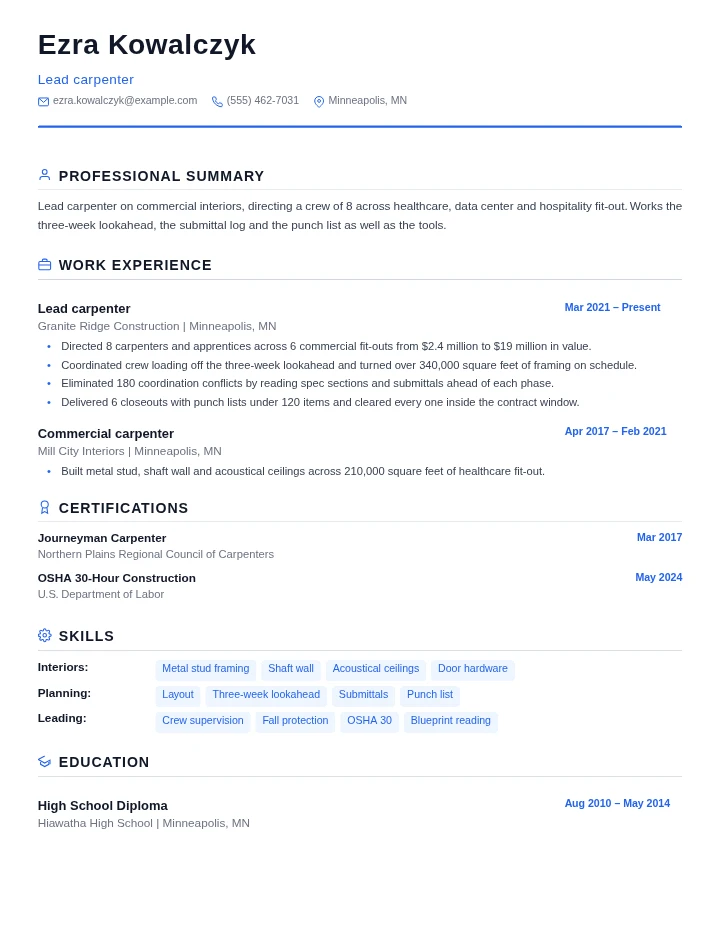
    Above journeyman the job stops being carpentry and starts being sequencing. Crew size, project value, the lookahead, the submittal log and the punch list are what this page spends its space on, and conflicts caught on paper are cheaper than conflicts caught with a crew standing there.

    Typical titles: Lead carpenter, Carpenter foreman, Superintendent

04Summary

Weak

Dedicated and hardworking carpenter with extensive experience in residential and commercial construction, skilled in all aspects of framing, finishing and general carpentry work.

Strong

Commercial interior systems carpenter on metal stud, shaft wall, acoustical ceilings and door hardware, running layout for a 4-carpenter crew. Journeyman card and OSHA 30, crossed over from residential framing.

Segment, four named systems, crew size and two credentials. A superintendent can tell in one line whether to call. The weak version says residential and commercial, which means the reader learns neither, and all aspects of framing is the phrase a candidate reaches for when they cannot name a system.

05Bullets

Weak

  • Responsible for performing a wide range of carpentry duties including framing, installation and finish work according to plans and specifications.

Strong

  • Built metal stud partitions, shaft wall and acoustical ceilings across 210,000 square feet of healthcare and office fit-out.

Three named systems, a square footage and two building types, all in one line. Square footage is the unit a commercial contractor already thinks in, and building type is what they match against. The weak bullet restates the occupation's definition, which the job title above it already supplied, and a wide range is doing the work a system list should do.

06Skills and keywords

Framing

  • Layout (in the example)
  • Blueprint Reading (in the example)
  • Rough Framing
  • Roof Framing

Commercial interiors

  • Metal Stud Framing (in the example)
  • Acoustical Ceilings (in the example)
  • Shaft Wall (in the example)
  • Door Hardware (in the example)

Documents

  • Submittals (in the example)
  • Punch List (in the example)
  • RFI

Safety

  • Fall Protection (in the example)
  • OSHA 30 (in the example)
  • Lead-Safe Renovator

Filled chips appear in the example above.

Paste a job description and Resumi shows which of these your resume already covers.

Build your carpenter resume

07Mistakes to avoid

  1. Writing cabinet maker when you mean installer

    Fix: The federal system runs two occupations with almost the same name. Carpenters carries a $29.12 median. Cabinetmakers and bench carpenters, which sits in production rather than construction, carries $22.44. Write installer if you install on site.

  2. No scale anywhere on the page

    Fix: Contractors want square footage or unit count on your last two or three projects and roughly how many carpenters worked alongside you. They are matching you against a job of a particular size, so experience in general tells them nothing.

  3. Sector instead of building type

    Fix: Commercial is not a project type. Healthcare, data center, hospitality, high-rise and industrial are, and a hirer is matching against the one in front of them. Residential resumes should do the same with product: production tract, custom, multifamily or remodel.

  4. Leaving out the driving record

    Fix: A valid license is close to universal in carpentry postings, and many add a clean record, a motor vehicle check or a medical card. This screen runs before anyone assesses your craft, so put a clean record on the page.

  5. Borrowed production figures

    Fix: No published benchmark exists for square footage framed, linear feet of trim, doors hung or punch turnaround, so a figure that sounds like a norm was invented by somebody. Yours lives in your time cards, a takeoff, a door schedule or the project schedule. Go and get it.

08Format and template

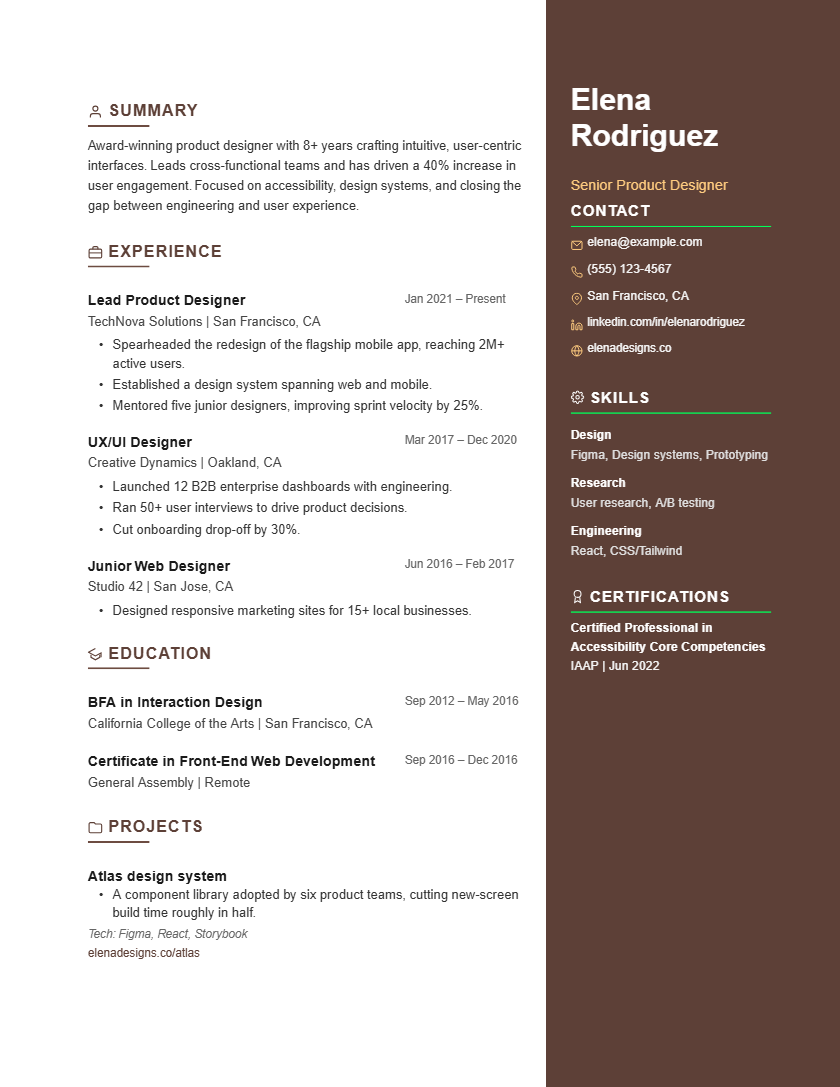
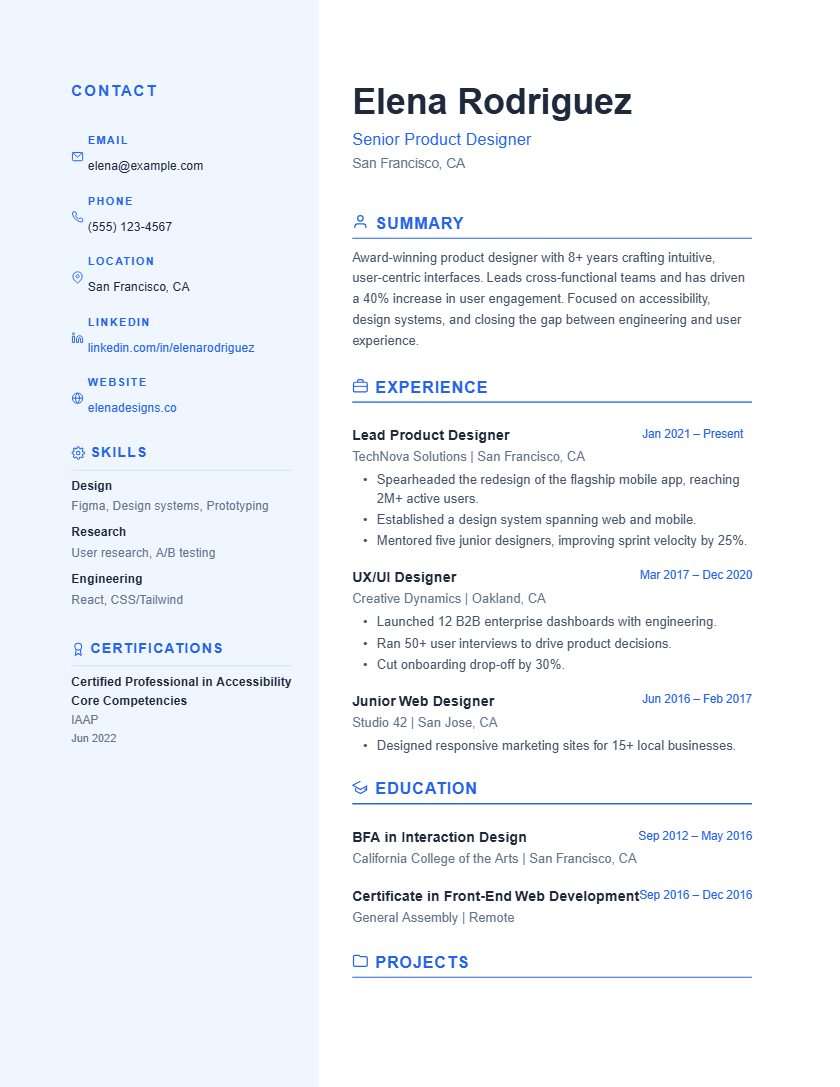
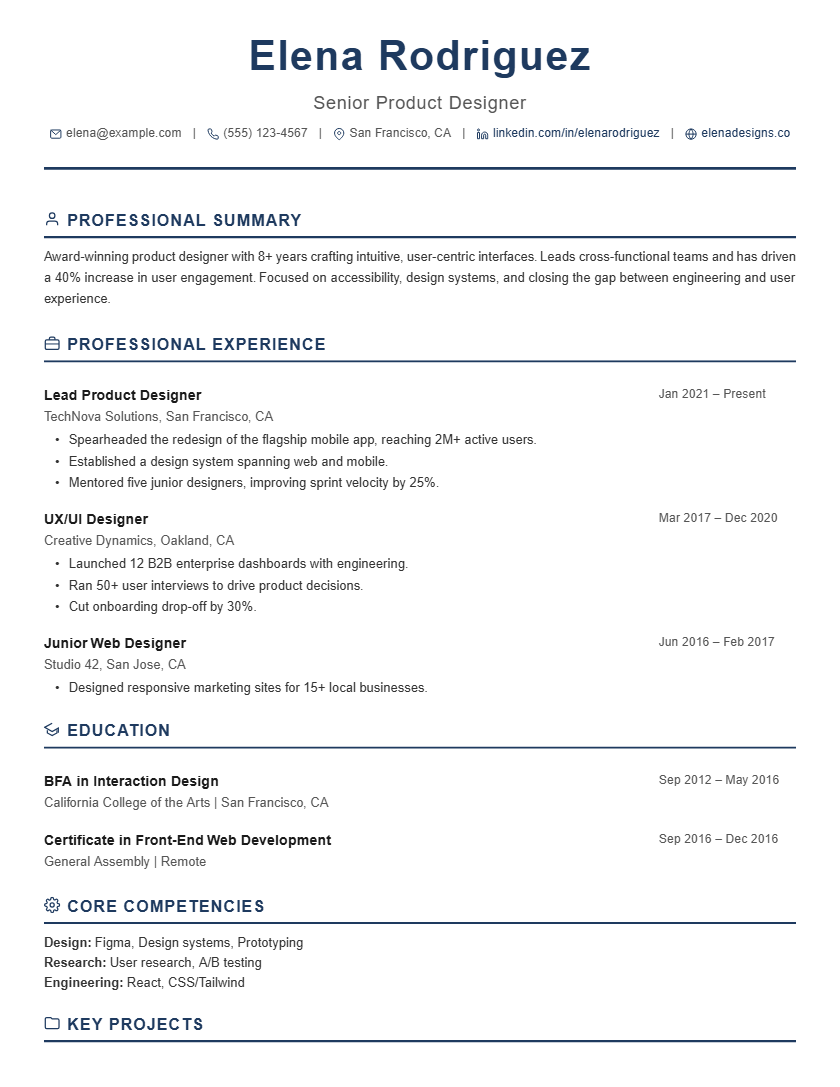
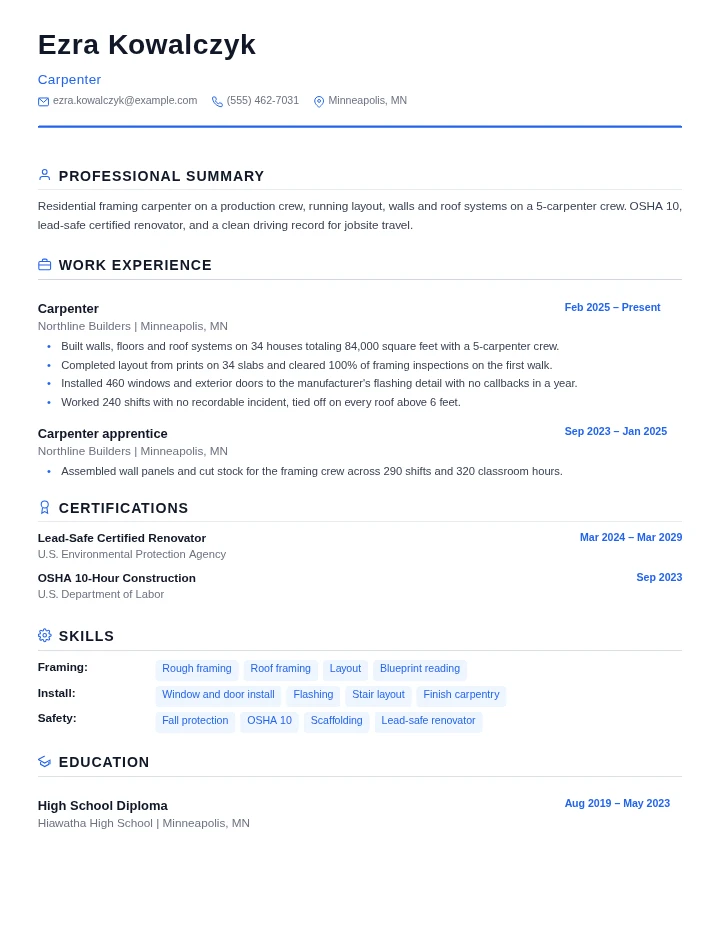
History first, then certifications, then a short skills block, with education last. Nothing in this trade is hired on a diploma, and the card a superintendent asks to see is the safety card. Head the resume with the exact title the posting uses, whether that is carpenter, commercial carpenter, interior systems carpenter or lead. This example uses Standard. The same content works in Brown Sidebar, Blue Professional and Executive Classic. Keep square footage and crew size next to the job they belong to.

Shown above: Standard

  • Brown Sidebar template
    Brown Sidebar
  • Blue Professional template
    Blue Professional
  • Executive Classic template
    Executive Classic

09Questions carpenters ask

Why is every carpenter salary figure I find lower than what I actually make?

Because a quarter of the trade is missing from it. The handbook counts 889,700 carpenter jobs and reports that 25 percent are self-employed. The wage survey behind almost every published salary figure asks establishments, not individuals, so those self-employed carpenters are not in the distribution at all. It counts 670,090. For an occupation where going out on your own is the most common destination, that is a structural blind spot, and it means the published median describes the three-quarters who work for somebody else.

Do I need a license to work as a carpenter?

Not to work for someone else, anywhere in the United States. The national license finder returns nine records for this occupation and every one is a contractor or business license rather than a worker license. The distinction matters: you need a contractor license in many states to take the work yourself, and that is a different credential with a different purpose. What employers actually ask for is a safety card, and the handbook says carpenters must pass the ten-hour course. Beyond that, the only license the handbook mentions is a driver's license.

Is the apprenticeship worth it, or should I just get hired?

It is the one structured route and it is paid from day one, typically at around half of journey scale or better, rising as you go. The union programs run four to five years, combining thousands of on-the-job hours with well over a hundred classroom hours a year, tuition-free. The federal system lists 34 approved apprenticeship titles for this occupation, which is unusually granular and includes separate tracks for interior systems, form work, pile driving and scaffold. It is a minority route rather than the typical path, so treat it as a real option rather than the only one.

How do I move from residential to commercial?

Change the vocabulary before you change the job. Residential talks about baseboard, crown, hardwood, rough framing and concrete. Commercial talks about metal stud, acoustical grid, shaft wall, layout, submittals and door hardware sets. A carpenter crossing over is mostly learning a new language and a new documentation habit rather than new craft. Get references who can speak to commercial-scale work specifically, because hiring-side sources say cross-segment references are discounted, and name building types rather than just saying commercial.

I do not track square footage or punch counts. What do I put?

Go and find them, because they exist somewhere even if you never wrote them down. The builder's schedule has finished square footage. A takeoff or a material invoice has linear feet of trim. The door schedule has the door count. Your superintendent has the punch list from the last closeout. Your time cards have the days. If a number genuinely is not tracked, say so and describe the check you added instead, which is more honest and more interesting than a figure a foreman can disprove.

What gets me from carpenter to lead or foreman?

Planning, not craft. The reason people stall is rarely carpentry skill. It is whether you can read a three-week lookahead and work backwards from it, whether you read spec sections and submittals rather than waiting for someone to tell you, whether you catch coordination conflicts on paper, and whether you address a crew performance problem directly. Put those on the page with numbers attached, and add the supervisor-level safety card, because that combination is what a superintendent is actually buying.

Free to start

Build your carpenter resume

No card, no trial that turns into a charge.

Sign up free