HVAC technician resume examples & writing guide for 2026

Three HVAC resumes at residential, commercial and refrigeration level, rendered in a real template and pulled apart line by line. Each one leads with the EPA card and its type, because that is the first thing a service manager looks for.

By the Resumi editorial teamUpdated 10 min read

Showing the mid-level example

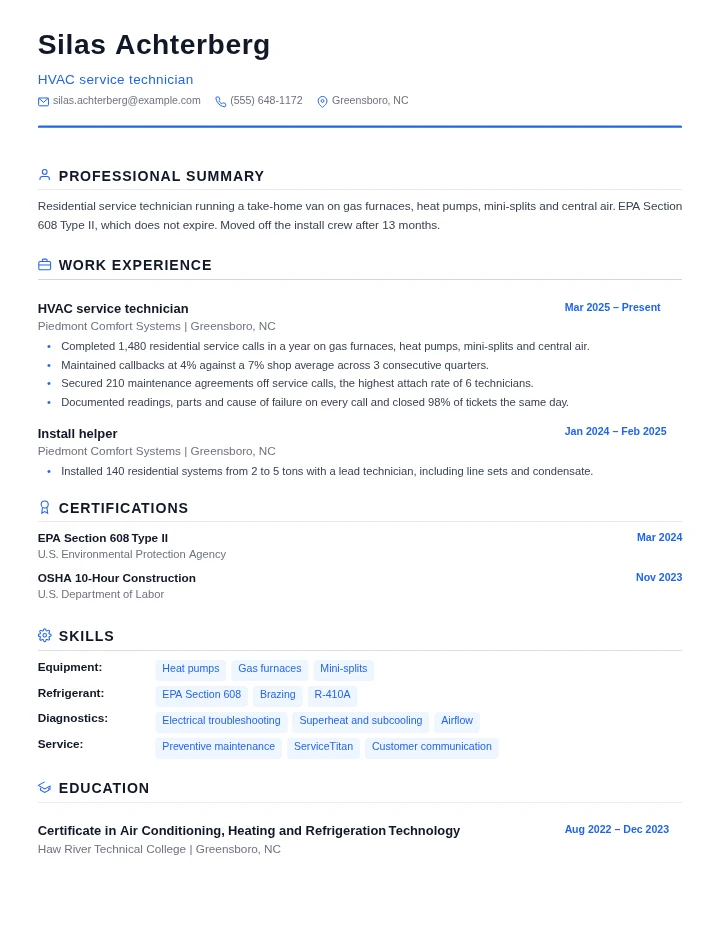
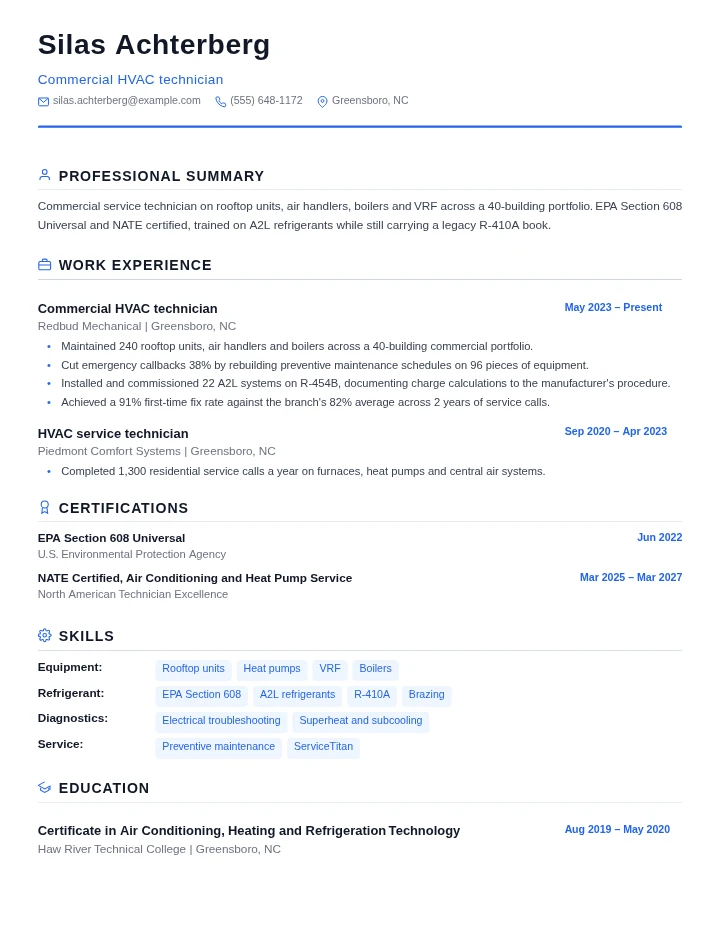
HVAC technician resume example, mid level, rendered in the Standard template
Strength: Excellent

Written by the Resumi editorial team for a fictional candidate. Role facts come from O*NET and the U.S. Bureau of Labor Statistics.

Strength band is Resumi’s optimization score, not a ranking any employer sees.

What makes this resume work

Each marker on the page has a note here. Press a marker to jump to its note.

  1. 1

    The equipment list is the experience

    Rooftop units, air handlers, boilers and variable refrigerant flow. Commercial postings are written as equipment inventories, so a commercial resume that does not enumerate the machines reads as unqualified whatever its years say.

  2. 2

    Both refrigerant families at once

    A2L trained while still carrying a legacy book. New residential and light commercial equipment has been capped at 700 global warming potential since January 2025, and older stock stayed legal to install after a rule change in 2026.

  3. 3

    Preventive work, with its count

    Thirty-eight percent fewer emergency callbacks, off ninety-six pieces of equipment put on a rebuilt schedule. That pairing is what turns a maintenance claim into something a branch manager can picture doing again.

  4. 4

    Commissioning, with the paperwork

    Twenty-two A2L systems started up with charge calculations recorded to the manufacturer's procedure. The documentation half is what separates a technician trained on the new refrigerants from one who has heard of them.

  5. 5

    Universal, and a renewal date

    The Section 608 card never expires, so it carries no date. The technician certification beside it renews every two years, so it does. Printing both correctly shows the candidate knows which is which.

Build your HVAC technician resume

Free to start · no card

01The example, in full

The resume shown above, as text you can search and copy.

Silas Achterberg

Commercial HVAC technician

Greensboro, NCsilas.achterberg@example.com(555) 648-1172

Summary

Commercial service technician on rooftop units, air handlers, boilers and VRF across a 40-building portfolio. EPA Section 608 Universal and NATE certified, trained on A2L refrigerants while still carrying a legacy R-410A book.

Experience

Commercial HVAC technician

May 2023 – Present

Redbud Mechanical · Greensboro, NC

  • Maintained 240 rooftop units, air handlers and boilers across a 40-building commercial portfolio.
  • Cut emergency callbacks 38% by rebuilding preventive maintenance schedules on 96 pieces of equipment.
  • Installed and commissioned 22 A2L systems on R-454B, documenting charge calculations to the manufacturer's procedure.
  • Achieved a 91% first-time fix rate against the branch's 82% average across 2 years of service calls.

HVAC service technician

Sep 2020 – Apr 2023

Piedmont Comfort Systems · Greensboro, NC

  • Completed 1,300 residential service calls a year on furnaces, heat pumps and central air systems.

Education

Certificate in Air Conditioning, Heating and Refrigeration Technology

Aug 2019 – May 2020

Haw River Technical College · Greensboro, NC

Skills

Equipment
Rooftop units, Heat pumps, VRF, Boilers
Refrigerant
EPA Section 608, A2L refrigerants, R-410A, Brazing
Diagnostics
Electrical troubleshooting, Superheat and subcooling
Service
Preventive maintenance, ServiceTitan

Certifications

EPA Section 608 Universal

Jun 2022

U.S. Environmental Protection Agency

NATE Certified, Air Conditioning and Heat Pump Service

Mar 2025

North American Technician Excellence

02Market snapshot

Median pay
$61,010 median annual pay, or $29.33 an hour
Typical education
A postsecondary nondegree award is typical entry, followed by long-term on-the-job training
Job outlook
Projected to grow 11 percent from 2025 to 2035, adding 48,200 jobs
Common credentials
No single national license: the finder returns 148 state credentials for the occupation

Sources: BLS OOH (2026) · CareerOneStop (2026)

03The same resume at three levels

The tinted row is the level shown above.

  • Entry-level

    0–2 years

    Everything here comes from somewhere a service manager can check: the dispatch report, the callback log, the agreement attach list. Nothing is borrowed from an industry average, because no credible published benchmark exists for any of these numbers and an invented one gets asked about in the interview.

    Typical titles: HVAC service technician, HVAC installer, Install helper

  • Mid-level

    3–6 years

    This is where a technician has to pick a lane. Residential and commercial share one federal occupation code but are different jobs with different pay ladders, and the equipment list is what tells a reader which one you have done. First-time fix beside the branch average is the strongest single line here.

    Typical titles: Commercial HVAC technician, HVAC service technician, HVAC mechanic

  • Senior

    7+ years

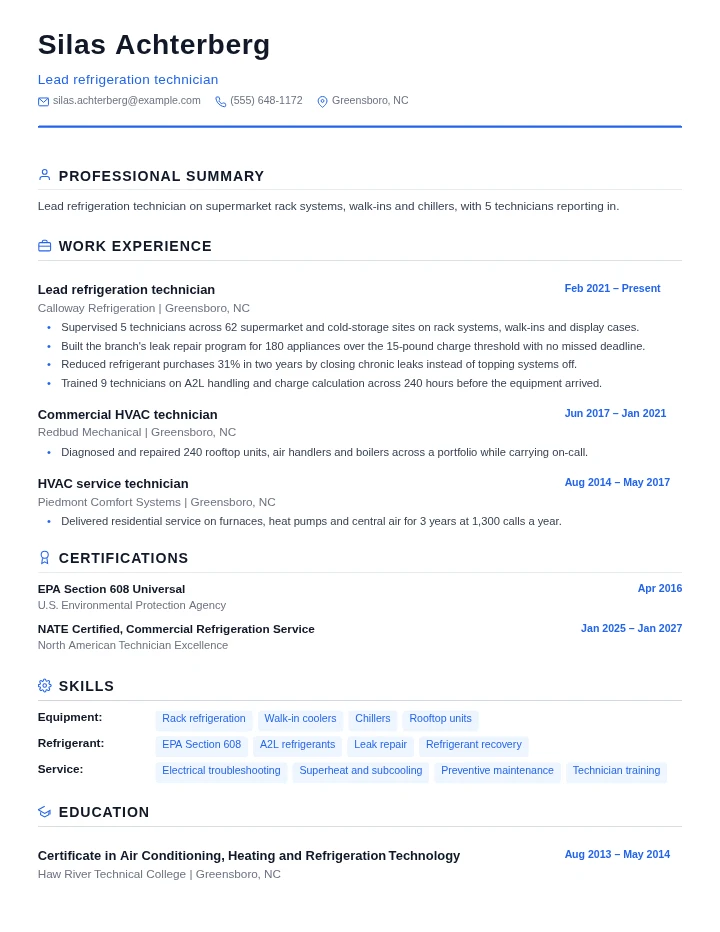
    The lead role is a coverage job, a compliance job and a cost job at once, so the page spends itself on those three. Refrigerant spend is the strongest line on it, because it converts a technical habit into a number the branch already tracks and nobody else on the stack will have.

    Typical titles: Lead refrigeration technician, Refrigeration technician, Service manager

04Summary

Weak

Hardworking and reliable HVAC technician with extensive hands-on experience in installation, maintenance and repair of heating and cooling systems in both residential and commercial settings.

Strong

Commercial service technician on rooftop units, air handlers, boilers and VRF across a 40-building portfolio. EPA Section 608 Universal and NATE certified, trained on A2L refrigerants while still carrying a legacy R-410A book.

Equipment, portfolio size, the card with its type, and the two refrigerant families the work actually spans. A service manager can decide from this alone whether to call. The weak version says residential and commercial, which means the reader learns nothing about which one you can be sent to tomorrow.

05Bullets

Weak

  • Responsible for diagnosing and repairing a wide variety of heating and air conditioning systems while providing excellent customer service to homeowners and businesses.

Strong

  • Achieved a 91% first-time fix rate against the branch's 82% average across 2 years of service calls.

A number the shop's own software produced, set beside the number it produced for everyone else. The comparison is what makes it readable, and both halves are checkable in an interview. The weak bullet is the occupation's definition, which the job title above it already supplied, and wide variety is doing the work an equipment list should do.

06Skills and keywords

Refrigerant

  • EPA Section 608 (in the example)
  • A2L Refrigerants (in the example)
  • R-410A (in the example)
  • Refrigerant Recovery

Equipment

  • Rooftop Units (in the example)
  • Heat Pumps (in the example)
  • Chillers

Diagnostics

  • Electrical Troubleshooting (in the example)
  • Superheat and Subcooling (in the example)
  • Building Automation

Service

  • Preventive Maintenance (in the example)
  • ServiceTitan (in the example)
  • NATE Certification (in the example)

Filled chips appear in the example above.

Paste a job description and Resumi shows which of these your resume already covers.

Build your HVAC technician resume

07Mistakes to avoid

  1. Writing EPA certified and stopping there

    Fix: The four Section 608 types are equipment classes, not levels. Type one is small appliances, type two high pressure, type three low pressure, universal all three. Postings ask for specific ones, so name yours. It is also the card that lets you buy refrigerant.

  2. No equipment list on a commercial resume

    Fix: Commercial postings read like equipment inventories: rooftop units, air handlers, water source heat pumps, chillers, boilers, cooling towers, rack systems. Enumerate the machines you have actually worked on. A resume with years but no equipment reads as unqualified whatever it says.

  3. Borrowed percentages for fix rates and callbacks

    Fix: There is no credible published benchmark for first-time fix, callback rate, average ticket or calls per day, so a figure that sounds like an industry standard came from a vendor blog. Get yours from your dispatch software, and print the shop average beside it.

  4. Leaving off the driving record

    Fix: A valid license and a clean record are a screening criterion in this trade, not a formality, because the insurer sets the bar. Postings say so directly, some specifying zero points. If yours is clean, say so on the page rather than making a service manager ask.

  5. Saying nothing about on-call

    Fix: Employers advertise their rotation in both directions, from no on-call as a selling point to a stated cadence to a stipend paid whether you get called or not. If you have carried a rotation, name the cadence. The reader is already thinking about it.

08Format and template

History first, then certifications, then a short skills block, with education last. The card has to clear the fold, because a service manager screens on it before anything else and will assume it is missing if they have to hunt. Head the resume with the exact title the posting uses, whether that is service technician, installer, mechanic or refrigeration technician. This example uses Standard. The same content works in Brown Sidebar, Blue Professional and Executive Classic.

Shown above: Standard

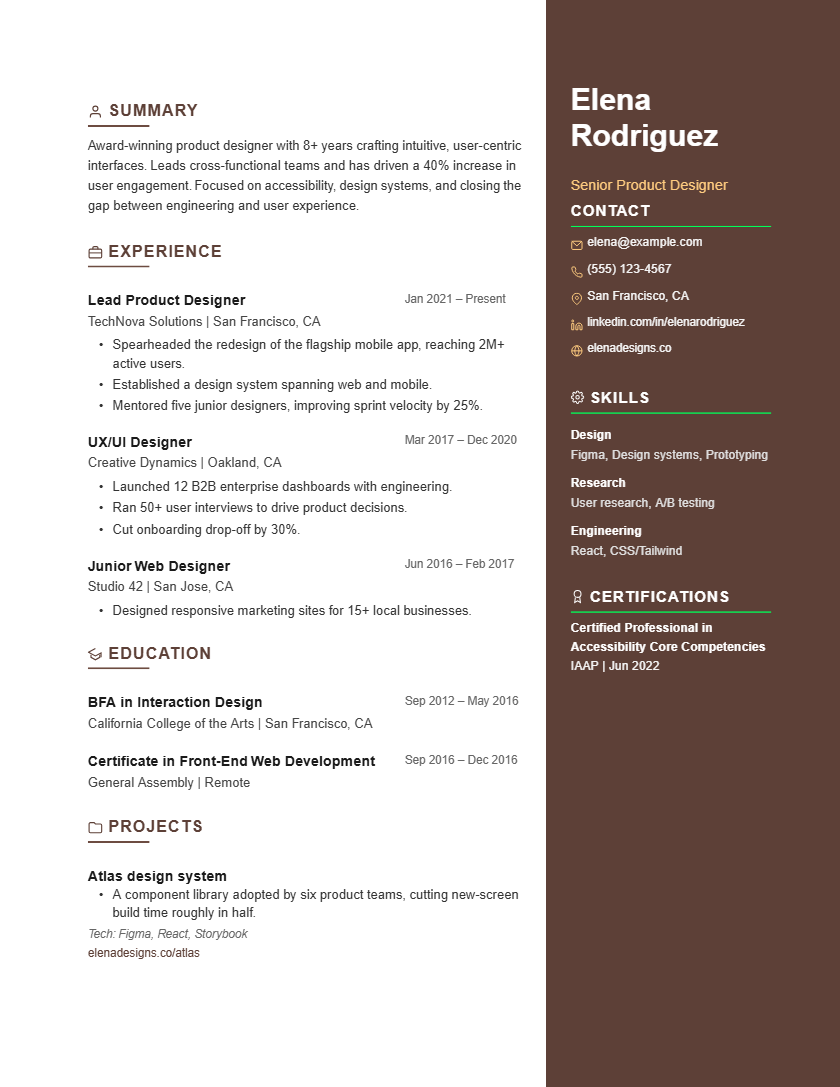
  • Brown Sidebar template
    Brown Sidebar
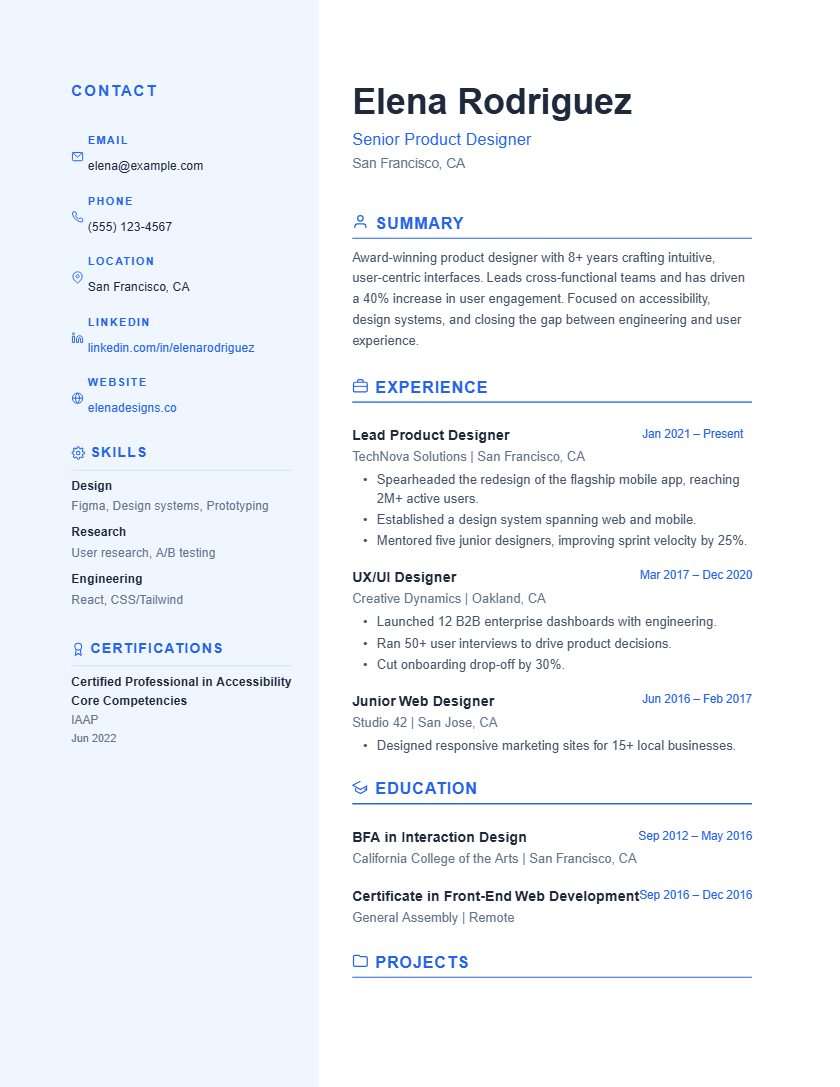
  • Blue Professional template
    Blue Professional
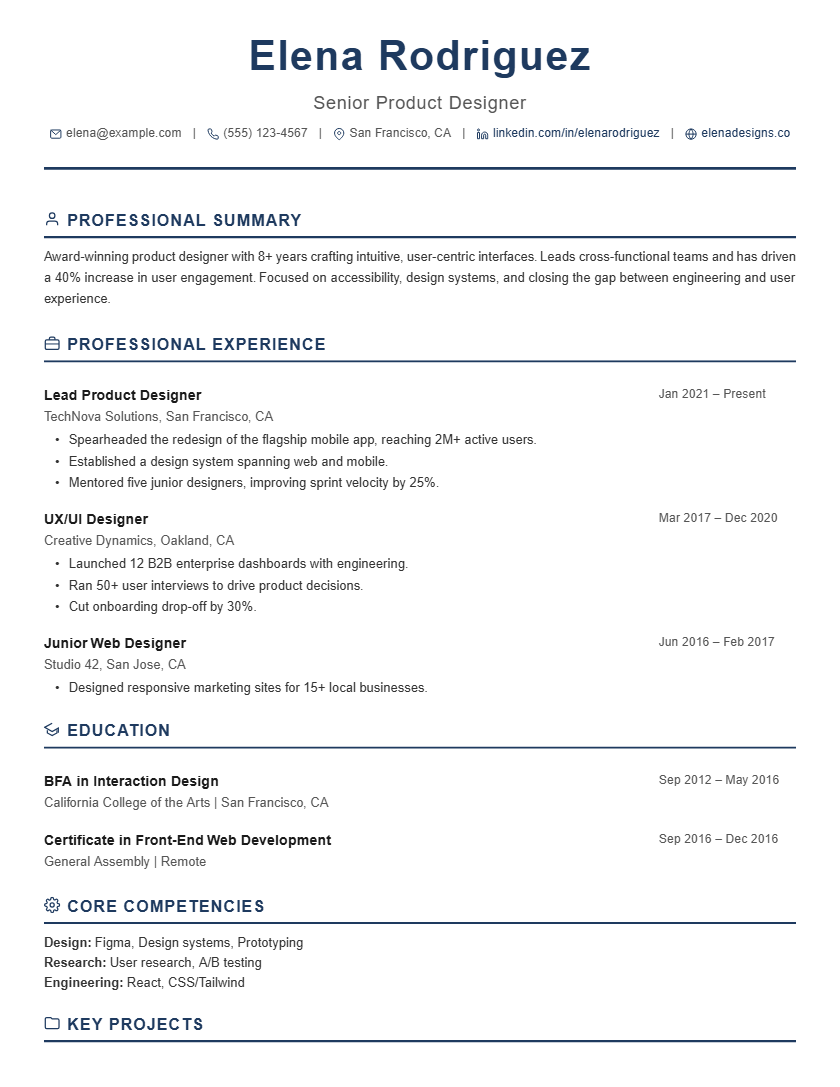
  • Executive Classic template
    Executive Classic

09Questions HVAC technicians ask

Which EPA 608 type should I put, and does it expire?

Put the exact type you hold, because the four are equipment classes rather than ranks. Type one covers small appliances, type two covers high-pressure equipment, which is most residential and light commercial work, type three covers low-pressure equipment such as centrifugal chillers, and universal covers all three. Postings screen on this directly, often asking for type two or universal by name. The certification does not expire, which is worth saying out loud on the page, because technicians often hedge on a card they earned years ago.

How do I show the new refrigerants without overclaiming?

Say what you have actually done with them and let the dates carry the rest. New residential and light commercial equipment has been capped at 700 global warming potential since the start of 2025, which brought in the mildly flammable A2L refrigerants in place of R-410A, and a rule change in 2026 kept pre-2025 stock legal to install federally. So the honest sentence for most technicians is that they run both families. If you have taken an association safety course, name it and date it. If you have only read about A2Ls, say trained rather than experienced.

I do not have a first-time fix rate. What do I use instead?

Ask before you invent. Your dispatch software tracks repeat visits on the same unit, and if it does not, your service manager knows your number. If neither is available, use what you can count yourself: calls completed in a season, systems installed with their tonnage range, equipment on your preventive maintenance route, hours of on-call carried, or the number of technicians you trained. A smaller figure you can defend beats an impressive one a service manager can disprove in the interview.

Do I need a license, and is that the same as my EPA card?

They are different things and the difference matters. The federal card is a certification to handle refrigerants. A license is a state matter, and the structure varies: some states license the contracting business rather than the individual, some certify individual tradespeople directly and treat that certification as mandatory, and some do both with separate registration and certification tiers. The national finder returns 148 credentials tied to this occupation. Check your own state board, and write the exact name of what you hold rather than the word licensed.

Should my resume lead with residential or commercial?

Lead with whichever one you are applying for, and make the equipment do the sorting. These are effectively two occupations under one federal code, with different pay ladders and different ceilings. Commercial refrigeration and chiller work pay higher than comfort cooling, and the controls branch is different again, because it screens on building automation platforms rather than on refrigerant handling. Pick the lane before you write the bullets, and keep the other lane as one compressed line rather than half the page.

Is the customer-facing part worth space, or should I stick to technical detail?

It is worth more space than most technicians give it. The federal profile's highest-rated task for this occupation is discussing malfunctions with users to isolate the problem and confirm the repair, and 98 percent of respondents report face-to-face discussion every day, which is more frequent than any hazard on the list. Selling agreements, explaining a failure clearly and closing a ticket without a callback are the measured parts of the job. Give them a bullet with a number, not an adjective in a summary.

Free to start

Build your HVAC technician resume

No card, no trial that turns into a charge.

Sign up free