Radiologic technologist resume examples & writing guide for 2026

Three radiologic technologist resumes at new graduate, CT technologist and supervisor level, rendered in a real template and annotated note by note. Each one writes the ARRT credential correctly and counts exams, repeats and turnaround.

By the Resumi editorial teamUpdated 8 min read

Showing the mid-level example

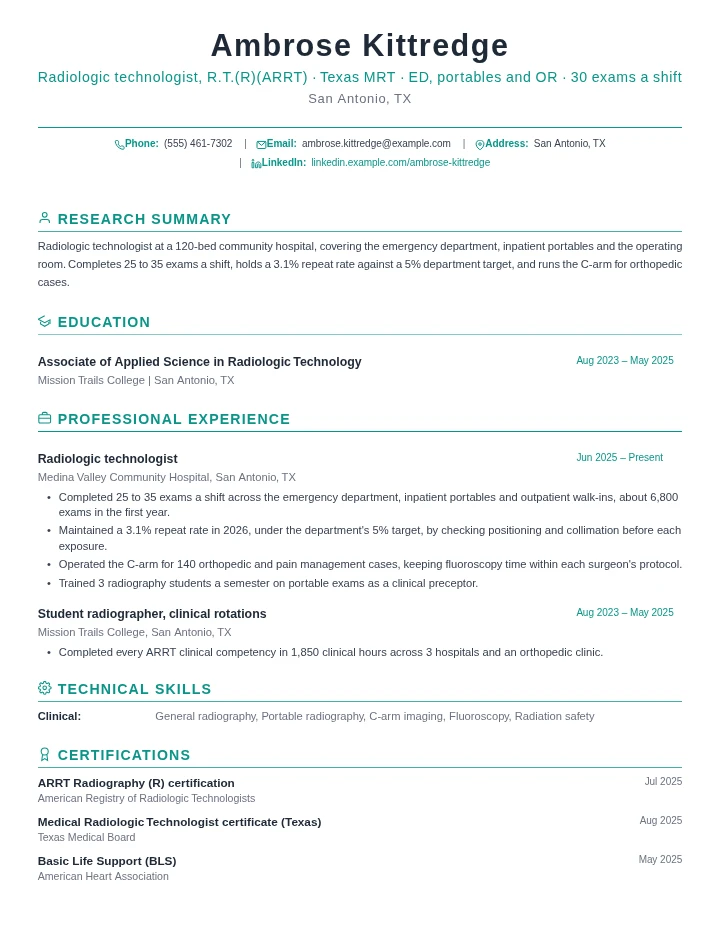
Radiologic technologist resume example, mid level, rendered in the Green Academic template
Strength: Strong

Written by the Resumi editorial team for a fictional candidate. Role facts come from O*NET and the U.S. Bureau of Labor Statistics.

Strength band is Resumi’s optimization score, not a ranking any employer sees.

What makes this resume work

Each marker on the page has a note here. Press a marker to jump to its note.

  1. 1

    Second credential in the string

    R.T.(R)(CT)(ARRT), the Texas certificate and a Level II trauma center. The added CT discipline is what moves a radiographer into CT work, and the trauma level tells a reader the case mix.

  2. 2

    Stroke scans timed

    A median of 11 minutes from arrival. In a stroke alert every minute counts, so a timed median against the hospital's target shows speed under pressure, not just speed.

  3. 3

    Scanners, patients and studies

    Two scanners, 18 to 24 patients a shift, and trauma, stroke and contrast work. The mix tells a manager which protocols this technologist already runs alone.

  4. 4

    Dose cut with a method

    Average dose down 18% after weight-based protocols built with the physicist. Lower dose at the same image quality is the radiation-safety result a CT department can show an inspector.

  5. 5

    Cross-training that worked

    Six radiographers trained, and 5 earned the CT credential. CT is the modality hospitals struggle most to staff, so growing CT technologists inside a department is worth a line.

01The example, in full

The resume shown above, as text you can search and copy.

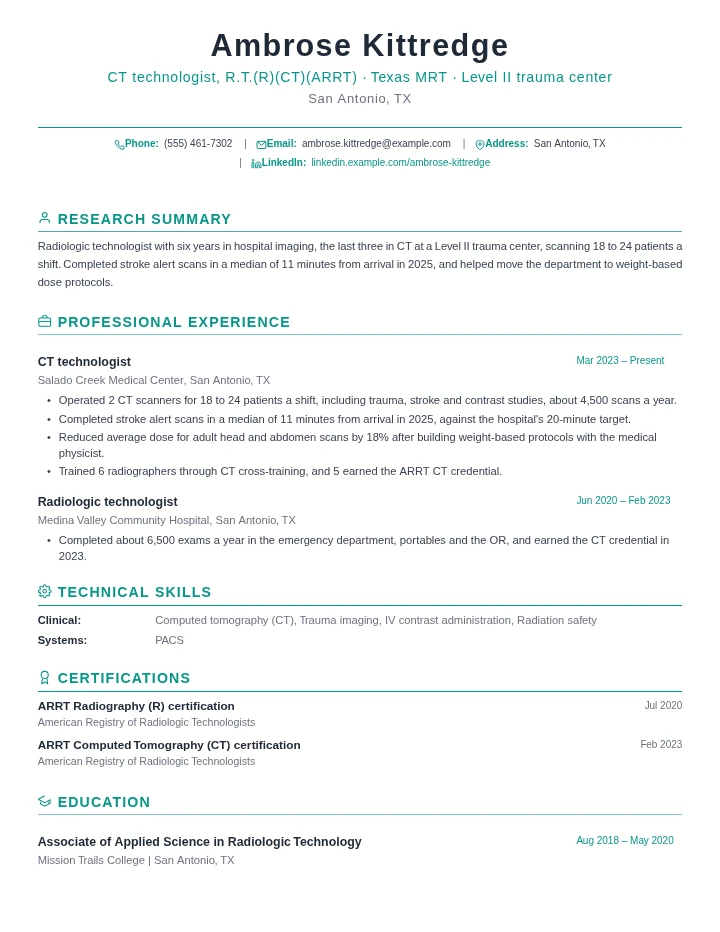
Ambrose Kittredge

CT technologist, R.T.(R)(CT)(ARRT) · Texas MRT · Level II trauma center

San Antonio, TXambrose.kittredge@example.com(555) 461-7302linkedin.example.com/ambrose-kittredge

Summary

Radiologic technologist with six years in hospital imaging, the last three in CT at a Level II trauma center, scanning 18 to 24 patients a shift. Completed stroke alert scans in a median of 11 minutes from arrival in 2025, and helped move the department to weight-based dose protocols.

Experience

CT technologist

Mar 2023 – Present

Salado Creek Medical Center · San Antonio, TX

  • Operated 2 CT scanners for 18 to 24 patients a shift, including trauma, stroke and contrast studies, about 4,500 scans a year.
  • Completed stroke alert scans in a median of 11 minutes from arrival in 2025, against the hospital's 20-minute target.
  • Reduced average dose for adult head and abdomen scans by 18% after building weight-based protocols with the medical physicist.
  • Trained 6 radiographers through CT cross-training, and 5 earned the ARRT CT credential.

Radiologic technologist

Jun 2020 – Feb 2023

Medina Valley Community Hospital · San Antonio, TX

  • Completed about 6,500 exams a year in the emergency department, portables and the OR, and earned the CT credential in 2023.

Education

Associate of Applied Science in Radiologic Technology

Aug 2018 – May 2020

Mission Trails College · San Antonio, TX

Skills

Clinical
Computed tomography (CT), Trauma imaging, IV contrast administration, Radiation safety
Systems
PACS

Certifications

ARRT Radiography (R) certification

Jul 2020

American Registry of Radiologic Technologists

ARRT Computed Tomography (CT) certification

Feb 2023

American Registry of Radiologic Technologists

02Market snapshot

Median pay
$80,110 median annual pay, $80,650 in hospitals and $97,490 in federal government
Typical education
Associate's degree from an accredited radiologic technology program
Job outlook
5% growth from 2025 to 2035, faster than average
Common credentials
Most states require a license or certification, and employers typically require certification

Sources: BLS OES (May 2025) · BLS OOH (2025)

03The same resume at three levels

The tinted row is the level shown above.

  • Entry-level

    0–2 years

    Education sits above the jobs, and the headline gives the ARRT credential, the Texas certificate, the areas covered and the pace. Bullets cover volume, repeat rate, operating room cases and precepting. Clinical rotations fold to one line with the competencies and trauma exams completed.

    Typical titles: Radiologic technologist, Radiographer, X-ray technologist

  • Mid-level

    3–6 years

    The headline adds the CT credential, the trauma level and the case mix. Bullets give scanners and volume, stroke timing, dose reduction, contrast and cross-training. The radiographer years fold to one line with annual exams and the year the CT credential was earned.

    Typical titles: CT technologist, Radiologic technologist, CT, Multimodality technologist

  • Senior

    7+ years

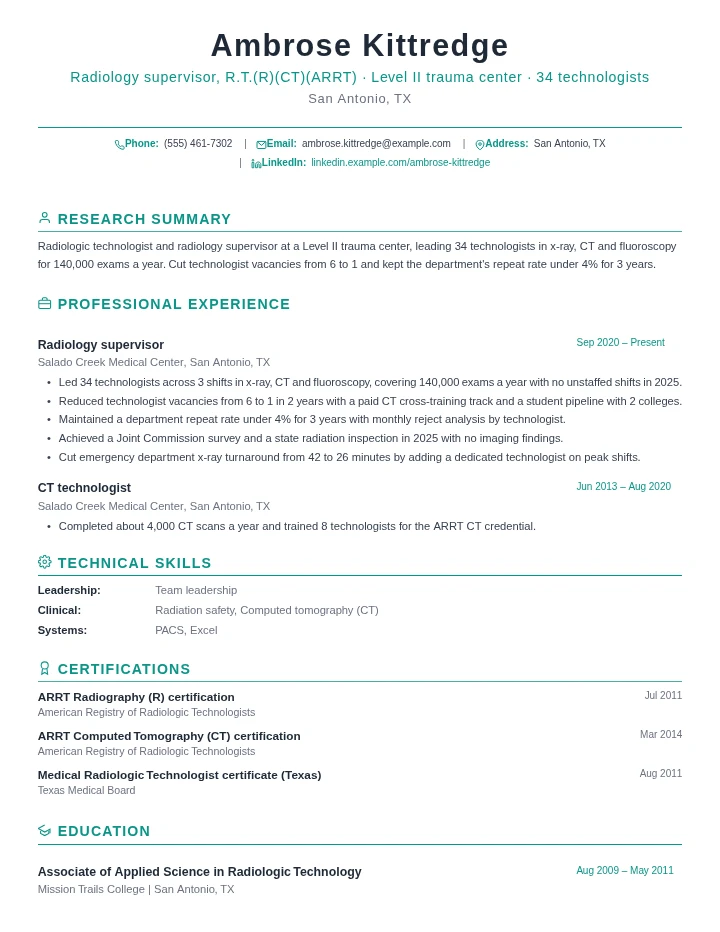
    Scope replaces exam counts: the size of the team and its shifts, coverage with no gaps, vacancies filled, the department repeat rate, emergency turnaround and inspections passed. The seven CT technologist years fold to one line with annual scans and the technologists trained for the CT credential.

    Typical titles: Radiology supervisor, Lead radiologic technologist, Imaging services manager

04Summary

Weak

Detail-oriented radiologic technologist committed to producing high-quality diagnostic images and providing compassionate patient care in a fast-paced environment.

Strong

Radiologic technologist with six years in hospital imaging, the last three in CT at a Level II trauma center, scanning 18 to 24 patients a shift. Completed stroke alert scans in a median of 11 minutes from arrival in 2025, and helped move the department to weight-based dose protocols.

The setting, the modality, the trauma level, the daily volume, a timed result and a dose change. An imaging manager can compare each with their own department. The weak version promises quality images without a modality, a setting or a number.

05Bullets

Weak

  • Performed CT scans on patients as ordered by physicians while following radiation safety guidelines.

Strong

  • Reduced average dose for adult head and abdomen scans by 18% after building weight-based protocols with the medical physicist.

A named result, the scans it applies to, the method and the partner who checked it. A CT manager can ask how dose was measured, which protocols changed and whether image quality held for larger patients. The weak bullet describes what the credential already permits, with no modality detail, no measure and no result, so every applicant in the pile could send it unchanged.

06Skills and keywords

Clinical

  • Computed tomography (CT) (in the example)
  • Trauma imaging (in the example)
  • IV contrast administration (in the example)
  • Radiation safety (in the example)
  • General radiography
  • Portable radiography (in the example)
  • Fluoroscopy
  • C-arm imaging

Systems

  • PACS (in the example)
  • Epic

Licenses and certifications

  • ARRT Radiography (R) certification (in the example)
  • ARRT Computed Tomography (CT) certification (in the example)
  • Medical Radiologic Technologist certificate (Texas) (in the example)
  • Basic Life Support (BLS)

Filled chips appear in the example above.

Paste a job description and Resumi shows which of these your resume already covers.

Build your radiologic technologist resume

07Mistakes to avoid

  1. Credential written loosely

    Fix: ARRT asks registrants to write the string as R.T.(R)(ARRT), adding each discipline in the order earned, such as R.T.(R)(CT)(ARRT). Put it after your name or in the headline, and list your state license or certificate separately with its state.

  2. No exam types or areas named

    Fix: General x-ray, portables, fluoroscopy, operating room C-arm, trauma and CT are different skills. Name the ones you run alone and the areas you cover, because a posting for the operating room or trauma screens on exactly that.

  3. Percentages with no starting point

    Fix: Reduced repeats by 22% leaves the reader guessing where you started. Give the rate before and after, or your rate against the department target, and the period. A 3.1% repeat rate against a 5% target says more than any percentage change.

  4. Volume with no quality measure

    Fix: Exams a shift shows pace, not care. Pair your volume with a quality figure, such as repeat rate, dose or turnaround, so a manager can see you are fast without retaking images or sending patients back for another exposure.

  5. Radiation safety as a single word

    Fix: Writing ALARA in a skills list shows you know the term. Show what you did with it instead: a dose protocol you helped build, collimation habits behind a low repeat rate, or a clean inspection, each with a number.

08Format and template

One column, reverse-chronological order and standard section headings, with every figure written as text. Put the ARRT credential string, your state license, setting and modality in the headline. Name the exam types you run alone and the measures your department tracks. List each ARRT discipline and the state credential with dates. This example uses Green Academic. The same content works in Standard, Warm Classic and Beige Border.

Shown above: Green Academic

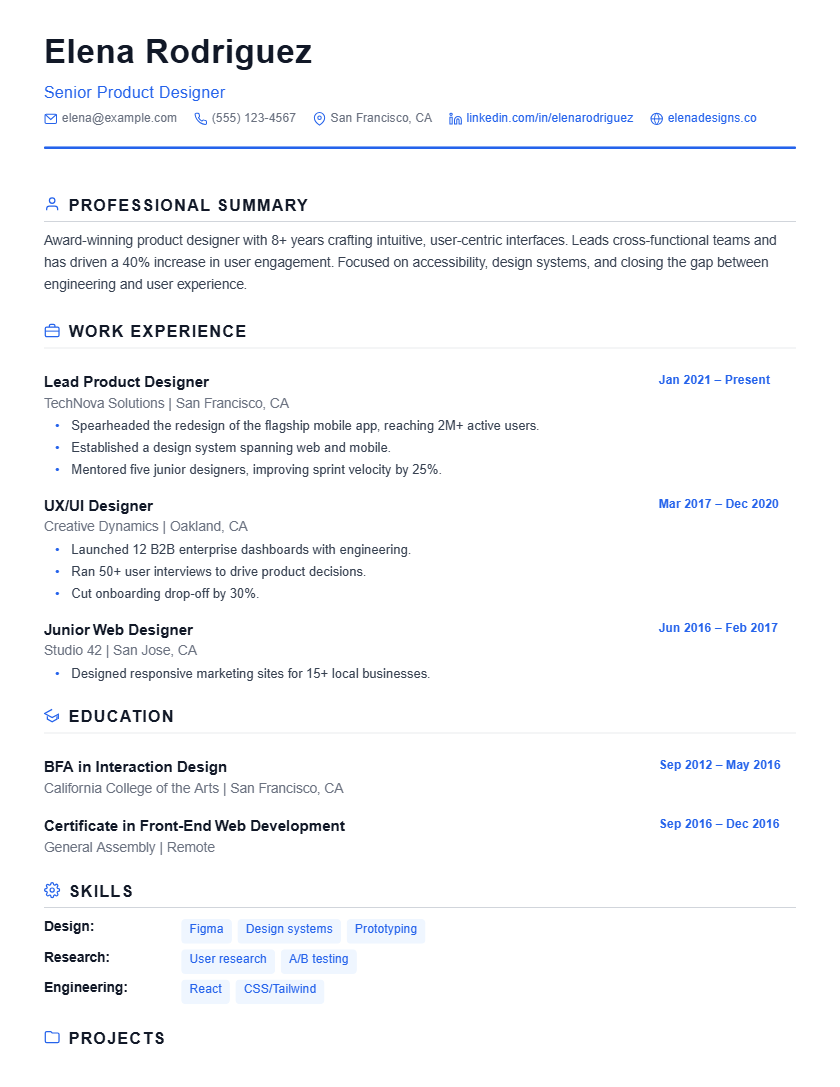
  • Standard template
    StandardFree
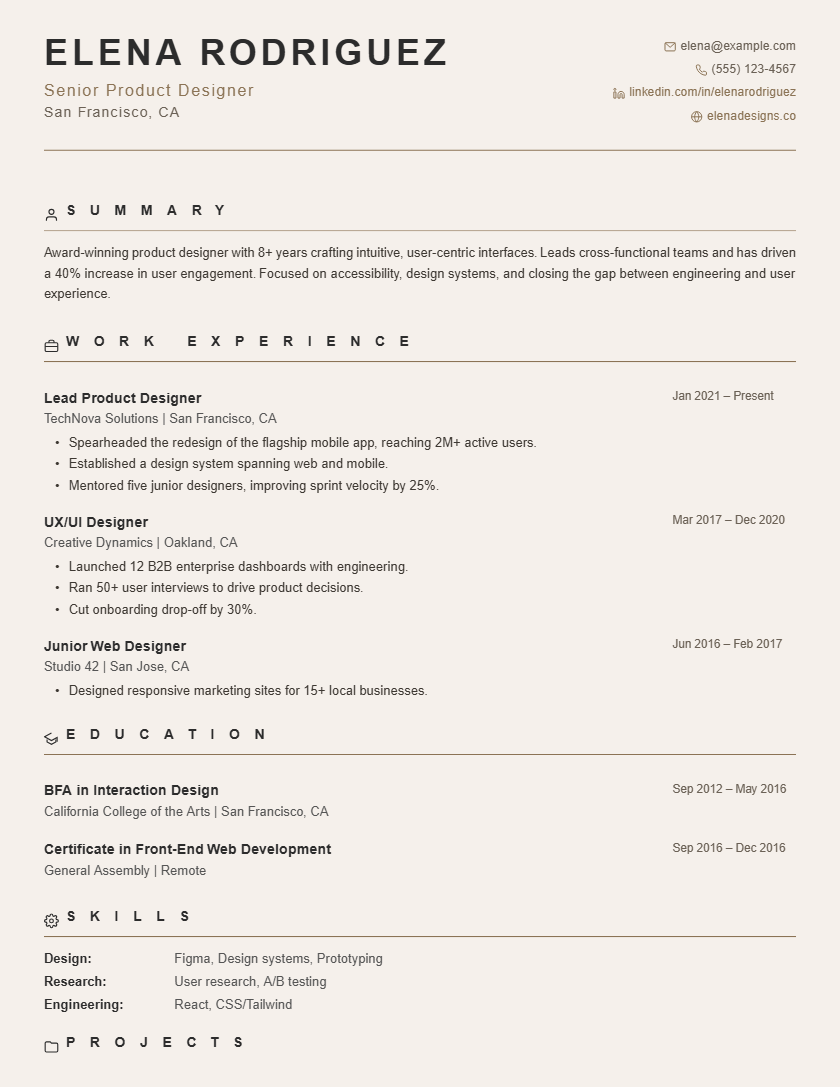
  • Warm Classic template
    Warm Classic
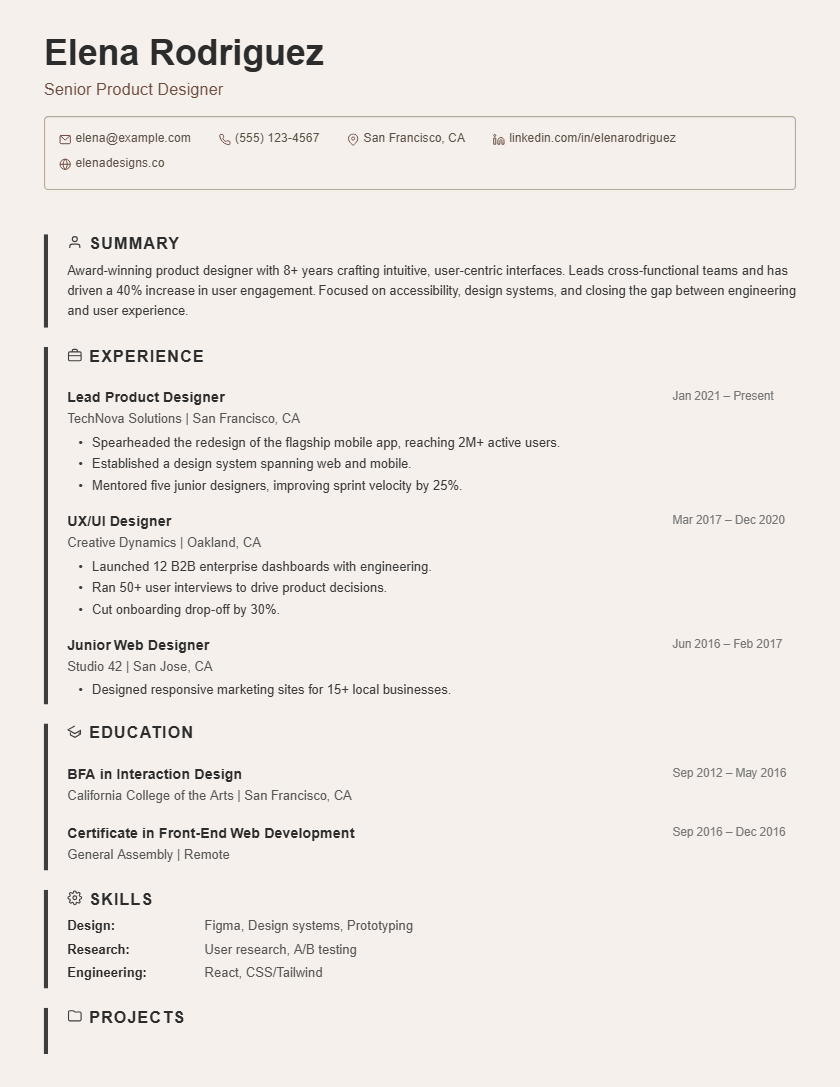
  • Beige Border template
    Beige Border

09Questions radiologic technologists ask

How do I write ARRT credentials on a resume?

ARRT's own guide gives the format: R.T.(R)(ARRT) for radiography, with each added discipline in the order earned, such as R.T.(R)(CT)(ARRT). Put the string after your name or in your headline. List each discipline in a certifications section with its date, and your state license or certificate separately. ARRT credentials renew every year, need 24 continuing education credits every two years, and R.T. holders also complete Continuing Qualifications Requirements every 10 years.

What numbers should a radiologic technologist put on a resume?

Use the measures your department keeps. Give exams a shift or a year, your repeat or reject rate against the target, turnaround for emergency exams, and operating room or trauma cases. In CT, add scans a shift, stroke timing, contrast studies and dose changes. Always show the starting point or the target beside a change, so the reader can judge the size of the result rather than guess at it.

How should a new graduate radiologic technologist write a resume?

Put education first, then clinical rotations with the hospitals and exam types you covered. List your ARRT registration, or the date you are registry eligible, since many postings accept new graduates who are registry eligible and earn it soon after hire. Add the state credential and BLS. Practitioners who hire new graduates say they look for composure under pressure, so name trauma or emergency rotations where you had them.

Is CT certification worth adding to a radiographer's resume?

For many radiographers, yes. In ASRT's 2025 staffing survey of imaging managers, CT had the highest vacancy rate of any imaging discipline, so trained CT technologists are in demand. ARRT's postprimary pathway asks for structured education and documented clinical procedures within the 24 months before you apply, then an exam. If you are cross-training, list the procedures completed and the date you expect the credential.

Which certifications help a radiologic technologist?

ARRT radiography registration and the state license or certificate come first, and most hospital postings also require Basic Life Support. After that, postprimary credentials in CT, MRI or mammography widen the jobs you can take. Experienced technologists who advise new graduates recommend adding certifications while you look for work, and some postings prefer a clinical instructor certificate for technologists who precept students.

How do I move from technologist to lead or radiology supervisor?

Show the parts of leadership you already do. Precepting students, mentoring newer technologists, cross-training others, running reject analysis and covering the schedule all count. Give numbers for each. Higher technologist grades in postings ask for mentoring of students and junior technologists, and supervisor roles are judged on coverage, vacancies, repeat rate and turnaround, so show any of those you have moved.

Free to start

Build your radiologic technologist resume

No card, no trial that turns into a charge.

Sign up free