Phlebotomist resume examples & writing guide for 2026

Three phlebotomist resumes at new, inpatient and lead level, rendered in a real template and taken apart line by line. Each names the setting, counts the draws in that setting's own unit, and puts patient identification where a lab manager looks first.

By the Resumi editorial teamUpdated 10 min read

Showing the mid-level example

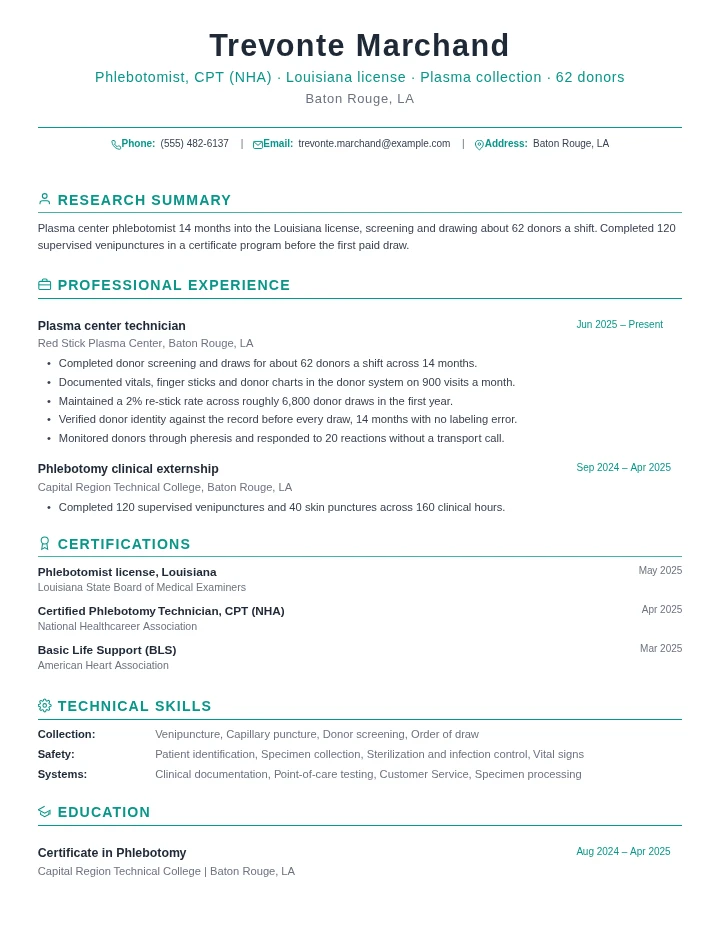
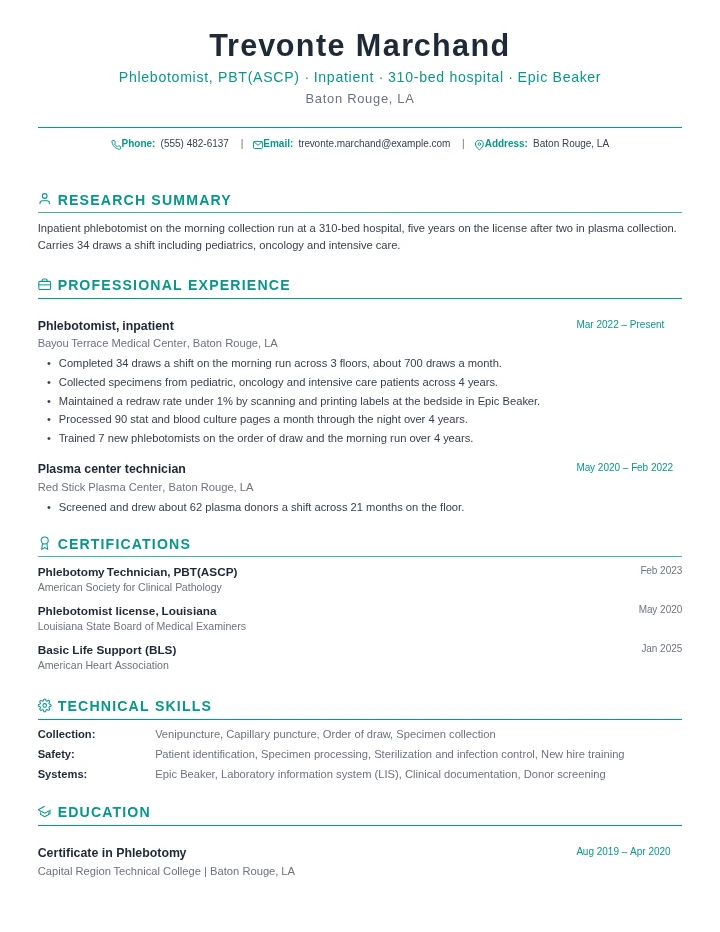
Phlebotomist resume example, mid level, rendered in the Green Academic template
Strength: Excellent

Written by the Resumi editorial team for a fictional candidate. Role facts come from O*NET and the U.S. Bureau of Labor Statistics.

Strength band is Resumi’s optimization score, not a ranking any employer sees.

What makes this resume work

Each marker on the page has a note here. Press a marker to jump to its note.

  1. 1

    Inpatient, with the bed count

    A 310-bed hospital, and the system it runs on. Inpatient work is read through the size of the house and the software, because both decide how long a new hire takes to be useful.

  2. 2

    The patient mix, named

    Pediatrics, oncology and intensive care. Difficult access is the whole skill at this level, and naming the populations is more informative than any adjective about being good with hard sticks.

  3. 3

    Draws a shift and a month

    Thirty-four a shift across 3 floors, about 700 a month. Both figures are ones a lab already reports, and the monthly total keeps the shift number from reading as a good day rather than a normal one.

  4. 4

    Redraws, tied to a method

    Under 1%, by scanning and printing labels at the bedside. The rate is the claim and the bedside labeling is the reason, which is the part another lab could adopt on Monday.

  5. 5

    Night pages counted

    Ninety stat and blood culture pages a month. The reactive half of inpatient work is invisible unless it is counted, and it is the half that decides whether someone can hold the shift.

  6. 6

    The plasma years, one line

    Sixty-two donors a shift across 21 months. A different setting earns its line by keeping its own unit rather than being converted into draws it never was.

Build your phlebotomist resume

Free to start · no card

01The example, in full

The resume shown above, as text you can search and copy.

Trevonte Marchand

Phlebotomist, PBT(ASCP) · Inpatient · 310-bed hospital · Epic Beaker

Baton Rouge, LAtrevonte.marchand@example.com(555) 482-6137

Summary

Inpatient phlebotomist on the morning collection run at a 310-bed hospital, five years on the license after two in plasma collection. Carries 34 draws a shift including pediatrics, oncology and intensive care.

Experience

Phlebotomist, inpatient

Mar 2022 – Present

Bayou Terrace Medical Center · Baton Rouge, LA

  • Completed 34 draws a shift on the morning run across 3 floors, about 700 draws a month.
  • Collected specimens from pediatric, oncology and intensive care patients across 4 years.
  • Maintained a redraw rate under 1% by scanning and printing labels at the bedside in Epic Beaker.
  • Processed 90 stat and blood culture pages a month through the night over 4 years.
  • Trained 7 new phlebotomists on the order of draw and the morning run over 4 years.

Plasma center technician

May 2020 – Feb 2022

Red Stick Plasma Center · Baton Rouge, LA

  • Screened and drew about 62 plasma donors a shift across 21 months on the floor.

Education

Certificate in Phlebotomy

Aug 2019 – Apr 2020

Capital Region Technical College · Baton Rouge, LA

Skills

Collection
Venipuncture, Capillary puncture, Order of draw, Specimen collection
Safety
Patient identification, Specimen processing, Sterilization and infection control, New hire training
Systems
Epic Beaker, Laboratory information system (LIS), Clinical documentation, Donor screening

Certifications

Phlebotomy Technician, PBT(ASCP)

Feb 2023

American Society for Clinical Pathology

Phlebotomist license, Louisiana

May 2020

Louisiana State Board of Medical Examiners

Basic Life Support (BLS)

Jan 2025

American Heart Association

02Market snapshot

Median pay
$45,230 median annual pay, $21.75 an hour. The band runs from under $35,780 to over $58,780
Typical education
A postsecondary nondegree award. A phlebotomy certificate program usually takes less than 1 year
Job outlook
+7% employment change, 2025-35, much faster than average. About 18,000 openings a year
Common credentials
16 certifications from 11 organizations. State licenses exist in only 3 states, California, Louisiana and Nevada

Sources: BLS OES (May 2025) · BLS OOH (2025) · CareerOneStop (2026)

03The same resume at three levels

The tinted row is the level shown above.

  • Entry-level

    0–2 years

    The unit matches the setting, so this page counts donors rather than patients. The re-stick rate carries the draws behind it, identity verification is stated rather than assumed, and the externship keeps the documented stick counts that the certifying bodies actually measure.

    Typical titles: Phlebotomist, Plasma center technician, Phlebotomy technician

  • Mid-level

    3–6 years

    Bed count and system lead because inpatient readers screen on both. The patient mix does the work an adjective would have done, the redraw rate carries the method that moved it, and the night pages are counted so the reactive half of the job is visible.

    Typical titles: Phlebotomist, Phlebotomy technician, Patient service technician

  • Senior

    7+ years

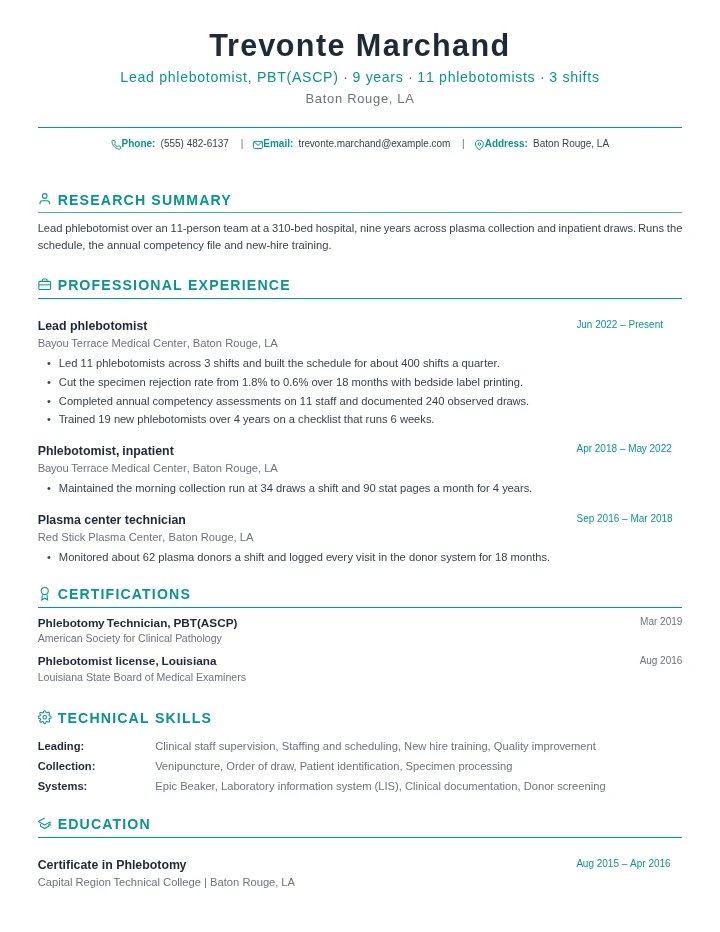
    The lead numbers belong to a team: staff, shifts, the schedule, the rejection rate and the competency observations. The two earlier seats hold a line each in their own units, so nine years and two settings still fit one page without converting anything into something it was not.

    Typical titles: Lead phlebotomist, Phlebotomy supervisor, Laboratory assistant lead

04Summary

Weak

Compassionate and detail-oriented phlebotomist with excellent venipuncture skills and a proven ability to put patients at ease while maintaining specimen integrity in high-volume settings.

Strong

Inpatient phlebotomist on the morning collection run at a 310-bed hospital, five years on the license after two in plasma collection. Carries 34 draws a shift including pediatrics, oncology and intensive care.

Setting, house size, years on the license, the setting before it, the daily volume and the patient populations that make the volume hard. A lab manager can staff a shift against every part of that. The weak version names no setting and no number at all.

05Bullets

Weak

  • Performed venipuncture and capillary puncture on patients of all ages while following all safety protocols and maintaining a high level of accuracy and patient satisfaction.

Strong

  • Maintained a redraw rate under 1% by scanning and printing labels at the bedside in Epic Beaker.

A rate the lab already reports and the mechanism that produced it. Redraws cost a second stick, a delayed result and sometimes a clinical decision made late, so the rate is the number a lab manager cares about most and the one a resume can least afford to invent. Naming bedside scanning and label printing as the reason turns the claim into something another lab could copy, and it quietly proves the candidate worked in a system that does it. The weak bullet describes the job every phlebotomist is hired to do, which means every applicant for the same opening could send it unchanged.

06Skills and keywords

Collection

  • Venipuncture (in the example)
  • Capillary puncture (in the example)
  • Order of draw (in the example)
  • Specimen collection (in the example)
  • Donor screening (in the example)
  • Point-of-care testing

Safety and accuracy

  • Patient identification (in the example)
  • Specimen processing (in the example)
  • Sterilization and infection control (in the example)
  • New hire training (in the example)
  • Vital signs
  • Quality improvement

Systems

  • Epic Beaker (in the example)
  • Laboratory information system (LIS) (in the example)
  • Clinical documentation (in the example)
  • Sunquest
  • Customer Service
  • Staffing and scheduling

Credentials

  • Phlebotomy Technician PBT(ASCP) (in the example)
  • Phlebotomist license (in the example)
  • Basic Life Support (BLS) (in the example)
  • Certified Phlebotomy Technician CPT (NHA)
  • Registered Phlebotomy Technician RPT (AMT)
  • Certified Patient Care Technician/Assistant (CPCT/A)

Filled chips appear in the example above.

Paste a job description and Resumi shows which of these your resume already covers.

Build your phlebotomist resume

07Mistakes to avoid

  1. Drew blood, written as a bullet

    Fix: It describes every phlebotomist alive and separates a three-year one from a three-week one not at all. Give the volume, the setting, the patient populations and the systems, and let the reader work out the rest from numbers rather than adjectives.

  2. Nothing about patient identification

    Fix: Mislabeling is the error this job exists to prevent, and it is the first thing a lab manager screens for. Say how you verify, against what, and what the record shows. A page that never mentions it reads as somebody who has not understood the point of the work.

  3. A certification with no issuer

    Fix: Several bodies certify phlebotomists and their credentials are written differently, with the issuer in parentheses or after the name. Write yours the way its own board writes it, add the year, and name the state license separately if you hold one.

  4. Invented accuracy percentages

    Fix: Ninety-nine point nine percent accuracy and a hundred and sixty draws a shift are figures competitor samples print and no lab reports. Your real numbers live in the program's documented stick count, the system's redraw log and your competency file. Use those.

  5. One setting's unit used in another

    Fix: Plasma counts donors and pheresis sessions, hospitals count draws a shift and stat pages, service centers count patients and registrations, mobile work counts cases and miles. Keep each in its own setting and translate the skills instead of the metric.

08Format and template

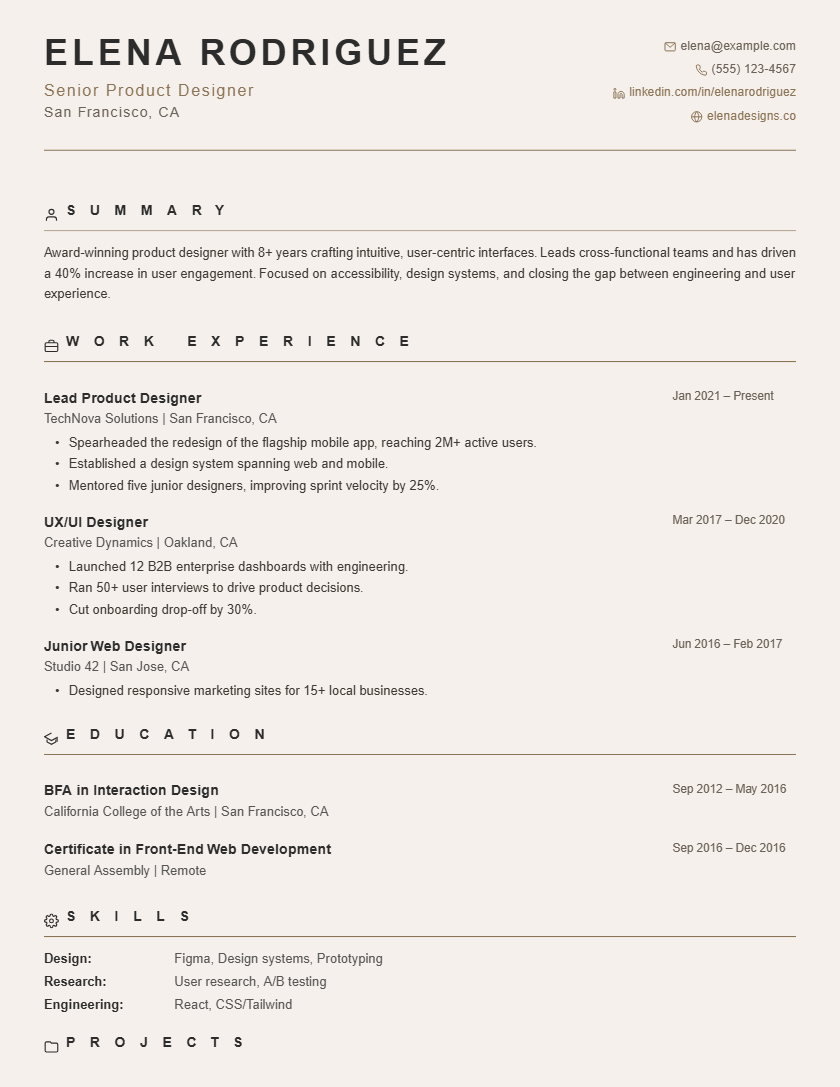
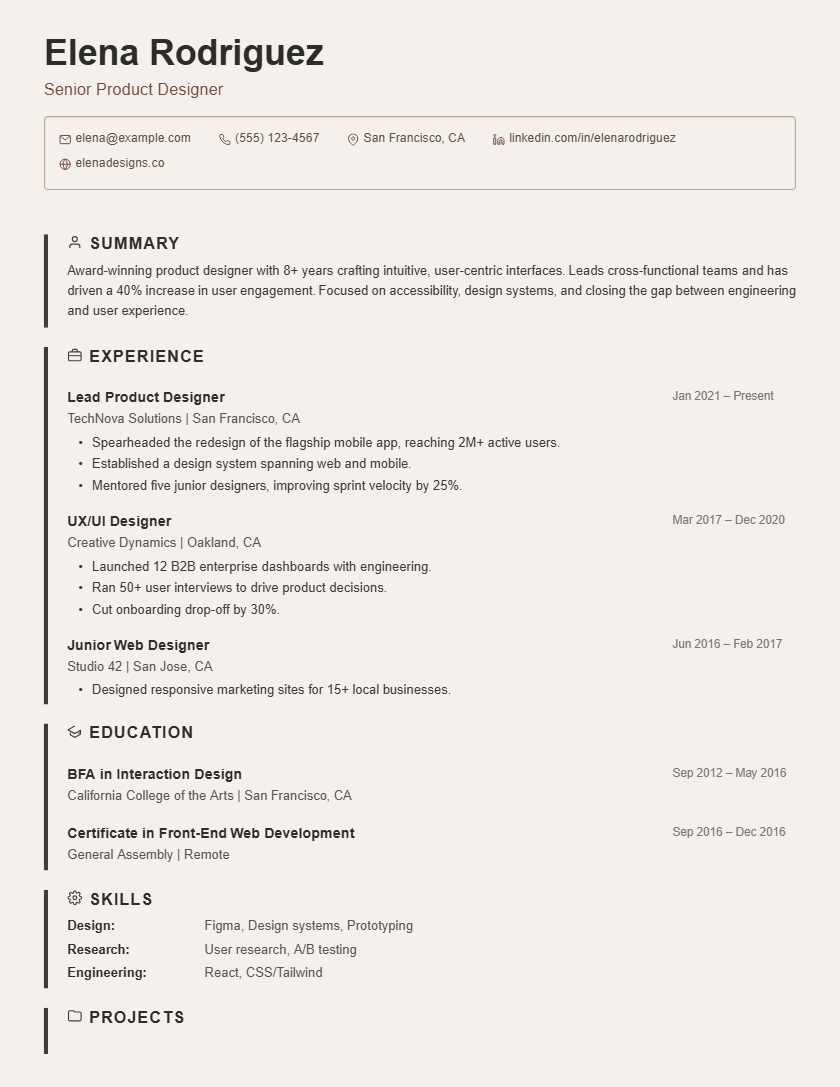
Single column, standard headings, no photo, one page. The certification with its issuer, the state license if you hold one, and the setting all belong above the fold, because those decide whether the rest gets read. This example uses Green Academic, which gives each credential a dated row and leaves room for the certificate program that made it possible. The same content works in Standard, Warm Classic and Beige Border, all single column. If a role requires driving to mobile sites or homes, put the licence and the clean record on the page too, because that is a hard gate in blood bank and mobile work.

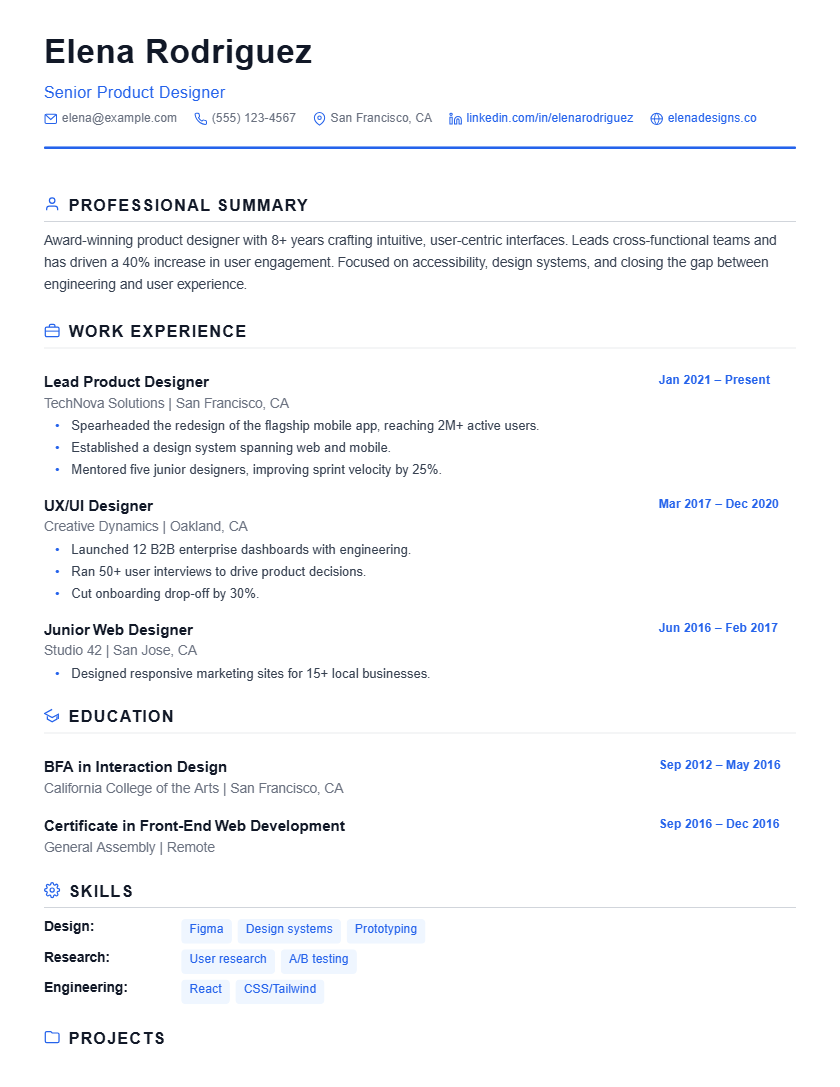
Shown above: Green Academic

  • Standard template
    StandardFree
  • Warm Classic template
    Warm Classic
  • Beige Border template
    Beige Border

09Questions phlebotomists ask

Is phlebotomy certification the same as a license?

No. A license comes from a state and only a few states issue one at all, with the credential carrying a different name in each. Certification comes from a private body that tests you and vouches for you, and it is not a government credential. What makes certification feel mandatory is employer policy: hospitals and the big reference labs generally require it whether or not the state does. So the honest framing is that a license is required where it exists, and certification is what lets you apply everywhere else.

I just finished a program and have no paid experience. What goes on the page?

The externship, written as a job, with the numbers your program documented. Give the site, the dates, the clinical hours and the stick counts, venipunctures and skin punctures separately, and say whether they were unaided. Those counts are exactly what the certifying bodies measure eligibility on, which means a reader already knows what they mean. Then name the populations you drew, the tube types and the system you charted in, and put the certification and its issuer at the top.

What numbers belong on a phlebotomist resume?

The ones your setting reports rather than the ones you can estimate. Draws a shift and a month, patients or donors a day, redraw and specimen rejection rate, hemolysis rate, stat pages answered, difficult-access populations, and the stick counts documented during training. Give the denominator with any percentage. Skip accuracy rates in the high nineties, because no lab computes them and a manager reading one discounts the whole page.

Will plasma center experience count for a hospital job?

Partly, and the resume has to do the bridging. Plasma is high-volume venipuncture on screened, healthy donors, one donor per long session, with no timed collections, no order of draw across a panel of tubes, no stat pages and usually no laboratory information system. What carries across is needle skill, donor reactions, identity verification and standing a full shift. What a hospital will ask about is difficult access, pediatric and geriatric draws, tube order and the clock, so name any of those you have and say plainly what you have not done yet.

How do I move from phlebotomy into the laboratory itself?

Expect a rung in between. A medical laboratory technician credential generally needs an associate degree or the equivalent credit hours plus an accredited program, so phlebotomy certification on its own does not qualify you. The route most people take is phlebotomist to laboratory assistant to technician, using employer tuition support along the way. On the resume that means foregrounding specimen processing, centrifugation, accessioning and the information system rather than the draw itself.

How long should a phlebotomist resume be?

One page, at every level on this page. The work compresses well because it is counted: a current seat with four or five bullets, the previous one with a line, and the training program with its hours and stick counts. The lead example here holds nine years and two settings on one sheet by keeping only the unit and the volume of each earlier role. If you have worked agency or travel assignments, group them under the agency with facilities and dates beneath rather than adding a second page.

Free to start

Build your phlebotomist resume

No card, no trial that turns into a charge.

Sign up free