Police officer resume examples & writing guide for 2026

Three police officer resumes at first-year, five-year and twelve-year level, rendered in a real template and annotated line by line. Each is written for a background investigator and an oral board: calls for service, reports, arrests, complaints, training and certifications, each counted and dated.

By the Resumi editorial teamUpdated 11 min read

Showing the mid-level example

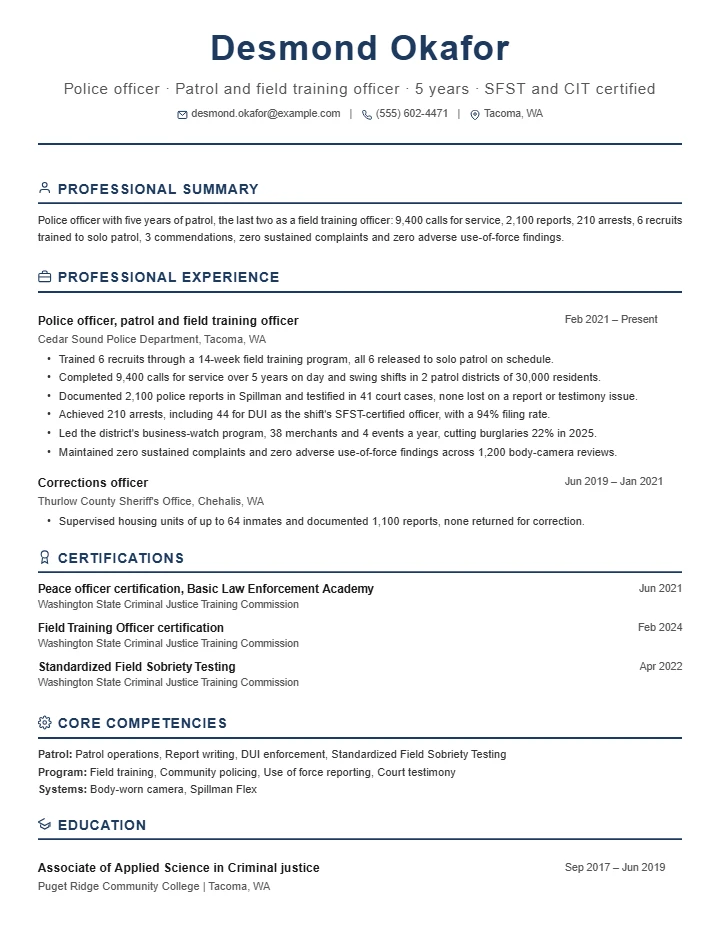
Police officer resume example, mid level, rendered in the Executive Classic template
Strength: Excellent

Written by the Resumi editorial team for a fictional candidate. Role facts come from O*NET and the U.S. Bureau of Labor Statistics.

Strength band is Resumi’s optimization score, not a ranking any employer sees.

What makes this resume work

Each marker on the page has a note here. Press a marker to jump to its note.

  1. 1

    FTO and certifications up front

    Police officer, patrol and field training officer, five years, SFST and CIT certified. Lateral postings require the certificate and a minimum period sworn, and the headline states both before the recruiter opens the packet.

  2. 2

    Record stated, including zeros

    Ninety-four hundred calls, 2,100 reports, 210 arrests, six recruits, three commendations, and zero sustained complaints and force findings. The zeros are written deliberately, because the background will report them either way.

  3. 3

    Recruits released on schedule

    Six recruits through a fourteen-week program, all six released to solo patrol on schedule. Field training is the first supervisory step in the handbook's promotion ladder, and the release rate is how an agency measures a trainer.

  4. 4

    Reports tied to court results

    Twenty-one hundred reports in the records system and 41 court cases, none lost on a report or testimony issue. The handbook lists testifying in court among the duties, and the outcome connects the writing to the case.

  5. 5

    Community program with a crime result

    Thirty-eight merchants and four events a year in a business-watch program, and burglaries down 22% in the district. Community relations appears in the occupation's first task, and this line gives it a number the chief can quote.

  6. 6

    Cards dated with the commission

    The peace officer certificate, the field training officer card and SFST, each with the state commission and the month. Lateral postings require the certificate and pay follows the specialties, so the recruiter verifies without a call.

Build your police officer resume

Free to start · no card

01The example, in full

The resume shown above, as text you can search and copy.

Desmond Okafor

Police officer · Patrol and field training officer · 5 years · SFST and CIT certified

Tacoma, WAdesmond.okafor@example.com(555) 602-4471

Summary

Police officer with five years of patrol, the last two as a field training officer: 9,400 calls for service, 2,100 reports, 210 arrests, 6 recruits trained to solo patrol, 3 commendations, zero sustained complaints and zero adverse use-of-force findings.

Experience

Police officer, patrol and field training officer

Feb 2021 – Present

Cedar Sound Police Department · Tacoma, WA

  • Trained 6 recruits through a 14-week field training program, all 6 released to solo patrol on schedule.
  • Completed 9,400 calls for service over 5 years on day and swing shifts in 2 patrol districts of 30,000 residents.
  • Documented 2,100 police reports in Spillman and testified in 41 court cases, none lost on a report or testimony issue.
  • Achieved 210 arrests, including 44 for DUI as the shift's SFST-certified officer, with a 94% filing rate.
  • Led the district's business-watch program, 38 merchants and 4 events a year, cutting burglaries 22% in 2025.
  • Maintained zero sustained complaints and zero adverse use-of-force findings across 1,200 body-camera reviews.

Corrections officer

Jun 2019 – Jan 2021

Thurlow County Sheriff's Office · Chehalis, WA

  • Supervised housing units of up to 64 inmates and documented 1,100 reports, none returned for correction.

Education

Associate of Applied Science in Criminal justice

Sep 2017 – Jun 2019

Puget Ridge Community College · Tacoma, WA

Skills

Patrol
Patrol operations, Report writing, DUI enforcement, Standardized Field Sobriety Testing
Program
Field training, Community policing, Use of force reporting, Court testimony
Systems
Body-worn camera, Spillman Flex

Certifications

Peace officer certification, Basic Law Enforcement Academy

Jun 2021

Washington State Criminal Justice Training Commission
Field Training Officer certification

Feb 2024

Washington State Criminal Justice Training Commission
Standardized Field Sobriety Testing

Apr 2022

Washington State Criminal Justice Training Commission
02Market snapshot

Median pay
$76,210 median annual pay for police and sheriff's patrol officers
Typical education
High school diploma to a college degree, then the agency's training academy and on-the-job training. Candidates are usually at least 21
Job outlook
+3% employment growth for police and sheriff's patrol officers, 2025–35. About 60,100 openings a year for police and detectives
Common credentials
State peace officer certification through POST boards and academies. CareerOneStop lists 15 certifications and 24 state licenses

Sources: BLS OES (May 2025) · BLS OOH (2025) · CareerOneStop (2026)

03The same resume at three levels

The tinted row is the level shown above.

  • Entry-level

    0–2 years

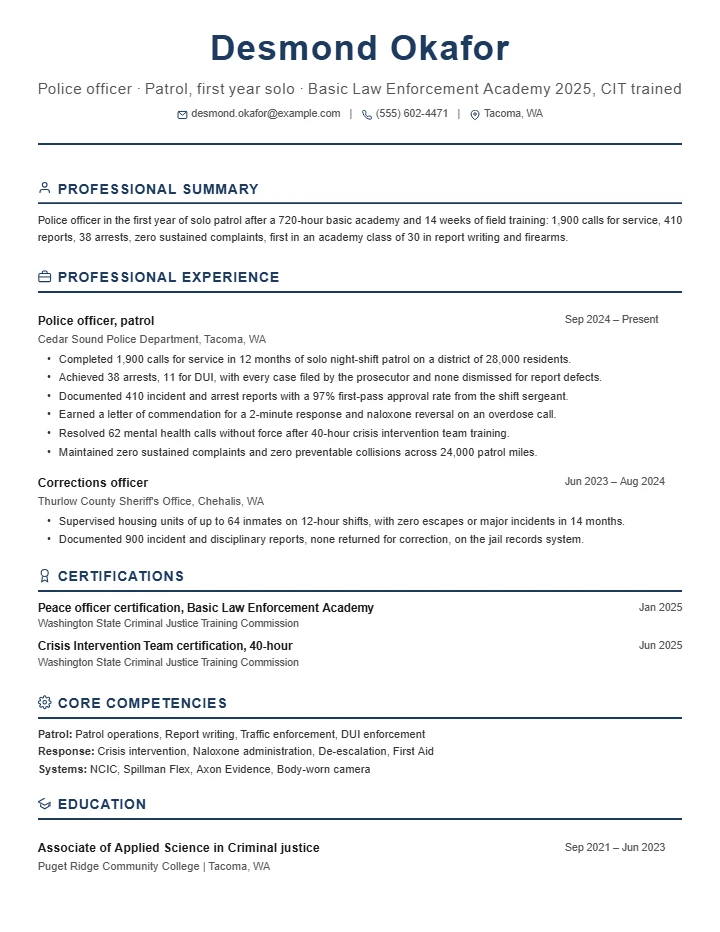
    Experience leads in year one because the academy and field training produced records an agency verifies: calls with the district size, reports with their approval rate, arrests with the DUI share, crisis calls without force, zero complaints. The jail year reads as custody and documentation, the degree sits below, and the certificate and CIT card are dated under the experience.

    Typical titles: Police officer, Patrol officer, Deputy sheriff

  • Mid-level

    3–6 years

    The default view. A patrol officer's page in the units a background investigator and oral board use: calls, reports, arrests and filing rate, court cases, recruits released, a community program with a crime result, the complaint and force record stated as zeros. The jail year keeps one line, and the certificate, FTO and SFST cards are dated under the experience.

    Typical titles: Field training officer, Senior patrol officer, Police officer II

  • Senior

    7+ years

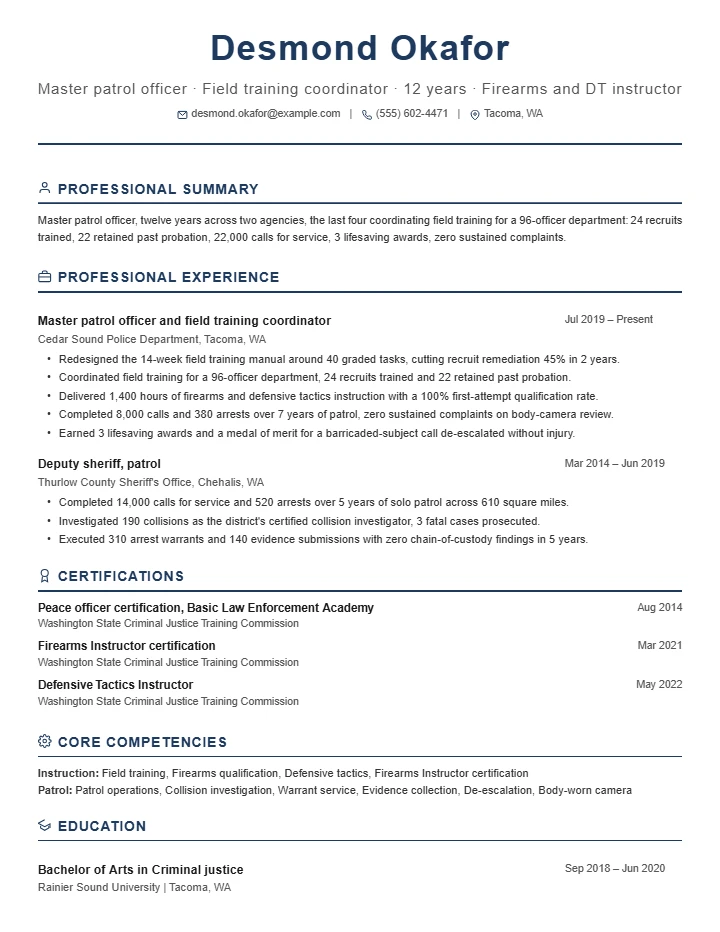
    Scope replaces call volume: a department's field training program with its retention and remediation figures, instruction hours with a qualification rate, awards named with their calls, and two agencies' worth of patrol compressed to three lines. The sheriff's years keep two lines, and the certificate and two instructor cards are dated at the bottom with the degree.

    Typical titles: Master patrol officer, Corporal, Field training coordinator

04Summary

Weak

Dedicated and highly motivated law enforcement professional with a strong commitment to public safety, integrity and community service, seeking to leverage my skills with a progressive agency.

Strong

Police officer with five years of patrol and two as a field training officer at a 96-officer municipal department: 9,400 calls for service, 2,100 reports, 210 arrests with a 94% filing rate, 6 recruits released to solo patrol, 3 commendations, zero sustained complaints and zero adverse use-of-force findings, SFST and FTO certified.

Calls, reports, arrests with their filing rate, recruits, commendations and a clean complaint record are what a background investigator verifies with the current agency and what an oral board asks about. The weak version is the values statement every applicant writes, and it gives the board nothing to ask.

05Bullets

Weak

  • Responsible for patrolling assigned areas, responding to calls for service, enforcing laws and preparing reports as required by department policy.

Strong

  • Achieved 210 arrests, including 44 for DUI as the shift's SFST-certified officer, with a 94% filing rate.

An arrest count with the DUI share, the certification that produced it and the prosecutor's filing rate, all of it in the records management system a background investigator can pull. The weak bullet is the job description from the handbook, and every officer on the shift could sign it. Postings screen on exactly these records.

06Skills and keywords

Patrol and enforcement

  • Patrol operations (in the example)
  • Report writing (in the example)
  • DUI enforcement (in the example)
  • Court testimony (in the example)
  • Traffic enforcement
  • Collision investigation
  • Warrant service
  • Evidence collection
  • Interview and interrogation

Response and community

  • Field training (in the example)
  • Community policing (in the example)
  • Use of force reporting (in the example)
  • Crisis intervention (in the example)
  • De-escalation
  • Naloxone administration
  • First Aid
  • Defensive tactics
  • Firearms qualification

Systems and credentials

  • Body-worn camera (in the example)
  • Spillman Flex (in the example)
  • Peace officer certification (in the example)
  • Field Training Officer certification (in the example)
  • Standardized Field Sobriety Testing (in the example)
  • Axon Evidence
  • NCIC
  • Crisis Intervention Team certification (in the example)
  • Drug Recognition Expert
  • Firearms Instructor certification

Filled chips appear in the example above.

Paste a job description and Resumi shows which of these your resume already covers.

Build your police officer resume

07Mistakes to avoid

  1. Duties from the job announcement, no counts

    Fix: Patrol, respond to calls, enforce laws and write reports are the handbook's duties and the posting's list. Write what the records system holds: calls for service, reports and their approval rate, arrests and the filing rate, court cases, recruits trained. A background investigator pulls the same numbers.

  2. A resume that disagrees with the personal history statement

    Fix: Backgrounds compare the resume against the application, the personal history statement and each prior employer's records, and an omission or a mismatch ends the file. Use the same dates, titles and reasons for leaving everywhere, and explain a gap in one line.

  3. Certifications without the issuing commission or date

    Fix: Lateral postings require a current state peace officer certificate, some accept one that lapsed recently, and specialty pay follows FTO, SFST, instructor and advanced certificates. List each with the commission that issued it, the month and any expiration, so the recruiter can verify without a call.

  4. Complaint and use-of-force record left unsaid

    Fix: Postings list background, polygraph and psychological screening, and agencies verify sustained complaints and force findings with the current employer. If the record is clean, write it as a count with the period it covers. Silence reads as a question the board will ask anyway.

  5. Four pages written for a federal application

    Fix: Officers who sit on boards say a local agency resume runs one page, two at most, and one reviewer says anything longer earns an inward groan. Give the current assignment five bullets with counts, earlier assignments two lines each, and let the application form carry the full history.

08Format and template

Executive Classic puts the name and a two-line headline over a plain page, with dates on the right and no graphics, which is what a civil service file and a background packet expect. Boards read the current assignment first, then certifications, then education, so this example keeps the certificates in a dated block under the experience and the skills to three short rows. The same content moves into Standard, Warm Classic or Blue Professional. Whichever you choose, the certification and the complaint record stay on the first screen.

Shown above: Executive Classic

  • Standard template
    StandardFree
  • Warm Classic template
    Warm Classic
  • Blue Professional template
    Blue Professional

09Questions police officers ask

What should a police officer resume include that a civil service application does not?

The numbers and the outcomes. The application collects every employer, address and reference for the background, and some agencies say a resume goes in the file unread. Where it is read, in lateral hiring, specialty assignments and promotions, it should carry what the application cannot: calls for service, reports and their approval rate, arrests and filing rate, court testimony, collisions investigated, recruits trained, commendations, and a stated complaint and use-of-force record. The handbook lists writing detailed reports and testifying in court among the core duties, so those counts speak the agency's language.

How do I write a police officer resume with no law enforcement experience?

Lead with the academy or the eligibility, then show the record an agency screens for. The handbook says candidates usually must be at least 21, pass physical, written, polygraph and drug tests and a background investigation, and that a felony conviction or drug use may disqualify. Officers who hire say prior jobs matter less than what they show, showing up, dealing with the public, handling conflict, and they name customer service, blue-collar trades, corrections, security, bartending and military service. Write those jobs with counts, a clean driving record and any first aid or CPR cards, and keep the personal history statement consistent.

Which certifications should a police officer list, and in what order?

The state peace officer certificate first, with the commission and date, because lateral postings require it and pay incentives attach to advanced certificates. Then the specialties that carry assignments or pay: field training officer, standardized field sobriety testing, crisis intervention team, drug recognition expert, firearms and defensive tactics instructor, collision investigation. CareerOneStop lists 15 certifications for the code, most of them K-9 team tests and hazardous materials or search-and-rescue credentials, none flagged as in demand, and 24 state peace officer licenses. List the cards the posting names, dated, and leave the rest for the file.

Should I put the complaint and use-of-force record on my resume?

Yes, as a count with the period. Agencies verify sustained complaints, force findings and discipline with the current employer and through the state commission, so the number is known before the interview. A line that reads zero sustained complaints and zero adverse use-of-force findings across five years and 1,200 body-camera reviews turns a background item into a credential. If the record is not clean, do not write around it. Address it in the personal history statement and be ready for the board, because the mismatch between a silent resume and a known finding is what ends files.

What does a lateral police officer resume need?

Certification status, years sworn, the size and type of the agency, and the specialties. Lateral postings ask for a current state certificate or one issued recently, a minimum period of full-time sworn service, good standing at the current agency, and often pay a bonus after the experienced-officer course. Agencies also ask why an officer is leaving. Put the certification and the years in the headline, give the current agency's size and your district's population, list the assignments with their dates, and keep every date identical to the application.

How long should a police officer resume be?

One page for a local or state agency, and officers who review packets say a longer one earns a groan before it earns a read. Federal applications once ran much longer, which is why laterals from federal service arrive with too much. Give the current assignment five bullets with counts, earlier assignments two lines each, the certifications in a dated block, and the degree with the field. The twelve-year example fits two agencies, two instructor certificates and a degree on one page.

Free to start

Build your police officer resume

No card, no trial that turns into a charge.

Sign up free