Correctional officer resume examples & writing guide for 2026

Three correctional officer resumes, from county detention officer to state prison sergeant, rendered in a real template and annotated line by line. Each one counts what a hiring sergeant or captain checks: the facility and custody level, counts, searches, reports and the shifts covered.

By the Resumi editorial teamUpdated 8 min read

Showing the mid-level example

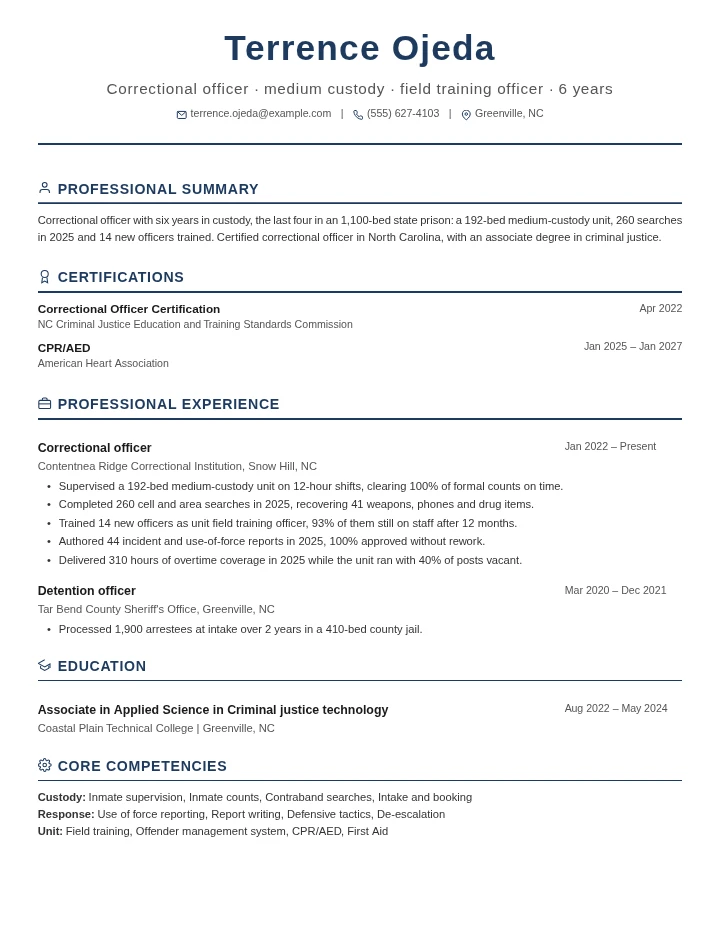
Correctional officer resume example, mid level, rendered in the Executive Classic template
Strength: Excellent

Written by the Resumi editorial team for a fictional candidate. Role facts come from O*NET and the U.S. Bureau of Labor Statistics.

Strength band is Resumi’s optimization score, not a ranking any employer sees.

What makes this resume work

Each marker on the page has a note here. Press a marker to jump to its note.

  1. 1

    Custody level in the headline

    Correctional officer, medium custody, field training officer, six years. Custody level and training duty tell a promotion board what you have run before they read a bullet.

  2. 2

    State certification on top

    The state correctional officer certification with its commission and date. Some states require it, and a background investigator checks every credential against the issuing body.

  3. 3

    A unit with every count cleared

    A 192-bed medium-custody unit on 12-hour shifts with every formal count cleared on time. Counts are the occupation's top-rated task, and the bed count gives the scale.

  4. 4

    Searches counted by finds

    Two hundred sixty searches and 41 weapons, phones and drug items recovered. Searching for contraband is a core task, and the finds show the searches were real.

  5. 5

    Reports that needed no rework

    Forty-four incident and use-of-force reports, all approved without rework. Keeping records of incidents is a top task, and clean reports are what a sergeant signs off on.

Build your correctional officer resume

Free to start · no card

01The example, in full

The resume shown above, as text you can search and copy.

Terrence Ojeda

Correctional officer · medium custody · field training officer · 6 years

Greenville, NCterrence.ojeda@example.com(555) 627-4103

Summary

Correctional officer with six years in custody, the last four in an 1,100-bed state prison: a 192-bed medium-custody unit, 260 searches in 2025 and 14 new officers trained. Certified correctional officer in North Carolina, with an associate degree in criminal justice.

Experience

Correctional officer

Jan 2022 – Present

Contentnea Ridge Correctional Institution · Snow Hill, NC

  • Supervised a 192-bed medium-custody unit on 12-hour shifts, clearing 100% of formal counts on time.
  • Completed 260 cell and area searches in 2025, recovering 41 weapons, phones and drug items.
  • Trained 14 new officers as unit field training officer, 93% of them still on staff after 12 months.
  • Authored 44 incident and use-of-force reports in 2025, 100% approved without rework.
  • Delivered 310 hours of overtime coverage in 2025 while the unit ran with 40% of posts vacant.

Detention officer

Mar 2020 – Dec 2021

Tar Bend County Sheriff's Office · Greenville, NC

  • Processed 1,900 arrestees at intake over 2 years in a 410-bed county jail.

Education

Associate in Applied Science in Criminal justice technology

Aug 2022 – May 2024

Coastal Plain Technical College · Greenville, NC

Skills

Custody
Inmate supervision, Inmate counts, Contraband searches, Intake and booking
Response
Use of force reporting, Report writing, Defensive tactics, De-escalation
Unit
Field training, Offender management system, CPR/AED, First Aid

Certifications

Correctional Officer Certification

Apr 2022

NC Criminal Justice Education and Training Standards Commission

CPR/AED

Jan 2025

American Heart Association

02Market snapshot

Median pay
$58,940 median annual pay for correctional officers and jailers
Typical education
High school diploma and a training academy. Federal prisons want a bachelor's degree or several years of experience
Job outlook
-7% for correctional officers and bailiffs, 2025–35, still about 30,000 openings a year
Common credentials
13 national certifications listed, from jail officer to corrections manager

Sources: BLS OES (May 2025) · BLS OOH (2025) · CareerOneStop (2026)

03The same resume at three levels

The tinted row is the level shown above.

  • Entry-level

    0–2 years

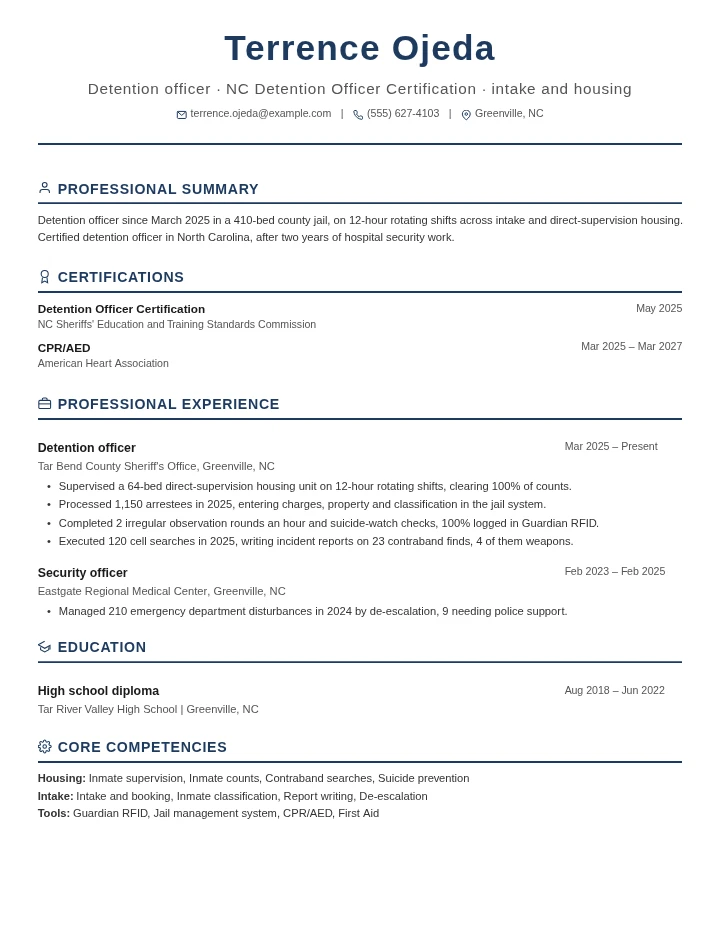
    The state certification and CPR come first, then the first year in four counted bullets: a direct-supervision unit with counts cleared, intake volume, observation rounds and suicide-watch checks logged, and searches with their finds written up. Hospital security keeps one line with the disturbances handled.

    Typical titles: Detention officer, Jailer, Detention deputy

  • Mid-level

    3–6 years

    The default view. A medium-custody unit in the units a promotion board reads: bed count and counts cleared, searches with finds, new officers trained and still on staff, reports approved without rework, and overtime covered during vacancies. The county jail keeps one line with its intake volume.

    Typical titles: Correctional officer, Corrections officer, Correctional officer II

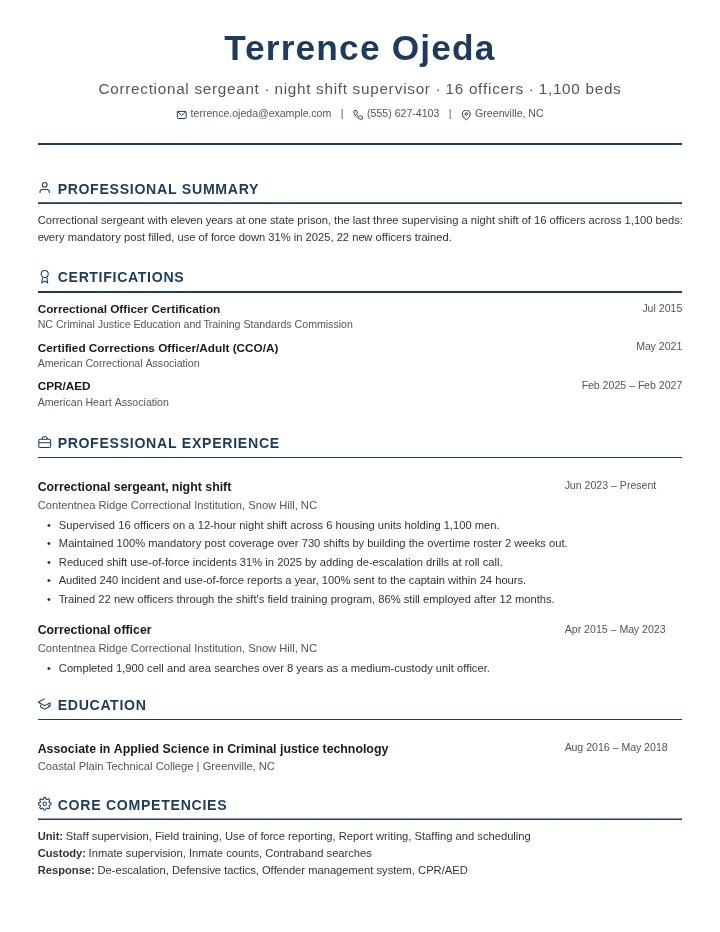
  • Senior

    7+ years

    Shift command replaces unit work: sixteen officers across six housing units, every mandatory post filled, use of force reduced with a method, reports audited on a clock, and new officers trained and kept. Eight years as a unit officer keep one line, with the searches counted.

    Typical titles: Correctional sergeant, Shift supervisor, Detention sergeant

04Summary

Weak

Dedicated correctional officer with strong communication skills, a commitment to safety and security, and experience maintaining order in a correctional facility.

Strong

Correctional officer with six years in custody, the last four in an 1,100-bed state prison: a 192-bed medium-custody unit, 260 searches in 2025 and 14 new officers trained.

A sergeant reads the facility, the custody level and the workload before anything else. The strong version gives bed counts, searches and training duty they can check with a phone call. The weak version fits any officer in any facility.

05Bullets

Weak

  • Responsible for searching cells and inmates for contraband and keeping the housing unit safe and secure.

Strong

  • Completed 260 cell and area searches in 2025, recovering 41 weapons, phones and drug items.

Searching people in custody and their cells for contraband is one of the occupation's highest-rated tasks, so every applicant claims it. The strong bullet gives the number of searches in a year and what they turned up, which a supervisor can match against the facility's own search logs. The weak bullet repeats the posting and says nothing about how often or how well.

06Skills and keywords

Custody and housing

  • Inmate supervision (in the example)
  • Inmate counts (in the example)
  • Contraband searches (in the example)
  • Intake and booking (in the example)
  • Inmate classification
  • Inmate transport
  • Key control
  • Suicide prevention

Response and records

  • De-escalation (in the example)
  • Defensive tactics (in the example)
  • Use of force reporting (in the example)
  • Report writing (in the example)
  • PREA compliance
  • Field training (in the example)

Systems and certifications

  • Jail management system (in the example)
  • Guardian RFID
  • Correctional Officer Certification (in the example)
  • Detention Officer Certification
  • Certified Jail Officer (CJO)
  • Certified Corrections Officer/Adult (CCO/A)
  • CPR/AED (in the example)

Filled chips appear in the example above.

Paste a job description and Resumi shows which of these your resume already covers.

Build your correctional officer resume

07Mistakes to avoid

  1. Claims a background check will contradict

    Fix: Every agency runs a background investigation of employment history and references, and officers who interview applicants say they are used to hearing lies. Give exact months for every job, list only certifications you hold, and never round up a title or a count.

  2. Percentages with no base

    Fix: Sample resumes say contraband incidents fell 20% without saying from what. A sergeant cannot check that. Count the searches you ran in a year and what they recovered, the arrestees you processed, and the reports you wrote, and keep the percentages for rates you can show.

  3. No facility type or custody level

    Fix: A county jail, a state prison and a federal facility hire for different work. Name the facility type, the bed count, the custody level and the supervision model, direct or linear, so the reader knows what your counts and searches were measured against.

  4. Certification with no issuer or date

    Fix: Some states require state certification, and county postings set a deadline to earn it after hire. Write the certification name, the issuing commission and the date. If it is still in progress, say when you expect to finish rather than listing it as held.

  5. The shift pattern left off

    Fix: Postings ask for nights, weekends, holidays and 12-hour rotating shifts, and short-staffed facilities run on overtime. Say which shift pattern you worked and how much overtime you covered, because it answers the first question a staffing sergeant has.

08Format and template

Executive Classic keeps plain headings and puts the certification block above experience, so a county or state screener sees the credential before the shifts. This example uses Executive Classic. The same content moves into Standard, Warm Classic or Blue Professional. Whichever you choose, give exact months for every role, name the facility type and bed count, spell out each certification with its issuing body, and keep inmate details off the page.

Shown above: Executive Classic

  • Standard template
    StandardFree
  • Warm Classic template
    Warm Classic
  • Blue Professional template
    Blue Professional

09Questions correctional officers ask

Do I need a college degree to be a correctional officer?

Not for most jobs. The handbook lists a high school diploma or equivalent plus a training academy, and 92 percent of O*NET's respondents said a new hire needs only a diploma. The exception is the Federal Bureau of Prisons, which asks for a bachelor's degree or several years of experience. Some promotion postings also ask for college credits, which is why the mid example adds an associate degree.

How do I show report writing on a correctional officer resume?

Count it. Recording prisoner information and incidents in daily logs is one of the occupation's highest-rated tasks, and written reports to supervisors on rule violations and unusual occurrences are another. Give the number of incident and use-of-force reports in a year and whether they were approved without rework or sent up on time, as the mid and senior examples do. Never describe the people involved.

How much do correctional officers make?

The May 2025 median for correctional officers and jailers was $58,940, with the lowest tenth under $42,760 and the highest tenth over $93,220. Employer matters most: the federal government paid a median $74,630, state government $59,990, local government $58,500 and facilities support services $46,910. Name your employer type and facility in the headline so the reader can place you.

Which certifications should a correctional officer list?

Start with your state certification, if your state requires one, written with the issuing commission and the date. CareerOneStop lists 13 national certifications for the occupation, among them the American Jail Association's Certified Jail Officer and the American Correctional Association's adult corrections officer credential. List CPR with its expiry. Put certifications above experience, as all three examples do, because screeners check them first.

How do I move from a county jail to a state or federal job?

Lead with the work that transfers: counts, searches, intake volume and reports, each counted. State government employs 52 percent of correctional officers and jailers and local government 40 percent, so most moves go from county to state, as in the mid example. Federal prisons employ 4 percent, pay more, and ask for a bachelor's degree or several years of experience.

Free to start

Build your correctional officer resume

No card, no trial that turns into a charge.

Sign up free