Firefighter resume examples & writing guide for 2026

Three firefighter resumes at probationary, driver/operator and lieutenant level, rendered in a real template and annotated line by line. Each one puts the certifications a hiring panel checks first at the top, then counts runs, fires worked, inspections and the crews trained.

By the Resumi editorial teamUpdated 8 min read

Showing the mid-level example

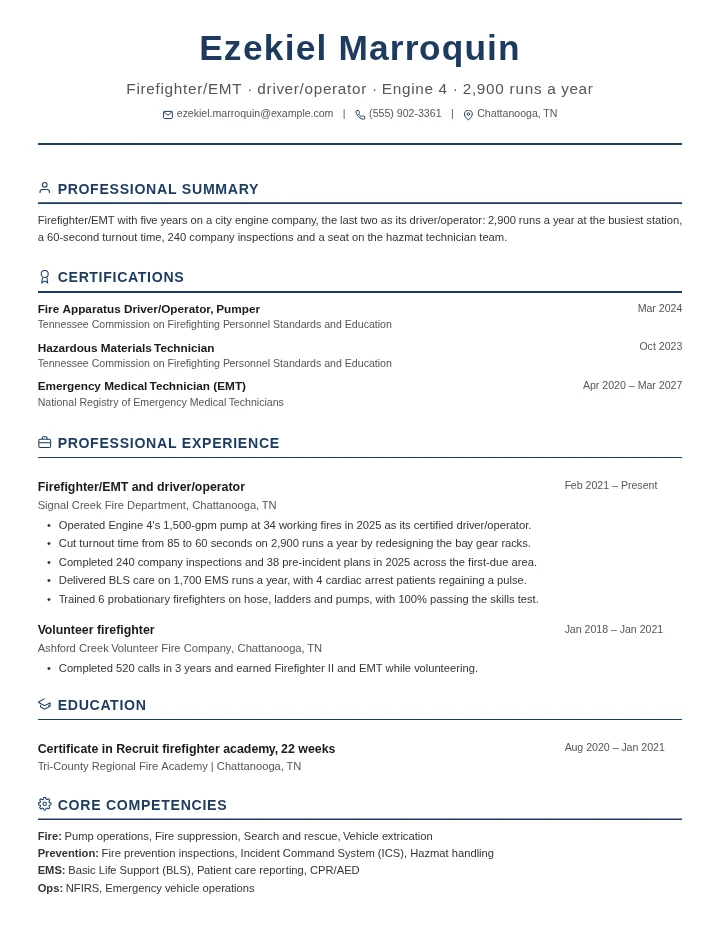
Firefighter resume example, mid level, rendered in the Executive Classic template
Strength: Excellent

Written by the Resumi editorial team for a fictional candidate. Role facts come from O*NET and the U.S. Bureau of Labor Statistics.

Strength band is Resumi’s optimization score, not a ranking any employer sees.

What makes this resume work

Each marker on the page has a note here. Press a marker to jump to its note.

  1. 1

    Engine and run volume up top

    Firefighter/EMT, driver/operator, Engine 4, 2,900 runs a year. A lateral or promotional panel reads the station's volume as the experience behind the title.

  2. 2

    Prevention work in the profile

    Two hundred forty company inspections in a year, named in the profile beside the run volume. Inspecting buildings for hazards is a listed firefighter task, and it shows a company that does more than respond.

  3. 3

    Driver/operator credential listed

    Driver/operator certification for a pumper, hazmat technician and EMT, each dated. Engineer postings require the driver/operator certificate at application, so it leads the list.

  4. 4

    The pump at working fires

    A 1,500-gpm pump at 34 working fires as the certified operator. Driving the apparatus and running its pumps are core tasks for the occupation, and the fire count is the experience.

  5. 5

    Turnout time cut on every run

    Turnout time from 85 to 60 seconds across 2,900 runs, by changing how gear sits in the bay. It is a measurable improvement any officer can check against the dispatch record.

Build your firefighter resume

Free to start · no card

01The example, in full

The resume shown above, as text you can search and copy.

Ezekiel Marroquin

Firefighter/EMT · driver/operator · Engine 4 · 2,900 runs a year

Chattanooga, TNezekiel.marroquin@example.com(555) 902-3361

Summary

Firefighter/EMT with five years on a city engine company, the last two as its driver/operator: 2,900 runs a year at the busiest station, a 60-second turnout time, 240 company inspections and a seat on the hazmat technician team.

Experience

Firefighter/EMT and driver/operator

Feb 2021 – Present

Signal Creek Fire Department · Chattanooga, TN

  • Operated Engine 4's 1,500-gpm pump at 34 working fires in 2025 as its certified driver/operator.
  • Cut turnout time from 85 to 60 seconds on 2,900 runs a year by redesigning the bay gear racks.
  • Completed 240 company inspections and 38 pre-incident plans in 2025 across the first-due area.
  • Delivered BLS care on 1,700 EMS runs a year, with 4 cardiac arrest patients regaining a pulse.
  • Trained 6 probationary firefighters on hose, ladders and pumps, with 100% passing the skills test.

Volunteer firefighter

Jan 2018 – Jan 2021

Ashford Creek Volunteer Fire Company · Chattanooga, TN

  • Completed 520 calls in 3 years and earned Firefighter II and EMT while volunteering.

Education

Certificate in Recruit firefighter academy, 22 weeks

Aug 2020 – Jan 2021

Tri-County Regional Fire Academy · Chattanooga, TN

Skills

Fire
Pump operations, Fire suppression, Search and rescue, Vehicle extrication
Prevention
Fire prevention inspections, Incident Command System (ICS), Hazmat handling
EMS
Basic Life Support (BLS), Patient care reporting, CPR/AED
Ops
NFIRS, Emergency vehicle operations

Certifications

Fire Apparatus Driver/Operator, Pumper

Mar 2024

Tennessee Commission on Firefighting Personnel Standards and Education

Hazardous Materials Technician

Oct 2023

Tennessee Commission on Firefighting Personnel Standards and Education

Emergency Medical Technician (EMT)

Apr 2020

National Registry of Emergency Medical Technicians

02Market snapshot

Median pay
$59,280 median annual pay, from under $34,910 to over $101,040
Typical education
Postsecondary nondegree award, usually the academy and EMS training, then long-term on-the-job training
Job outlook
+4% for 2025–35, about 13,100 new jobs and 26,800 openings a year
Common credentials
No license. CareerOneStop lists 14 certifications, from wildland Firefighter Type 2 to Emergency Medical Responder

Sources: BLS OES (May 2025) · BLS OOH (2025) · CareerOneStop (2026)

03The same resume at three levels

The tinted row is the level shown above.

  • Entry-level

    0–2 years

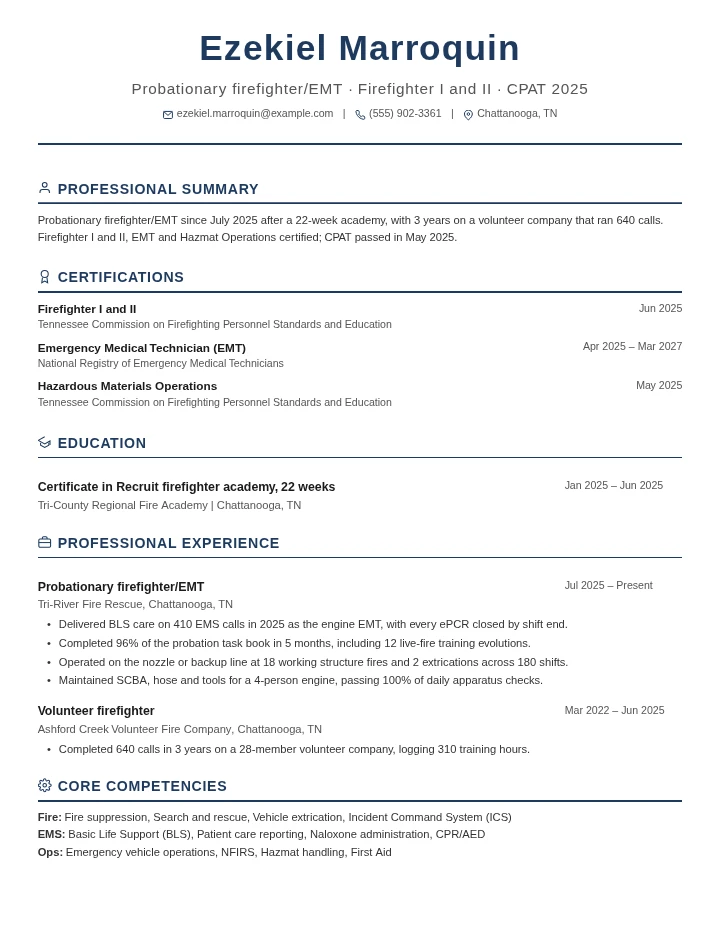
    The certifications and the academy come first, then the probationary year in four counted bullets: EMS calls with reports closed, the task book progress, working fires by position, and daily checks without a failure. The volunteer company keeps one line with its calls and training hours.

    Typical titles: Probationary firefighter, Firefighter/EMT, Firefighter trainee

  • Mid-level

    3–6 years

    The default view. An engine company in the units an officer tracks: fires worked at the pump, turnout time on every run, company inspections and pre-incident plans, EMS care with its outcomes, and probationary firefighters trained. The volunteer years keep one line with the certifications earned there.

    Typical titles: Firefighter/EMT, Fire engineer, Driver/operator

  • Senior

    7+ years

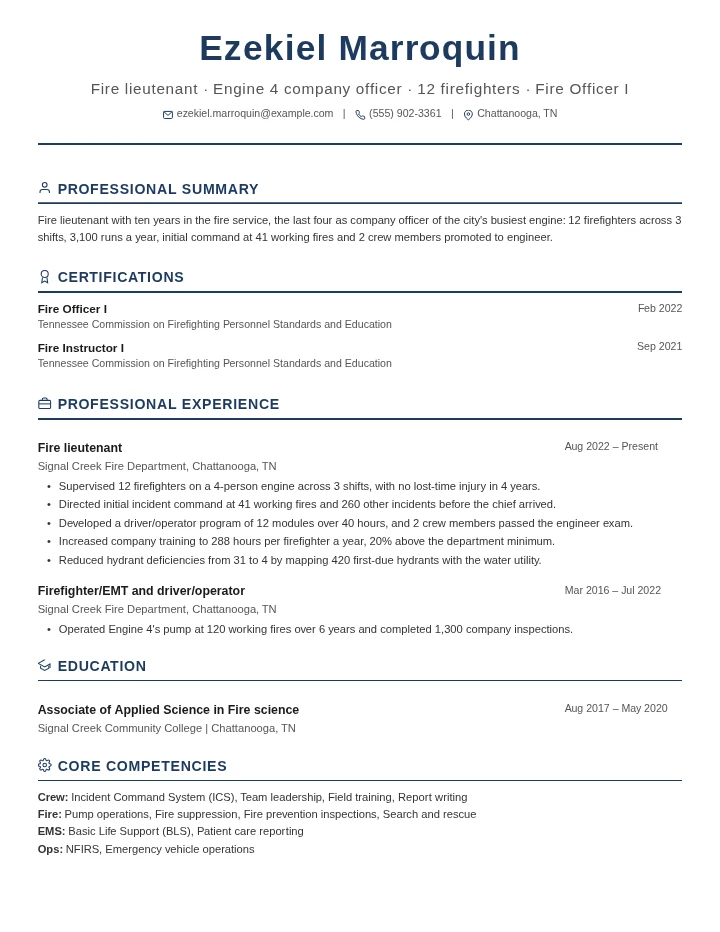
    Scope replaces runs: a crew of twelve across three shifts with its injury record, initial command at working fires, a driver/operator program that produced engineers, training hours above the minimum, and hydrant deficiencies fixed with the utility. The six engineer years keep one line with their fires and inspections.

    Typical titles: Fire lieutenant, Fire captain, Company officer

04Summary

Weak

Dedicated and courageous firefighter with a passion for serving the community, strong physical fitness and the ability to remain calm in high-pressure emergency situations.

Strong

Firefighter/EMT with five years on a city engine company, the last two as its driver/operator: 2,900 runs a year at the busiest station, a 60-second turnout time, 240 company inspections and a seat on the hazmat technician team.

A hiring or promotional panel reads rank, run volume and credentials before anything else. The strong version gives all three plus two numbers an officer can check. The weak version describes what every candidate at the oral board will claim.

05Bullets

Weak

  • Responded to fire and medical emergencies, operated fire apparatus and performed fire suppression and rescue duties as assigned.

Strong

  • Operated Engine 4's 1,500-gpm pump at 34 working fires in 2025 as its certified driver/operator.

Driving and operating fire apparatus and pumps is a core task for the occupation, and engineer postings require the driver/operator certificate. The strong bullet names the apparatus, its pump rating, the number of working fires and the credential behind it. A battalion chief can check every part against the department's incident records, and the weak bullet gives them nothing to check.

06Skills and keywords

Fireground

  • Fire suppression (in the example)
  • Pump operations (in the example)
  • Search and rescue (in the example)
  • Vehicle extrication (in the example)
  • Incident Command System (ICS) (in the example)
  • Hazmat handling (in the example)

EMS and prevention

  • Basic Life Support (BLS) (in the example)
  • Patient care reporting (in the example)
  • CPR/AED (in the example)
  • Naloxone administration
  • Fire prevention inspections (in the example)
  • Emergency vehicle operations (in the example)
  • NFIRS (in the example)

Credentials

  • Firefighter I
  • Firefighter II (in the example)
  • Emergency Medical Technician (EMT) (in the example)
  • Hazardous Materials Operations
  • Hazardous Materials Technician (in the example)
  • Fire Apparatus Driver/Operator (in the example)
  • Fire Officer I
  • Fire Instructor I
  • Emergency Medical Responder

Filled chips appear in the example above.

Paste a job description and Resumi shows which of these your resume already covers.

Build your firefighter resume

07Mistakes to avoid

  1. Certifications buried at the bottom

    Fix: Entry postings require proof of Firefighter I and II, EMT and hazmat certification by the closing date, and promotional postings require officer and instructor cards before the exam. List each near the top with the issuing body and the date, not as a line in a skills list.

  2. No CPAT or written test date

    Fix: Many departments accept only a CPAT card or written score from the last twelve to eighteen months. If you are applying for an entry job, write the test and the month you passed it in your headline or summary so a screener does not have to ask.

  3. Volunteer service written as a hobby

    Fix: The handbook says volunteer firefighting helps a career application. Write the company like an employer: calls run, training hours logged, positions held and the certifications you earned while serving. A panel reads that as experience.

  4. Runs counted, work on them missing

    Fix: Answered 300 calls tells an officer you showed up. Split fire from EMS, name your position on the apparatus, and add an outcome: working fires on the nozzle, patients who regained a pulse, extrications completed.

  5. A lieutenant application that reads like a firefighter's

    Fix: Lieutenant postings test supervision, incident command, records and drills. Show the crew you supervised, the fires where you held command, the training you built and the people who were promoted after it.

08Format and template

Executive Classic keeps headings plain and the certifications block high on the page, so a civil service screener and an oral board read the same order: rank, credentials, then service. This example uses Executive Classic. The same content moves into Standard, Warm Classic or Blue Professional. Whichever you choose, keep the CPAT or rank in the headline, every certificate with its issuing body and date, and every role's dates in months.

Shown above: Executive Classic

  • Standard template
    StandardFree
  • Warm Classic template
    Warm Classic
  • Blue Professional template
    Blue Professional

09Questions firefighters ask

Do I need to be an EMT to become a firefighter?

Usually, yes. The handbook says firefighters typically need a high school diploma and training in emergency medical services, and may need EMT or paramedic certification. Entry postings this year ask for a current EMT card at application, and some pay more or require paramedic certification within a few years of hire. Put the EMT card in your certifications block with its expiration date, and count your EMS calls in your bullets.

Which certifications should be on a firefighter resume?

The ones the posting names, with the issuing body and date: usually Firefighter I and II, EMT, hazardous materials operations and CPR. CareerOneStop lists 14 more specialized certifications for the occupation, from the wildland Firefighter Type 2 to the Emergency Medical Responder and safety officer credentials. The handbook adds that some states require a commercial license or a firefighter endorsement to drive the apparatus. Driver/operator, Fire Officer I and Fire Instructor I come later, on the promotional path.

How much do firefighters make?

The May 2025 median was $59,280 a year, or $28.50 an hour, with the lowest 10 percent under $34,910 and the highest 10 percent over $101,040. State government paid a median $64,980, federal government $63,270 and local government $59,850. Local governments employed 87 percent of firefighters in 2025, so most resumes go to a city or county civil service office, and the posting's pay range is the one that matters.

How should I list volunteer firefighter experience?

As a job. The handbook says working as a volunteer firefighter may help in getting a career job, and panels read volunteer service as experience when it is written that way. Give the company, your dates, the calls you ran, the training hours you logged and the certifications you earned there. The entry example keeps its volunteer company as a full role with 640 calls and 310 training hours.

What does it take to be promoted to engineer or lieutenant?

The handbook describes the ladder as firefighter, engineer, lieutenant, captain and chief ranks, with a bachelor's degree often required beyond battalion chief. Engineer postings ask for a driver/operator certificate, and lieutenant postings ask for Fire Officer I and Fire Instructor I plus years as an engineer, then a written exam and an assessment center. On paper, show the pump hours, the crews you trained and any command you held before the title.

Free to start

Build your firefighter resume

No card, no trial that turns into a charge.

Sign up free