Veterinary technician resume examples & writing guide for 2026

Three veterinary technician resumes at new RVT, emergency and critical care, and supervisor level, rendered in a real template and annotated note by note. Each one names the state credential and counts anesthesia, catheters and patients.

By the Resumi editorial teamUpdated 8 min read

Showing the mid-level example

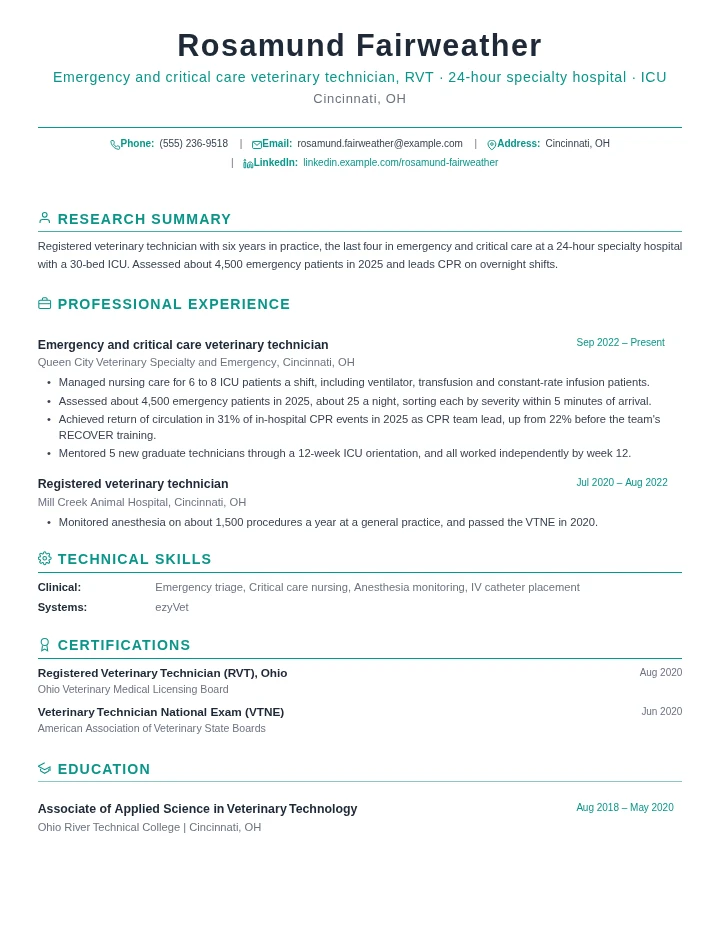
Veterinary technician resume example, mid level, rendered in the Green Academic template
Strength: Strong

Written by the Resumi editorial team for a fictional candidate. Role facts come from O*NET and the U.S. Bureau of Labor Statistics.

Strength band is Resumi’s optimization score, not a ranking any employer sees.

What makes this resume work

Each marker on the page has a note here. Press a marker to jump to its note.

  1. 1

    Specialty service in the headline

    Emergency and critical care at a 24-hour specialty hospital. Specialty hospitals hire technicians by department, and the headline tells a manager which board this technician can run.

  2. 2

    Volume and a lead role

    About 4,500 emergency patients a year and CPR lead on nights. The count shows the pace of the job, and leading CPR shows the trust the hospital places in this technician.

  3. 3

    ICU load named

    Six to 8 ICU patients a shift, with ventilator and transfusion cases. Naming the patient types tells a reader the technician handles the hardest nursing in the building.

  4. 4

    CPR outcome with a before

    Return of circulation in 31% of CPR events, up from 22%. An outcome with its starting point shows the training worked, which a medical director can check against their own numbers.

  5. 5

    New graduates brought up

    Five new graduates through a 12-week ICU orientation, all working alone by the end. Hospitals depend on technicians who can teach, and the result shows the orientation worked.

Build your veterinary technician resume

Free to start · no card

01The example, in full

The resume shown above, as text you can search and copy.

Rosamund Fairweather

Emergency and critical care veterinary technician, RVT · 24-hour specialty hospital · ICU

Cincinnati, OHrosamund.fairweather@example.com(555) 236-9518linkedin.example.com/rosamund-fairweather

Summary

Registered veterinary technician with six years in practice, the last four in emergency and critical care at a 24-hour specialty hospital with a 30-bed ICU. Assessed about 4,500 emergency patients in 2025 and leads CPR on overnight shifts.

Experience

Emergency and critical care veterinary technician

Sep 2022 – Present

Queen City Veterinary Specialty and Emergency · Cincinnati, OH

  • Managed nursing care for 6 to 8 ICU patients a shift, including ventilator, transfusion and constant-rate infusion patients.
  • Assessed about 4,500 emergency patients in 2025, about 25 a night, sorting each by severity within 5 minutes of arrival.
  • Achieved return of circulation in 31% of in-hospital CPR events in 2025 as CPR team lead, up from 22% before the team's RECOVER training.
  • Mentored 5 new graduate technicians through a 12-week ICU orientation, and all worked independently by week 12.

Registered veterinary technician

Jul 2020 – Aug 2022

Mill Creek Animal Hospital · Cincinnati, OH

  • Monitored anesthesia on about 1,500 procedures a year at a general practice, and passed the VTNE in 2020.

Education

Associate of Applied Science in Veterinary Technology

Aug 2018 – May 2020

Ohio River Technical College · Cincinnati, OH

Skills

Clinical
Emergency triage, Critical care nursing, Anesthesia monitoring, IV catheter placement
Systems
ezyVet

Certifications

Registered Veterinary Technician (RVT), Ohio

Aug 2020

Ohio Veterinary Medical Licensing Board

Veterinary Technician National Exam (VTNE)

Jun 2020

American Association of Veterinary State Boards
02Market snapshot

Median pay
$47,380 median annual pay, and $52,200 in educational services
Typical education
Associate's degree for technicians, and a bachelor's degree for technologists
Job outlook
9% growth from 2025 to 2035, much faster than average
Common credentials
Most states require technicians and technologists to pass an exam

Sources: BLS OES (May 2025) · BLS OOH (2025)

03The same resume at three levels

The tinted row is the level shown above.

  • Entry-level

    0–2 years

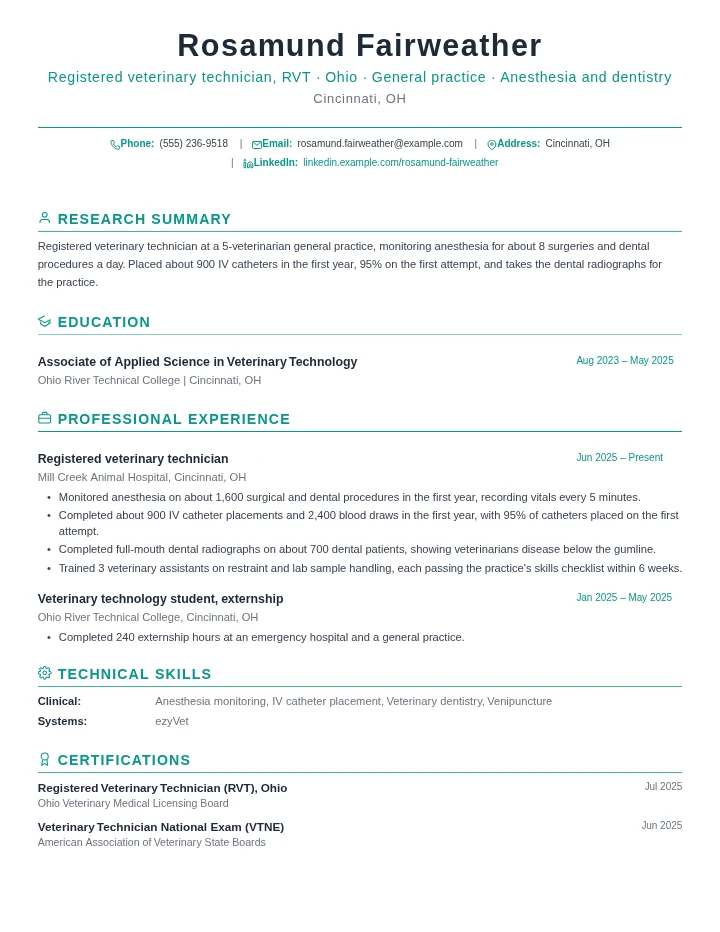
    Education sits above the jobs, and the headline gives the credential, the state, the setting and the skills. Bullets cover anesthesia, catheters and blood draws, dental radiographs and training assistants. The externship folds to one line with its hours and settings.

    Typical titles: Registered veterinary technician, Credentialed veterinary technician, Veterinary nurse

  • Mid-level

    3–6 years

    The headline names the department, the setting and the credential. Bullets give emergency patients assessed, ICU load, CPR outcomes and new graduates mentored. The general practice years fold to one line with anesthetic cases and the year the VTNE was passed.

    Typical titles: Emergency veterinary technician, ICU veterinary technician, Critical care veterinary nurse

  • Senior

    7+ years

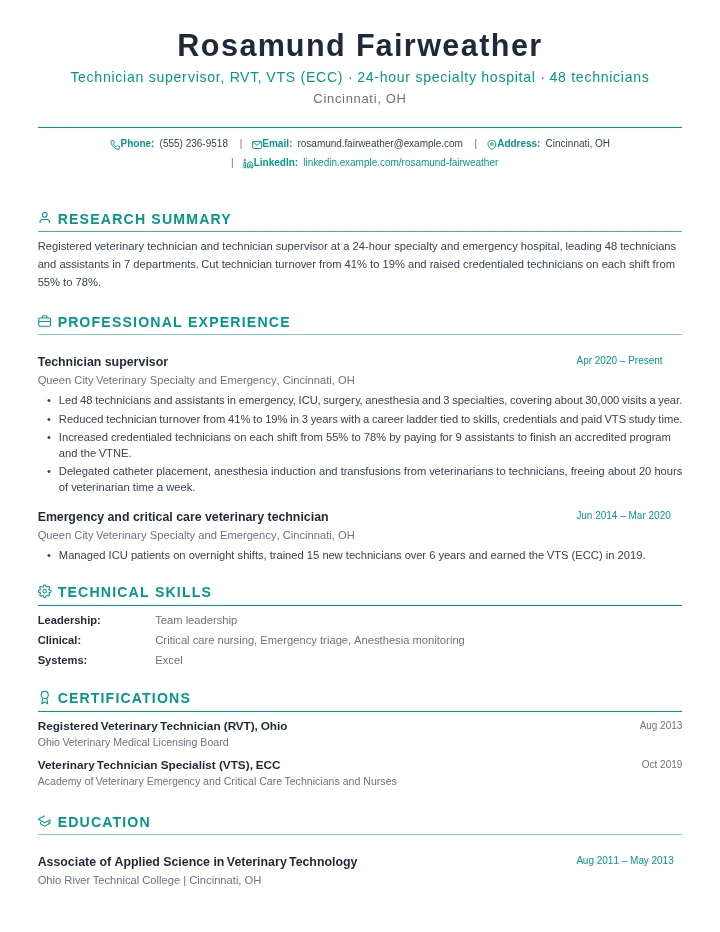
    Scope replaces patient counts: the size of the team, the departments and visits covered, turnover, the credentialed share of each shift and the duties delegated to technicians. The emergency years fold to one line with the technicians trained and the year the specialty credential was earned.

    Typical titles: Technician supervisor, Lead veterinary technician, Veterinary nursing manager

04Summary

Weak

Compassionate veterinary technician who loves animals and is dedicated to providing the highest quality of care to every patient and client.

Strong

Registered veterinary technician with six years in practice, the last four in emergency and critical care at a 24-hour specialty hospital with a 30-bed ICU. Assessed about 4,500 emergency patients in 2025 and leads CPR on overnight shifts.

The credential, the department, the setting, the size of the ICU, a patient count and a lead role. A hospital manager can compare each with their own team. The weak version promises love for animals without a credential, a skill or a number.

05Bullets

Weak

  • Assisted veterinarians with exams, surgeries and treatments and cared for hospitalized patients.

Strong

  • Achieved return of circulation in 31% of in-hospital CPR events in 2025 as CPR team lead, up from 22% before the team's RECOVER training.

An outcome, the role behind it, the starting point and the training that changed it. A medical director can ask how events were recorded and which steps improved. The weak bullet describes what every technician and assistant does, with no credential, no skill and no result, so every applicant in the pile could send it unchanged.

06Skills and keywords

Clinical

  • Emergency triage (in the example)
  • Critical care nursing (in the example)
  • Anesthesia monitoring (in the example)
  • IV catheter placement (in the example)
  • Veterinary dentistry
  • Venipuncture

Systems

  • ezyVet (in the example)
  • Excel

Credentials

  • Registered Veterinary Technician (RVT) (in the example)
  • Veterinary Technician National Exam (VTNE) (in the example)
  • Veterinary Technician Specialist (VTS)

Filled chips appear in the example above.

Paste a job description and Resumi shows which of these your resume already covers.

Build your veterinary technician resume

07Mistakes to avoid

  1. Credential title left vague

    Fix: States use different titles, such as CVT, LVT, RVT or LVMT, and the exam is the same national one. Write your title and the state that issued it, and say you passed the VTNE, because postings ask for a credential in the state where the clinic sits.

  2. Skills listed without counts

    Fix: Anesthesia, catheters, dentistry and radiographs are the skills postings ask about. Give a number for each, such as anesthetic cases a year or catheters placed with your first-attempt rate, so a manager can see how routine they are for you.

  3. Accuracy claims nobody measures

    Fix: A claim like improved diagnosis accuracy by 15% matches nothing a clinic records. Use measures the hospital does keep, such as patients triaged, first-attempt catheters, CPR outcomes, medication errors or anesthetic cases, with the count behind each.

  4. Assistant and technician blurred

    Fix: Many technicians report that clinics treat credentialed and uncredentialed staff the same. Make the difference plain: name the credential, the skills only a credentialed technician performs in your state, and any assistants you train or supervise.

  5. No department or setting named

    Fix: General practice, emergency, ICU, surgery, anesthesia and specialty services need different strengths. Put your department and setting in the headline, because specialty hospitals hire technicians by department and screen on it first.

08Format and template

One column, reverse-chronological order and standard section headings, with every figure written as text. Put your credential title, state, setting and main skills in the headline. Give counts for anesthesia, catheters, dentistry and patients, and the measures your hospital tracks. List the state credential, the VTNE and any specialty credential with dates. This example uses Green Academic. The same content works in Standard, Warm Classic and Beige Border.

Shown above: Green Academic

  • Standard template
    StandardFree
  • Warm Classic template
    Warm Classic
  • Beige Border template
    Beige Border

09Questions veterinary technicians ask

Should I write CVT, LVT or RVT on my resume?

Use the exact title your state issues, with the state beside it, such as RVT, Ohio. The national exam is the same everywhere: AAVSB runs the Veterinary Technician National Exam and sends scores to the state, and the state grants the credential. If you hold credentials in two states, list both. Postings often accept any of the titles, so naming your state's makes the match clear.

What numbers should a veterinary technician put on a resume?

Give anesthetic cases a year, catheters placed with your first-attempt rate, blood draws, dental radiograph series and patients a day. Emergency and ICU technicians should add patients triaged, ICU patients a shift and CPR outcomes. Supervisors should add team size, turnover, the share of credentialed staff per shift and medication errors. Always show the starting point beside any change you made.

How should a new veterinary technician write a resume?

Put your accredited program first, then your externship with its hours and settings. List the VTNE and your state credential, or the date you expect it. Some hospitals run new graduate programs with a mentor and rotations through emergency, ICU, surgery and anesthesia, so name the departments you want to learn and the skills you already have, with counts from school.

Is a Veterinary Technician Specialist credential worth it?

For technicians who want to lead in one area, often yes. NAVTA lists 16 specialty academies, from emergency and critical care to anesthesia, dentistry and surgery. A specialist in dentistry has written that the credential opened doors to teaching, lecturing and writing. The path takes years of logged work in the specialty, so list the academy, the specialty and the date earned.

How do I show a hospital that I am more than a veterinary assistant?

Show the skills and duties a credentialed technician performs in your state: anesthesia induction and monitoring, IV catheters, dental radiographs, ICU nursing and training or supervising assistants. Many technicians in NAVTA's 2024 survey reported little difference between their duties and those of uncredentialed staff, so a resume that names technician-level work with counts answers that concern before the interview even starts.

How do I move from veterinary technician to supervisor?

Show the lead work you already do. Mentoring new graduates, running a department's schedule, leading CPR, training assistants and fixing a safety problem all count. Give numbers for each. Practitioner leaders recommend specialty credentials and professional groups for those moving into supervision, and hospitals judge supervisors on turnover and staffing, so show any of those you have improved, with numbers.

Free to start

Build your veterinary technician resume

No card, no trial that turns into a charge.

Sign up free