Line cook resume examples & writing guide for 2026

Three line cook resumes at prep, station and lead level, rendered in a real template and taken apart line by line. Every one names the stations it can run and the covers it runs them through, because job ads never do.

By the Resumi editorial teamUpdated 10 min read

Showing the mid-level example

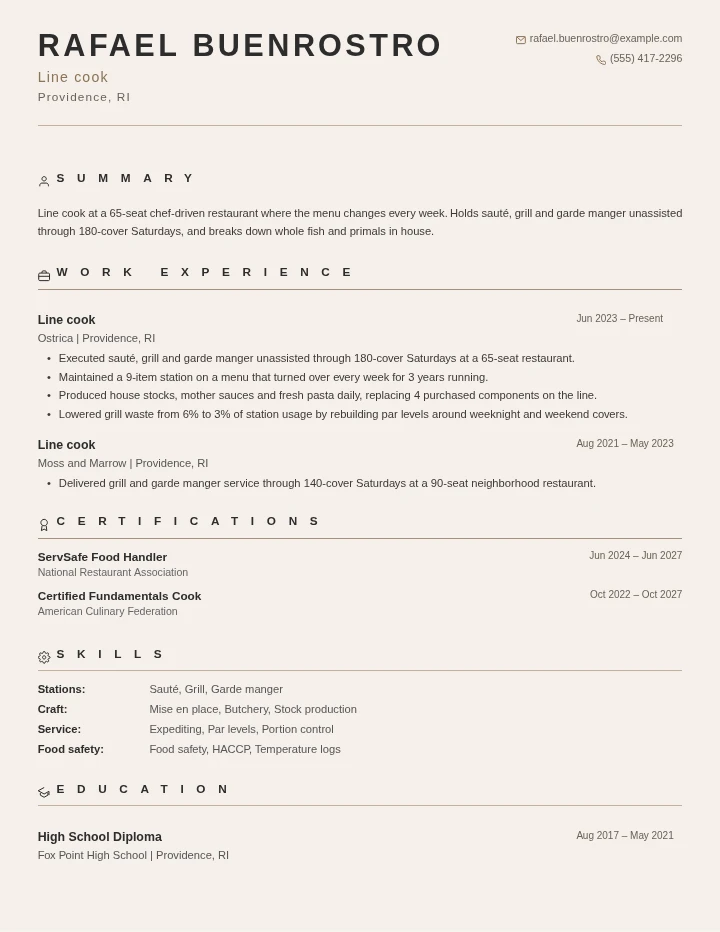
Line cook resume example, mid level, rendered in the Warm Classic template
Strength: Excellent

Written by the Resumi editorial team for a fictional candidate. Role facts come from O*NET and the U.S. Bureau of Labor Statistics.

Strength band is Resumi’s optimization score, not a ranking any employer sees.

What makes this resume work

Each marker on the page has a note here. Press a marker to jump to its note.

  1. 1

    Three stations and the segment

    Sauté, grill and garde manger at a sixty-five seat chef-driven house. Segment matters as much as station, because a hotel chef and an independent chef are reading for two different kinds of speed.

  2. 2

    Scratch work named explicitly

    Breaking down whole fish and primals used to be assumed. Trade coverage this year describes butchery, stocks and sauces being bought in instead, which turns them from a baseline into a scarce thing worth naming.

  3. 3

    A menu that turns every week

    Nine items rebuilt weekly for three years is the hardest thing on this page to fake, and it answers the question a chef with a changing menu actually cares about, which is how fast you learn.

  4. 4

    Waste with a mechanism

    Six percent to three percent is the claim, and rebuilding par levels around weeknight and weekend covers is how. A percentage with no method behind it reads as invented, and chefs call references.

  5. 5

    Credentials dated, not just listed

    A food handler card and an American Culinary Federation cook certification, each with its issue date on the page. Hiring sources treat an undated certification as a lapsed one, so the date is the point.

Build your line cook resume

Free to start · no card

01The example, in full

The resume shown above, as text you can search and copy.

Rafael Buenrostro

Line cook

Providence, RIrafael.buenrostro@example.com(555) 417-2296

Summary

Line cook at a 65-seat chef-driven restaurant where the menu changes every week. Holds sauté, grill and garde manger unassisted through 180-cover Saturdays, and breaks down whole fish and primals in house.

Experience

Line cook

Jun 2023 – Present

Ostrica · Providence, RI

  • Executed sauté, grill and garde manger unassisted through 180-cover Saturdays at a 65-seat restaurant.
  • Maintained a 9-item station on a menu that turned over every week for 3 years running.
  • Produced house stocks, mother sauces and fresh pasta daily, replacing 4 purchased components on the line.
  • Lowered grill waste from 6% to 3% of station usage by rebuilding par levels around weeknight and weekend covers.

Line cook

Aug 2021 – May 2023

Moss and Marrow · Providence, RI

  • Delivered grill and garde manger service through 140-cover Saturdays at a 90-seat neighborhood restaurant.

Education

High School Diploma

Aug 2017 – May 2021

Fox Point High School · Providence, RI

Skills

Stations
Sauté, Grill, Garde manger
Craft
Mise en place, Butchery, Stock production
Service
Expediting, Par levels, Portion control
Food safety
Food safety, HACCP, Temperature logs

Certifications

ServSafe Food Handler

Jun 2024

National Restaurant Association
Certified Fundamentals Cook

Oct 2022

American Culinary Federation

02Market snapshot

Median pay
$37,390 median annual pay for restaurant cooks, or $17.98 an hour
Typical education
No credential required: 47 percent hold a high school diploma, 34 percent less than that
Job outlook
Projected to grow 12 percent from 2025 to 2035, adding 171,400 restaurant cook jobs
Common credentials
No occupational license exists, only a state or county food handler card

Sources: CareerOneStop (2025) · O*NET (2026) · BLS OOH (2025)

03The same resume at three levels

The tinted row is the level shown above.

  • Entry-level

    0–2 years

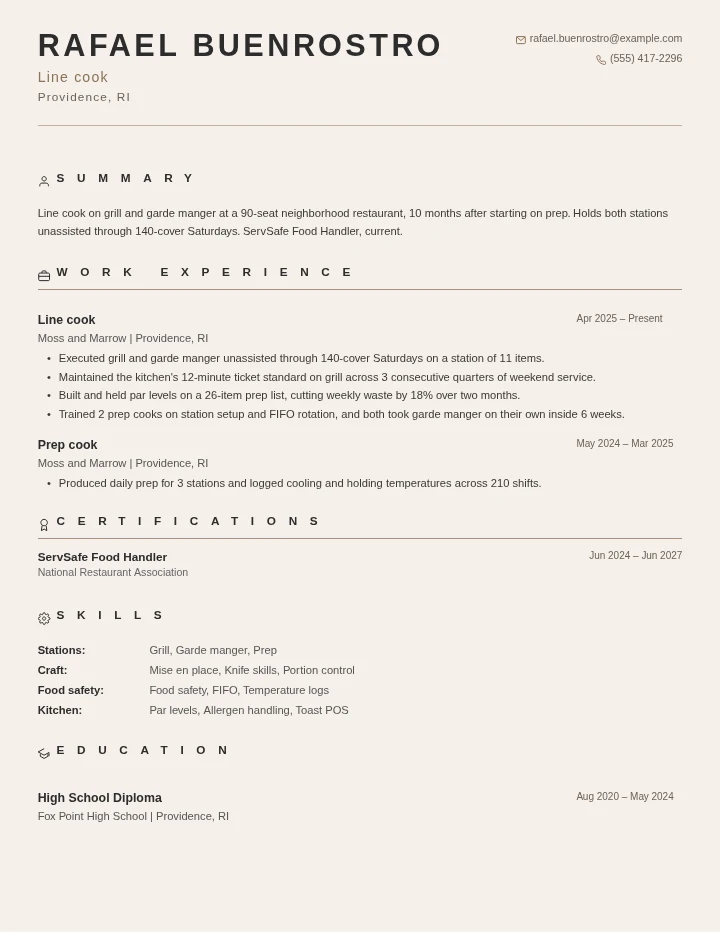
    Employment history first, then the food handler card, because three of the postings read for this page gate on it by name. The case here is narrow on purpose: two stations, one house, a countable prep list. A short honest list beats a long list a trail shift would expose.

    Typical titles: Line cook, Prep cook, Grill cook

  • Mid-level

    3–6 years

    The mid resume is where honest tiering starts to matter. Three stations held unassisted is a stronger claim than a list of six, because a paid trail shift will test whichever one the chef picks. Claim only what you would be happy to be handed on a Saturday.

    Typical titles: Line cook, Chef de partie, Sauté cook

  • Senior

    7+ years

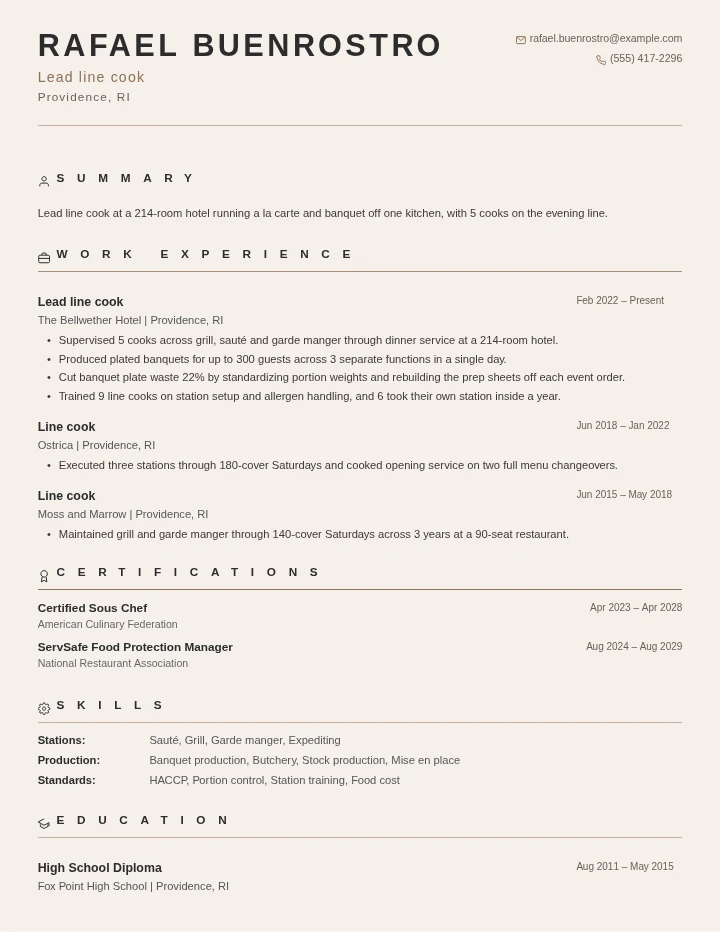
    Eleven years fits one sheet because the two earlier restaurants hold a line each. The current job carries the whole argument: people supervised, banquet volume in its own unit, a cost number with a lever behind it, and cooks who moved up.

    Typical titles: Lead line cook, Sous chef, Banquet cook

04Summary

Weak

Hardworking and passionate line cook with experience in fast-paced kitchen environments and a strong commitment to quality food, cleanliness and teamwork.

Strong

Line cook at a 65-seat chef-driven restaurant where the menu changes every week. Holds sauté, grill and garde manger unassisted through 180-cover Saturdays.

Stations, segment, seat count and covers. Four facts a chef can act on, in two sentences. The weak version is the summary on almost every cook resume in the stack, and fast-paced environment is doing the work that a cover count should be doing. Passionate is not a station.

05Bullets

Weak

  • Responsible for preparing and cooking menu items to order while maintaining a clean and organized work station in accordance with health standards.

Strong

  • Executed sauté, grill and garde manger unassisted through 180-cover Saturdays at a 65-seat restaurant.

Three named stations, held alone, at a stated volume, in a stated size of house. The weak bullet describes what a line cook is, which every chef reading it already knows, and it would be equally true of the worst cook they ever fired. Swap in your own stations and your own covers and the same sentence starts doing work.

06Skills and keywords

Stations

  • Grill Station (in the example)
  • Sauté Station (in the example)
  • Garde Manger (in the example)
  • Fry Station

Craft

  • Mise en Place (in the example)
  • Butchery (in the example)
  • Stock Production (in the example)
  • Knife Skills

Food safety

  • Food Safety (in the example)
  • HACCP (in the example)
  • FIFO

Credentials

  • ServSafe Food Handler (in the example)
  • Certified Fundamentals Cook (in the example)
  • Certified Sous Chef

Filled chips appear in the example above.

Paste a job description and Resumi shows which of these your resume already covers.

Build your line cook resume

07Mistakes to avoid

  1. The stations are missing

    Fix: Name three to five stations by their real names in the top third of the page: grill, sauté, garde manger, fry, pantry, pasta. One posting read for this page asks applicants in writing to list the stations they have worked.

  2. No volume anywhere on the page

    Fix: Get a cover count from your own POS or your chef and put it next to a station. Fast-paced environment is not a volume, and it appears on every competing resume. Use your busiest service and a normal weeknight, because the pair says more than either figure alone.

  3. Claiming a station you cannot run on a Saturday

    Fix: Split the list: stations you run unassisted, then stations you are trained on. The standard hiring step in kitchens is a paid trail shift of four to six hours, and it scores station setup, speed and how you handle a mistake.

  4. Short stints hidden instead of labeled

    Fix: Kitchen tenures are short across the whole sector, and hiring chefs know it. Put a two-word reason next to the ones that need it: seasonal, restaurant closed, opening team. Concealment is what reads badly, because the first thing a chef does is call the last kitchen.

  5. A food safety card with no date on it

    Fix: Name the exact credential, the body that issued it and the month you earned it. Hiring sources treat an undated certification as an expired one. If yours has lapsed, renew it before you apply, because a lapsed card is a reason to pass.

08Format and template

History first, then certifications, then a short stations and skills block, with education last. That order puts the food handler card above the fold, which matters because postings gate on it by name. Head the resume with the exact title the posting uses, whether that is line cook, chef de partie or cook II. This example uses Warm Classic. The same content works in Standard, Beige Border and Beige Two-Column. Keep every station next to the restaurant it was worked in, never in a list of its own.

Shown above: Warm Classic

  • Standard template
    StandardFree
  • Beige Border template
    Beige Border
  • Beige Two-Column template
    Beige Two-Column

09Questions line cooks ask

I never went to culinary school. Does that kill me?

No, and the federal data says so plainly. Among people working this occupation, 47 percent hold a high school diploma, 34 percent hold less than that, and only 12 percent hold a two-year degree. The American Culinary Federation itself publishes a route without a degree: its Certified Sous Chef credential can be earned on a high school diploma plus five years of line experience, against three years for someone with an associate degree. What replaces school is countable station time, so put that on the page instead.

I do not know my covers. Nobody ever told me. What do I put?

Ask, because someone in the building knows. Most kitchens run a point of sale or a kitchen display system that reports covers by daypart, and a chef will have the number to the guest. If you genuinely cannot get it, do not invent one. Use what you can verify instead: seats in the dining room, items on your station, how often the menu changes, cooks on the line with you, functions per day if you work banquet. A verifiable smaller fact beats an impressive number you cannot defend.

My history is nine restaurants in twelve years. How bad is that?

Less bad than hiding it. Accommodation and food services has the highest quit rate of any sector in the country, and every chef reading your resume has the same history. What reads badly is an unexplained gap or a date that does not match, because chefs verify dates and call the last kitchen. Label the short ones in two words, seasonal or restaurant closed or opening team, and let the range of segments read as range rather than as drift.

Do I need a license to work as a line cook?

No. There is no occupational license for this job the way there is for an electrician, and anyone selling you one is selling you nothing. What you need is a food handler card from your county or state health department, usually within 14 to 60 days of hire and valid two to three years. Rules are set locally, so check your county health department rather than a national site. If you are being hired as the person in charge, the credential that matters is a certified food protection manager.

Should I put trail shifts and stages on my resume?

List them, but never as jobs. Put them in their own short line under the restaurant they were at, with the word stage or trail and the length, because a four-hour trail sitting in the employment history next to three-year jobs looks like padding at best. Where they genuinely earn their space is when the house is a name worth knowing or the technique was something you cannot show anywhere else, such as whole-animal butchery or a wood-fired station.

How do I show a chef I am ready for sous?

Put the supervisory evidence on the page as numbers, because that is what the credential itself is built on. The American Culinary Federation requires two years of supervisory experience within the past ten for its Certified Sous Chef, so the things that count are cooks supervised, cooks trained who took their own station, schedules or orders you owned, and menu changeovers you opened. Ordering, costing and a food protection manager certification are the three that most often separate a lead cook from a sous chef on paper.

Free to start

Build your line cook resume

No card, no trial that turns into a charge.

Sign up free