Credit analyst resume examples & writing guide for 2026

Three credit analyst resumes at analyst, senior analyst and credit manager level, rendered in a real template and annotated note by note. Every one gives loan sizes, memo counts, the portfolio covered and a call the analyst made that changed a loan.

By the Resumi editorial teamUpdated 8 min read

Showing the mid-level example

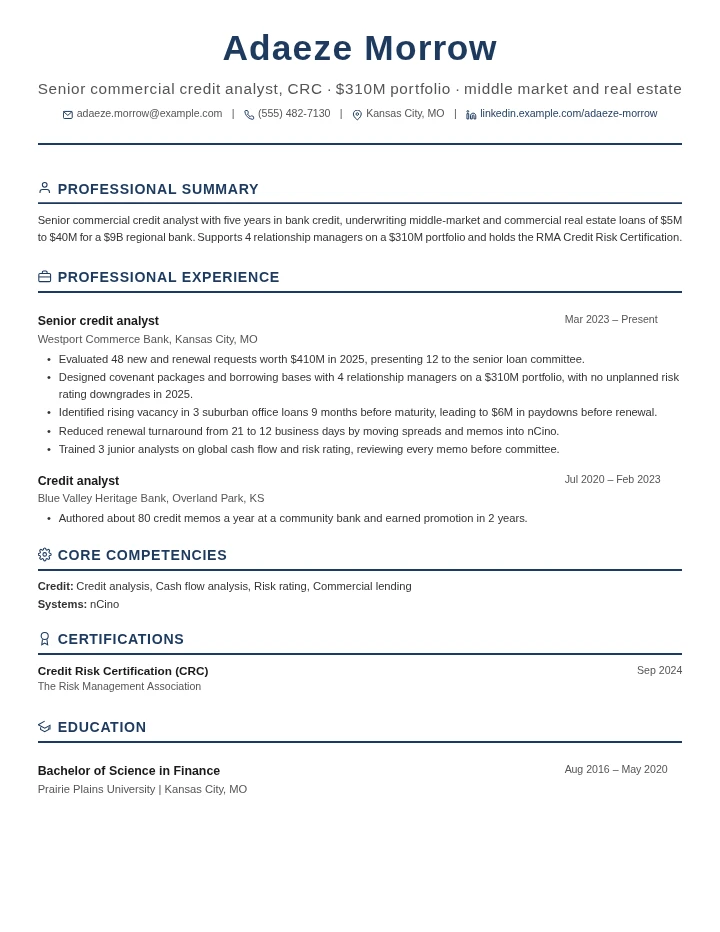
Credit analyst resume example, mid level, rendered in the Executive Classic template
Strength: Strong

Written by the Resumi editorial team for a fictional candidate. Role facts come from O*NET and the U.S. Bureau of Labor Statistics.

Strength band is Resumi’s optimization score, not a ranking any employer sees.

What makes this resume work

Each marker on the page has a note here. Press a marker to jump to its note.

  1. 1

    Certification, portfolio and segments

    CRC, a $310M portfolio and middle-market and real estate lending. The headline tells a regional bank which desks this analyst can sit on and how much they support.

  2. 2

    Loan size range named

    Loans of $5M to $40M at a $9B bank. Size matters in credit, because larger loans bring more complex structures, and the range shows the step up from community banking.

  3. 3

    Requests taken to committee

    Forty-eight requests worth $410M, 12 presented to senior loan committee. Presenting is the skill that separates a senior analyst, and the count shows it happened often.

  4. 4

    Risk spotted before maturity

    Office vacancy found 9 months early, leading to $6M in paydowns. Commercial real estate has been under pressure, and an analyst who catches a problem early protects the bank.

  5. 5

    Juniors trained and reviewed

    Three junior analysts trained and every memo reviewed before committee. Teaching global cash flow and risk rating is the step toward running the credit team.

Build your credit analyst resume

Free to start · no card

01The example, in full

The resume shown above, as text you can search and copy.

Adaeze Morrow

Senior commercial credit analyst, CRC · $310M portfolio · middle market and real estate

Kansas City, MOadaeze.morrow@example.com(555) 482-7130linkedin.example.com/adaeze-morrow

Summary

Senior commercial credit analyst with five years in bank credit, underwriting middle-market and commercial real estate loans of $5M to $40M for a $9B regional bank. Supports 4 relationship managers on a $310M portfolio and holds the RMA Credit Risk Certification.

Experience

Senior credit analyst

Mar 2023 – Present

Westport Commerce Bank · Kansas City, MO

  • Evaluated 48 new and renewal requests worth $410M in 2025, presenting 12 to the senior loan committee.
  • Designed covenant packages and borrowing bases with 4 relationship managers on a $310M portfolio, with no unplanned risk rating downgrades in 2025.
  • Identified rising vacancy in 3 suburban office loans 9 months before maturity, leading to $6M in paydowns before renewal.
  • Reduced renewal turnaround from 21 to 12 business days by moving spreads and memos into nCino.
  • Trained 3 junior analysts on global cash flow and risk rating, reviewing every memo before committee.

Credit analyst

Jul 2020 – Feb 2023

Blue Valley Heritage Bank · Overland Park, KS

  • Authored about 80 credit memos a year at a community bank and earned promotion in 2 years.

Education

Bachelor of Science in Finance

Aug 2016 – May 2020

Prairie Plains University · Kansas City, MO

Skills

Credit
Credit analysis, Cash flow analysis, Risk rating, Commercial lending
Systems
nCino

Certifications

Credit Risk Certification (CRC)

Sep 2024

The Risk Management Association

02Market snapshot

Median pay
$83,510 median annual pay for credit analysts
Typical education
Bachelor's degree, with no prior experience or training required
Job outlook
4% decline from 2025 to 2035, about 2,800 fewer jobs
Common credentials
Job Zone Four. 95% of surveyed analysts say a bachelor's degree is required

Sources: BLS OES (May 2025) · BLS OOH (2025) · O*NET (31.0)

03The same resume at three levels

The tinted row is the level shown above.

  • Entry-level

    0–2 years

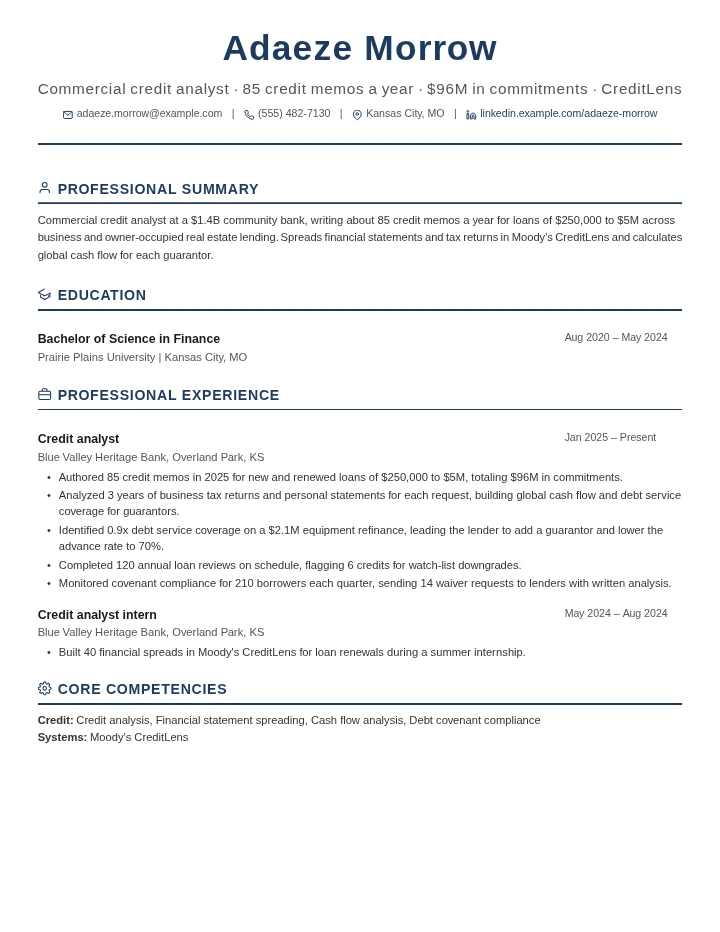
    Education sits above the jobs, and the headline gives memos, commitments and the spreading system. Bullets cover memo volume with dollars, global cash flow work, a coverage call that changed a loan, annual reviews and covenant monitoring. The internship folds to one line with the spreads built.

    Typical titles: Credit analyst, Commercial credit analyst, Credit analyst I

  • Mid-level

    3–6 years

    The headline adds the CRC, the portfolio and the lending segments. Bullets give requests with committee presentations, covenants and borrowing bases with no surprise downgrades, an early warning on office loans, faster renewals in nCino and juniors trained. The community bank years fold to one line.

    Typical titles: Senior credit analyst, Commercial credit underwriter, Credit analyst III

  • Senior

    7+ years

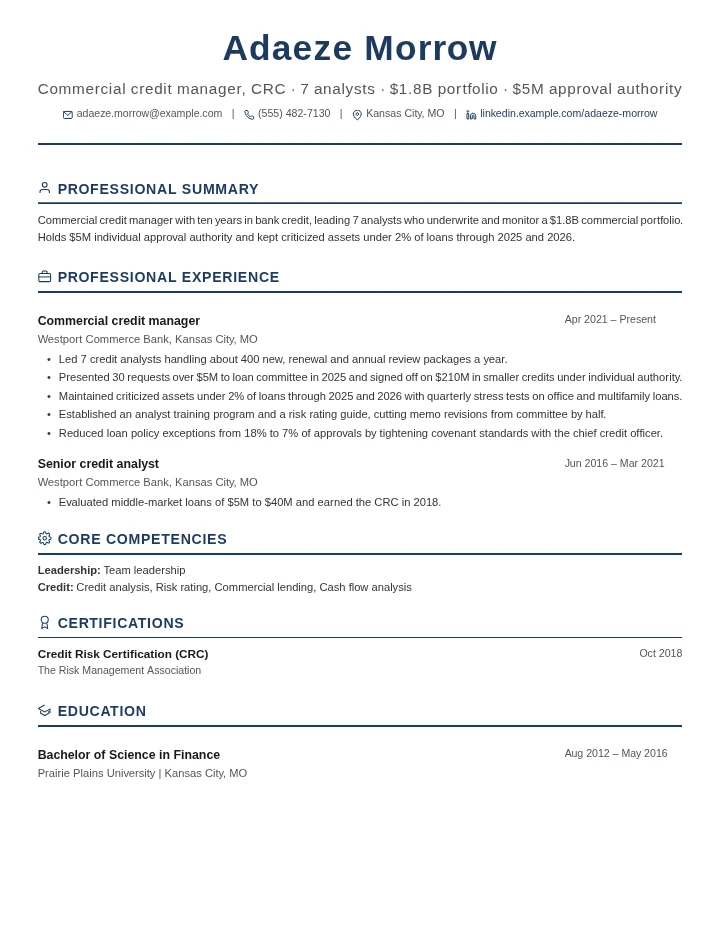
    Scope replaces individual underwriting: the team's volume, decisions split between committee and individual authority, criticized assets held down with stress tests, a training program with a rating guide and policy exceptions reduced. The senior analyst years fold to one line with the CRC.

    Typical titles: Commercial credit manager, Credit officer, Credit administration manager

04Summary

Weak

Analytical finance professional with strong attention to detail and experience evaluating financial statements, assessing risk and supporting lending decisions in a banking environment.

Strong

Senior commercial credit analyst with five years in bank credit, underwriting middle-market and commercial real estate loans of $5M to $40M for a $9B regional bank. Supports 4 relationship managers on a $310M portfolio and holds the RMA Credit Risk Certification.

The segments, the loan sizes, the bank's size, the portfolio and a credential. A credit officer can place this analyst on a desk in one read. The weak version supports lending decisions without a loan size, a portfolio or a decision.

05Bullets

Weak

  • Analyzed financial statements and prepared credit memos for commercial loan requests.

Strong

  • Identified rising vacancy in 3 suburban office loans 9 months before maturity, leading to $6M in paydowns before renewal.

The risk found, how early it was found and what the bank did about it. A credit officer can ask how the vacancy showed up in the numbers and what the borrowers said. The weak bullet describes the duty every analyst has, with no loan, no amount and no judgment shown, so it could sit on any credit resume at any bank.

06Skills and keywords

Credit

  • Credit analysis (in the example)
  • Cash flow analysis (in the example)
  • Risk rating (in the example)
  • Commercial lending (in the example)
  • Financial statement spreading
  • Debt covenant compliance

Systems

  • nCino (in the example)
  • Moody's CreditLens
  • Excel

Credentials

  • Credit Risk Certification (CRC) (in the example)

Filled chips appear in the example above.

Paste a job description and Resumi shows which of these your resume already covers.

Build your credit analyst resume

07Mistakes to avoid

  1. No loan sizes or lending types

    Fix: Give the range of loans you underwrote and the types: business loans, owner-occupied or investor real estate, construction or asset-based lending. A bank hiring for its middle-market desk needs to see you have worked at that size.

  2. Duties instead of credit decisions

    Fix: Every analyst spreads statements and writes memos. Give one or two calls you made that changed a loan, such as a coverage problem that added a guarantor or an early warning that led to paydowns, with the amounts.

  3. Claiming the bank's loss rates

    Fix: Portfolio results such as charge-offs belong to the bank and its lenders. Give the work you did on them, such as reviews completed, downgrades flagged or covenant breaches caught, and leave portfolio totals to managers who ran the portfolio.

  4. No volume or turnaround

    Fix: Give memos or packages a year, the dollar total and, if you improved it, turnaround time. Credit departments plan staffing on these numbers, so they help a hiring manager size your workload.

  5. Systems and certification left out

    Fix: Postings ask for spreading and loan systems by name, such as Moody's CreditLens or nCino, and many credit departments value the RMA Credit Risk Certification. List both, with the year earned for the certification.

08Format and template

Reverse-chronological order, standard section headings, and every figure written as text. Put your memo count or portfolio, loan sizes and spreading system in the headline. Name the lending types in the summary. Keep the Credit Risk Certification in a certifications section with the year. Leave out borrower names. This example uses Executive Classic. The same content works in Standard, Warm Classic and Maroon Elegant.

Shown above: Executive Classic

  • Standard template
    StandardFree
  • Warm Classic template
    Warm Classic
  • Maroon Elegant template
    Maroon Elegant

09Questions credit analysts ask

What should a credit analyst put on a resume?

Give the bank's size, the loan sizes and lending types you underwrote, and your memo or package count with a dollar total. Name the spreading and loan systems you use. Then add one or two credit calls that changed a loan, annual reviews completed on schedule, and any committee presentations. A credit officer reading it should be able to tell which desk you could join.

Is the RMA Credit Risk Certification worth it?

For a career in bank credit, it is the best-known designation. The Risk Management Association recommends at least three years of credit risk experience before the 120-question exam, and five or more is typical. It covers cash flow analysis, collateral, loan structure, problem loans and risk management. List it with the year once you pass, and keep your lending results first.

How do I show credit judgment on a resume?

Pick a decision and give its result. A coverage shortfall that led to a guarantor, a covenant breach caught early, or a weak property found before renewal all show judgment. Give the loan size and the outcome in dollars. Avoid claiming the bank's loss rates as your own, because a credit officer knows those depend on many people and decisions.

What is the difference between a bank credit analyst and a trade credit analyst?

A bank credit analyst underwrites loans: spreading statements, building cash flow and coverage, rating risk and presenting to loan committee. A trade credit analyst at a company sets credit limits and terms for customers who buy on account, and often handles collections and bad debt reserves. Name your side clearly, because the skills overlap but the postings ask for different experience.

How do I move from credit analyst to credit officer?

Show the steps toward approval authority. Presenting requests to loan committee, reviewing other analysts' memos, training juniors and holding the Credit Risk Certification all count. Give counts for each. Many banks grant individual approval authority gradually, so if you hold any authority, state the limit in your headline. It is the clearest sign of a bank's trust in your judgment.

Is credit analysis a good career if the job is shrinking?

BLS projects credit analyst jobs to fall 4% from 2025 to 2035. Commercial lending still depends on people who understand local markets, business conditions and industries, as the ABA Banking Journal noted in 2026, and banks of every size were posting credit analyst roles from intern to senior level when this page was written. A resume that shows judgment, committee work and systems such as nCino stands apart from analysts who only spread statements.

Free to start

Build your credit analyst resume

No card, no trial that turns into a charge.

Sign up free