Lawyer resume examples & writing guide for 2026

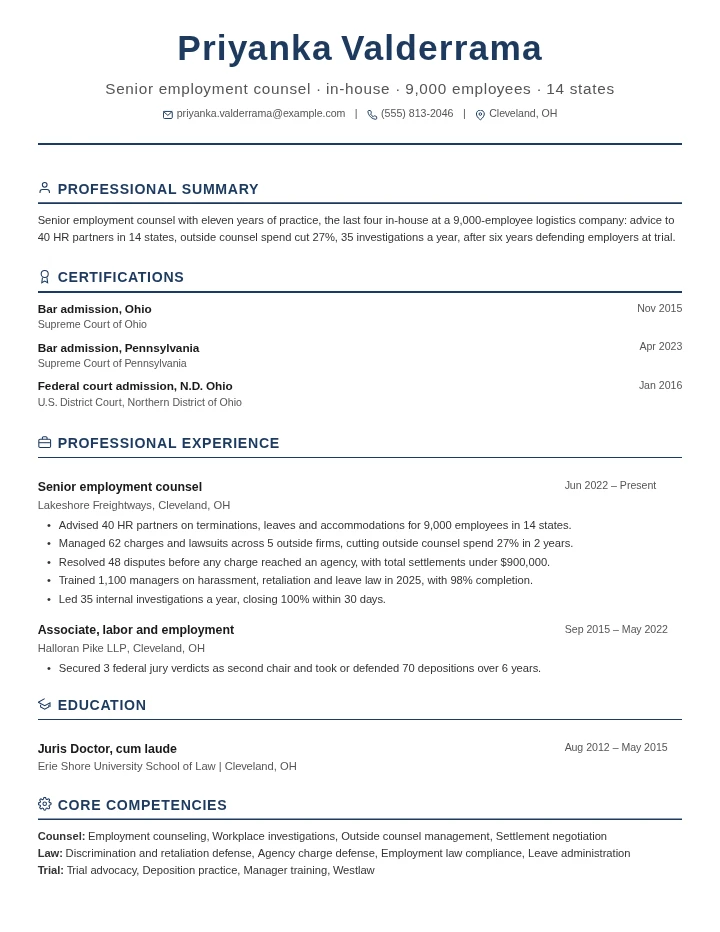
Three lawyer resumes following one employment litigator from second-year associate to in-house counsel, rendered in a real template and annotated line by line. Each one shows what a hiring partner or general counsel checks first: bar admissions, practice area, depositions, motions, trials and outcomes.

By the Resumi editorial teamUpdated 8 min read

Showing the mid-level example

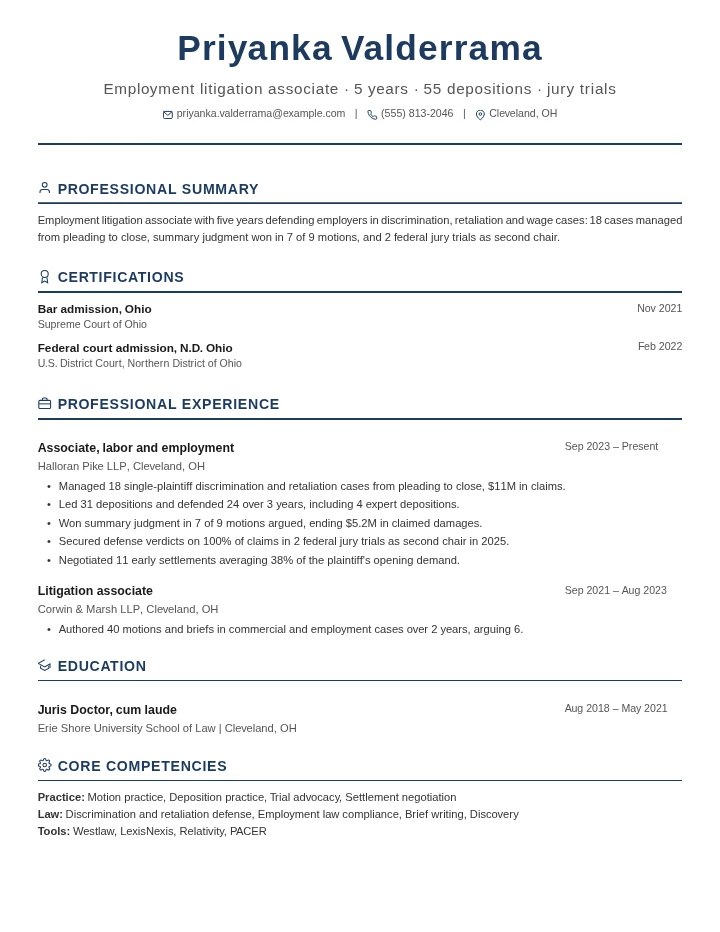
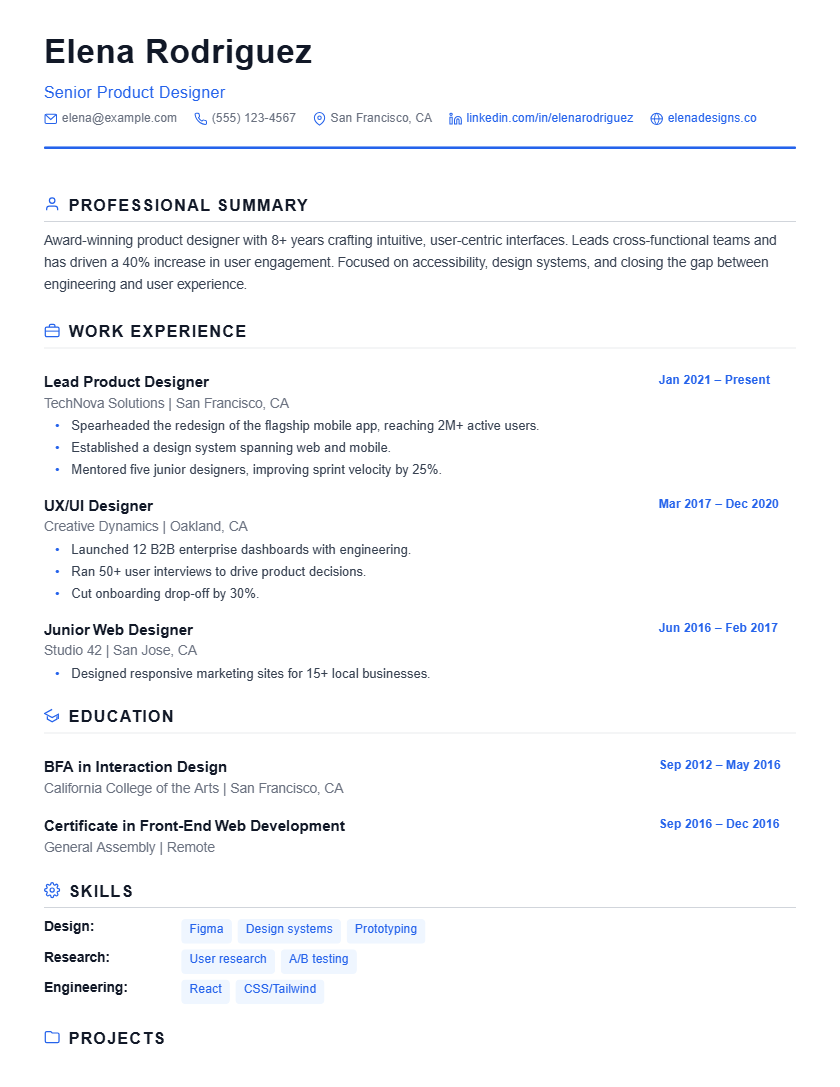
Lawyer resume example, mid level, rendered in the Executive Classic template
Strength: Excellent

Written by the Resumi editorial team for a fictional candidate. Role facts come from O*NET and the U.S. Bureau of Labor Statistics.

Strength band is Resumi’s optimization score, not a ranking any employer sees.

What makes this resume work

Each marker on the page has a note here. Press a marker to jump to its note.

  1. 1

    Depositions and trials in the title

    Employment litigation associate, five years, 55 depositions, jury trials. Lateral postings ask for depositions, motion practice and trial preparation, so the headline answers all three.

  2. 2

    Admissions above experience

    Ohio and federal court admissions with dates. Postings require a lawyer in good standing with the bar, and a hiring committee confirms it before anything else.

  3. 3

    Cases owned end to end

    Eighteen cases from pleading to close, $11M in claims. Owning a case shows the independence a firm is paying for when it hires a mid-level lateral rather than a new graduate.

  4. 4

    Motions with a win rate

    Summary judgment won in seven of nine motions, ending $5.2M in claimed damages. It is an outcome a partner can verify on the docket, not a description of the work.

  5. 5

    Trial work named honestly

    Defense verdicts in two federal jury trials as second chair. The role is stated plainly, because a hiring partner will ask who examined which witnesses in the interview.

Build your lawyer resume

Free to start · no card

01The example, in full

The resume shown above, as text you can search and copy.

Priyanka Valderrama

Employment litigation associate · 5 years · 55 depositions · jury trials

Cleveland, OHpriyanka.valderrama@example.com(555) 813-2046

Summary

Employment litigation associate with five years defending employers in discrimination, retaliation and wage cases: 18 cases managed from pleading to close, summary judgment won in 7 of 9 motions, and 2 federal jury trials as second chair.

Experience

Associate, labor and employment

Sep 2023 – Present

Halloran Pike LLP · Cleveland, OH

  • Managed 18 single-plaintiff discrimination and retaliation cases from pleading to close, $11M in claims.
  • Led 31 depositions and defended 24 over 3 years, including 4 expert depositions.
  • Won summary judgment in 7 of 9 motions argued, ending $5.2M in claimed damages.
  • Secured defense verdicts on 100% of claims in 2 federal jury trials as second chair in 2025.
  • Negotiated 11 early settlements averaging 38% of the plaintiff's opening demand.

Litigation associate

Sep 2021 – Aug 2023

Corwin & Marsh LLP · Cleveland, OH

  • Authored 40 motions and briefs in commercial and employment cases over 2 years, arguing 6.

Education

Juris Doctor, cum laude

Aug 2018 – May 2021

Erie Shore University School of Law · Cleveland, OH

Skills

Practice
Motion practice, Deposition practice, Trial advocacy, Settlement negotiation
Law
Discrimination and retaliation defense, Employment law compliance, Brief writing, Discovery
Tools
Westlaw, LexisNexis, Relativity, PACER

Certifications

Bar admission, Ohio

Nov 2021

Supreme Court of Ohio

Federal court admission, N.D. Ohio

Feb 2022

U.S. District Court, Northern District of Ohio
02Market snapshot

Median pay
$159,670 median annual pay for lawyers
Typical education
Doctoral or professional degree: typically 4 years of college and 3 years of law school
Job outlook
+5% for 2025–35, about 28,700 openings a year
Common credentials
A state bar exam to practice, and states may require continuing legal education to keep the license

Sources: BLS OES (May 2025) · BLS OOH (2025)

03The same resume at three levels

The tinted row is the level shown above.

  • Entry-level

    0–2 years

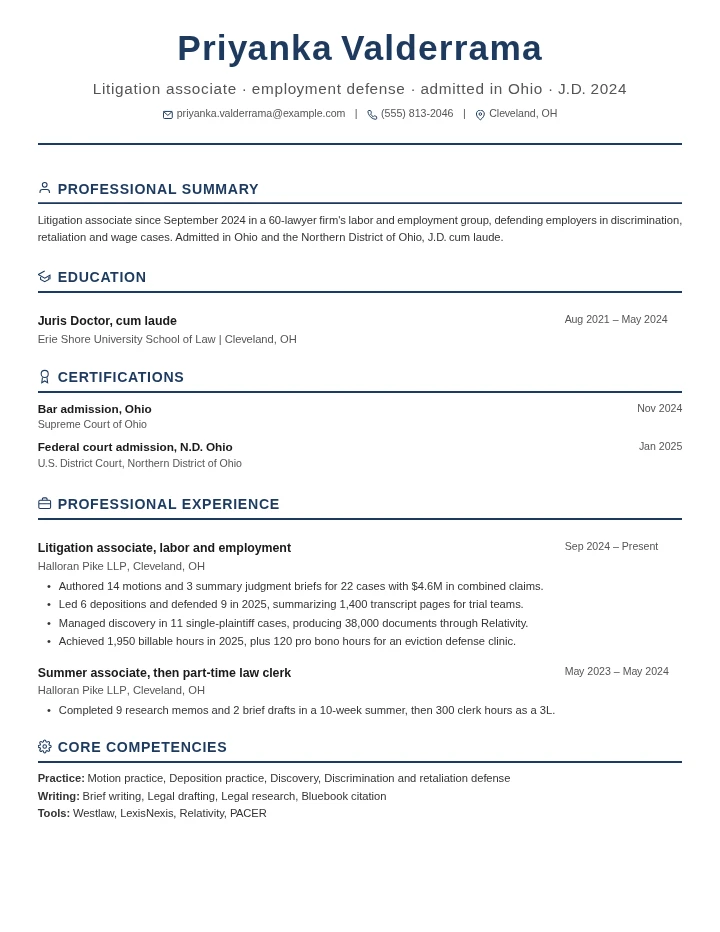
    Education leads, then state and federal admissions, then two years in four counted bullets: motions and summary judgment briefs with claim value, depositions taken and defended, discovery run through Relativity, and billable and pro bono hours. The summer and clerk role keeps one line with its memos and hours.

    Typical titles: Litigation associate, Associate attorney, Junior associate

  • Mid-level

    3–6 years

    The default view. Five years of employment defense in the units a hiring partner weighs: cases owned with claim value, depositions taken and defended, summary judgment outcomes, trial verdicts as second chair, and settlements against the opening demand. The first firm keeps one line, and the J.D. sits beneath.

    Typical titles: Employment litigation associate, Labor and employment associate, Mid-level associate

  • Senior

    7+ years

    Counseling replaces case work: HR partners advised across 14 states, charges and lawsuits managed with outside counsel spend cut, disputes resolved before a charge, managers trained, and investigations closed on a clock. Six firm years keep one line with the trials and depositions that made the move in-house possible.

    Typical titles: Senior employment counsel, Employment counsel, Associate general counsel

04Summary

Weak

Results-driven attorney with a proven track record of providing exceptional legal services, strong research and writing skills, and a passion for advocacy.

Strong

Employment litigation associate with five years defending employers in discrimination, retaliation and wage cases: 18 cases managed from pleading to close, summary judgment won in 7 of 9 motions.

A hiring partner reads practice area, years and what the lawyer owned before anything else. The strong version gives all three with outcomes they can check on a docket. The weak version could open any lawyer's resume in any practice.

05Bullets

Weak

  • Handled all aspects of litigation, including discovery, motion practice and depositions, for a variety of employment matters.

Strong

  • Won summary judgment in 7 of 9 motions argued, ending $5.2M in claimed damages.

Analyzing the probable outcome of a case and developing the arguments to present it are two of the occupation's highest-rated tasks, and summary judgment is where both show. The strong bullet gives the number of motions, the win rate and the damages that ended. A partner can verify it on the docket, while the weak bullet only lists the stages every litigator works through.

06Skills and keywords

Litigation

  • Motion practice (in the example)
  • Deposition practice (in the example)
  • Trial advocacy (in the example)
  • Settlement negotiation (in the example)
  • Discovery (in the example)
  • Brief writing (in the example)

Employment law and counseling

  • Discrimination and retaliation defense (in the example)
  • Employment law compliance (in the example)
  • Agency charge defense
  • Employment counseling
  • Workplace investigations
  • Outside counsel management

Research tools and admissions

  • Westlaw (in the example)
  • LexisNexis (in the example)
  • Relativity (in the example)
  • PACER (in the example)
  • Bar admission (in the example)
  • Federal court admission (in the example)

Filled chips appear in the example above.

Paste a job description and Resumi shows which of these your resume already covers.

Build your lawyer resume

07Mistakes to avoid

  1. Bar admission buried or missing

    Fix: Recruiters list a buried admission among the most common lawyer resume mistakes, because firms confirm eligibility first. Put every state and federal admission near the top with its date. If admission is pending, say so with the exam date rather than leaving it off.

  2. Document review where depositions belong

    Fix: A recruiter who practiced as a litigator tells associates to lead with depositions and motion practice rather than document review. Count depositions taken and defended, motions drafted and argued, and trials, then mention review volume only if it is the role.

  3. Client names that are not public

    Fix: Career offices and legal recruiters both warn that non-public matters must stay confidential. Name a case only if it is on the public docket, and otherwise describe the client by type and size, such as a regional logistics company, with the claim value.

  4. Your role left out of the matter

    Fix: Recruiters name thin detail about your own role and work product as a common mistake. For each case or deal, say what you did: drafted the brief, argued the motion, took the witness, second-chaired the trial. A firm hiring laterally is paying for that independence.

  5. One typo on a legal resume

    Fix: A legal recruiter at a national search firm says some hiring partners will not consider a resume with a single typo, since drafting precision is the job. Proofread every party name, date and citation, and read the finished page aloud before sending it.

08Format and template

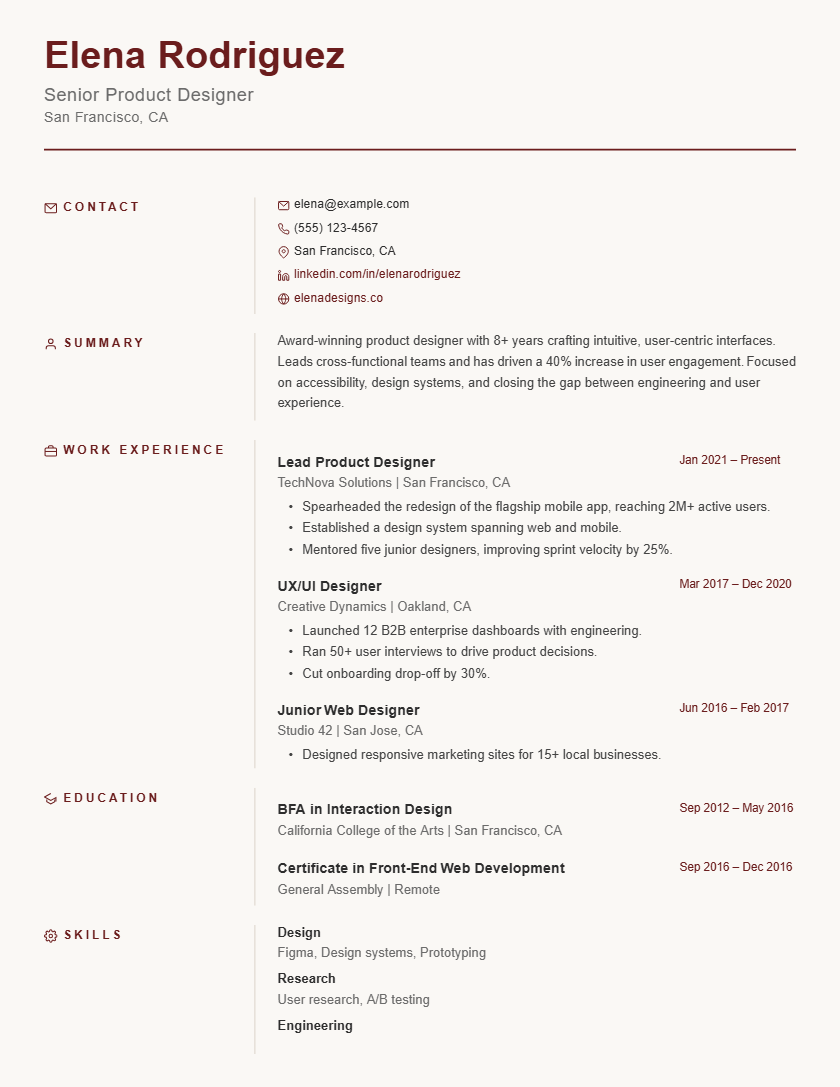
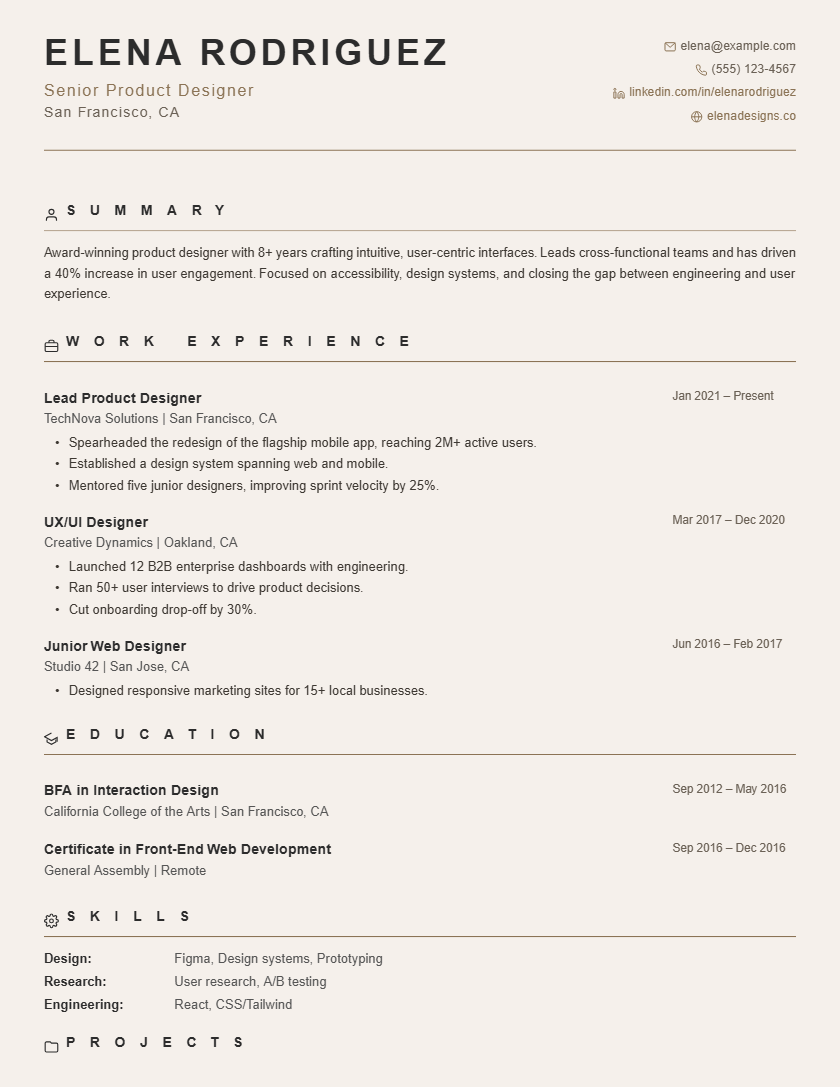
Executive Classic keeps plain headings and puts bar admissions above experience, so a hiring partner confirms eligibility before reading the matters. This example uses Executive Classic. The same content moves into Standard, Maroon Elegant or Warm Classic. Whichever you choose, list every admission with its date, give each matter your role and its size, keep non-public clients unnamed, and proofread every citation.

Shown above: Executive Classic

  • Standard template
    StandardFree
  • Maroon Elegant template
    Maroon Elegant
  • Warm Classic template
    Warm Classic

09Questions lawyers ask

Should a lawyer's resume be one page?

Usually, early on. Law school career offices advise junior private-sector lawyers to keep to one page and let senior lawyers run to two when the second page carries substantive legal work, not interests. Public sector applications can run longer. All three examples fit one page by giving older roles a single line and moving detail into a separate representative matters list.

How do I list a bar admission that is still pending?

Say exactly where it stands. Prospective lawyers take a licensing exam called the bar exam, and career offices suggest wording such as the state, the exam you sat and that admission is pending. Never list an admission as granted before the court swears you in, because firms verify it. Once admitted, add the month and the court, as the entry example does for both its state and federal admissions.

How much do lawyers make?

The May 2025 median for lawyers was $159,670, with the lowest tenth under $78,360 and the highest tenth over $351,600. Employer type moves it: the federal government paid a median $178,380, legal services $157,870, local government $131,390 and state government $115,330. Name your setting in the headline, because a firm, a company and an agency read the same title differently.

Do I need a representative matters list as well as a resume?

Once you have several years of practice, often yes. Legal recruiters describe it as the place to show, case by case, the size of each matter and the role you played, which a resume can only summarize. Keep non-public clients unnamed, keep it to matters you actually worked on, and make sure every number on the list matches the resume, because interviewers compare the two.

How do I move from a law firm to an in-house role?

Lead with advice, not just litigation. In-house employment postings this year ask for counseling on terminations, leaves and accommodations, investigations, manager training and early resolution, alongside firm litigation experience. Advising clients on legal rights and obligations is a core task for the occupation, so count the people you advised and the disputes you closed early, as the senior example does.

Free to start

Build your lawyer resume

No card, no trial that turns into a charge.

Sign up free